
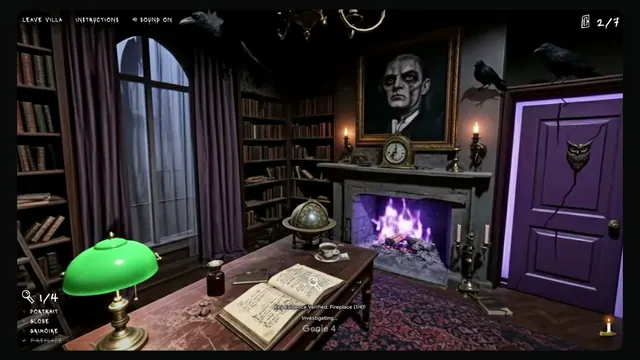
A gothic manor with a room-by-room mystery is one of Google’s examples of what people can make with Genie 4. Called Villa Giallo, it was created with creative technologist Will, who works as BLVCKL!GHT. It is a more revealing example than another beautiful landscape: a mystery invites someone to remember a room, follow a clue and expect an action to matter later.
Google began rolling Genie 4 out to eligible Google AI Ultra subscribers in Project Genie on November 18, then opened paid developer access through the Gemini API on November 19. The model generates a world as someone moves through it. That puts a tempting idea within reach: describe a place, step inside and start playing. How much of a video game does that give you?
Already, it can give you an interactive experience. A responsive scene does not by itself establish that it keeps a dependable record of what happened, applies rules consistently or can be taken elsewhere as a finished game. Those distinctions leave plenty of room for interesting creations. They also explain why a convincing walk through a manor is an early step toward a reliable mystery, rather than evidence that every part of making one has disappeared.
A scene that answers back
A normal video keeps playing the same sequence when a viewer presses a movement key. Genie 4 takes movement and text instructions into account while producing the next images and sounds. A request to change the weather can alter the world during the session. This is a meaningful change in what an audience can do with generated media.
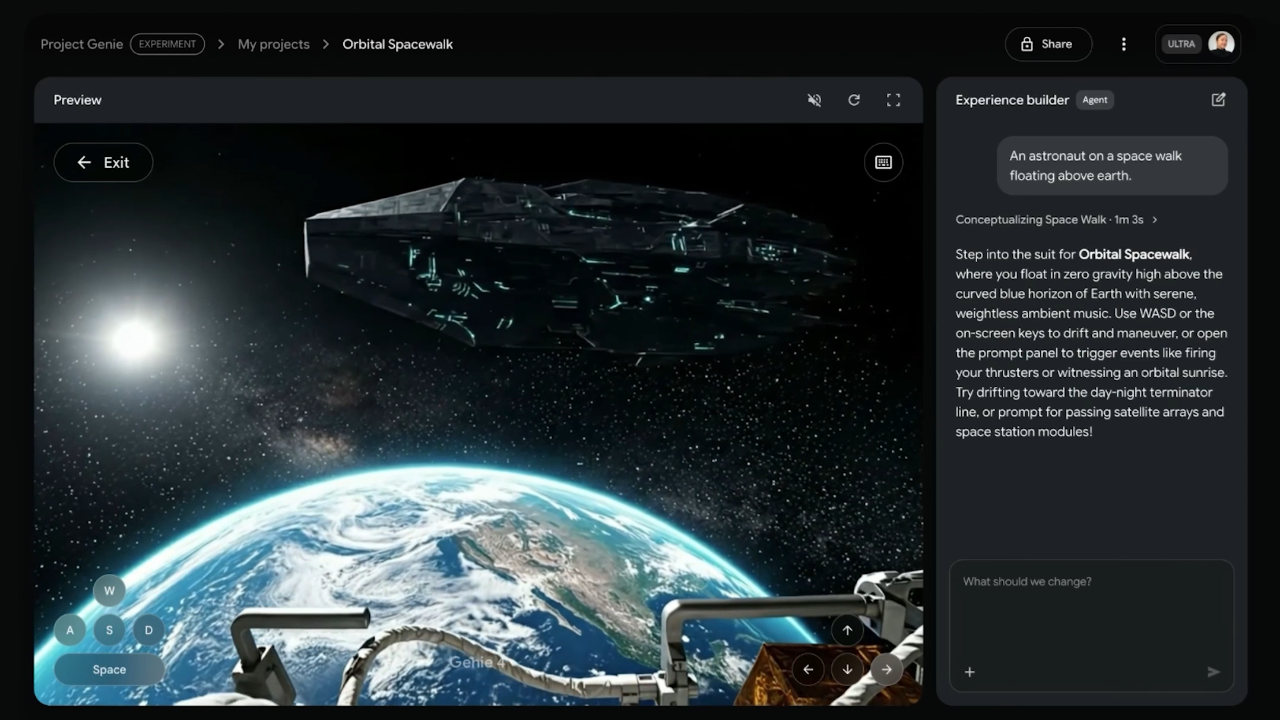
The experience combines world generation with Gemini’s reasoning and steering. Google’s model card describes a system that takes text, images and user actions and returns real-time video with synchronized audio. The output can look like a space with depth that a person navigates, even though the developer is receiving a stream of generated media.
The distinction matters when a visitor looks away. Google’s developer guide says Genie 4 maintains a rolling window of recent frames rather than a persistent three-dimensional scene graph, the organized record of objects in a scene. Doors, buttons or landmarks can shift after a long look away or a full turn. Those are possible failure modes described by Google, not outcomes that happen on every turn.
For a visitor enjoying an unfamiliar landscape, a changed doorway might be a curiosity. For someone solving a mystery, it can break the connection between noticing something and acting on it. A clue needs to remain meaningful after the player has gone to another room. Better-looking frames alone cannot establish that connection.
What a game has to remember
A game usually needs some agreed way to decide what happened. A player has collected a key, completed a task or moved a piece. Even a game that deliberately changes its world needs a way to make those changes part of the experience it intends to offer.
Epic Games’ documentation gives a concrete example of how conventional engines support this. Unreal Engine separates the definition of rules and winning conditions from the state that tracks scores, missions or the positions of chess pieces. A developer can inspect and change those records. This is one established approach, not a requirement that every game use Unreal or include a winner.
Consider a simple hypothetical mystery. A key opens one locked door. Once the player picks it up, the game needs to know they have it; when they return to the door, the opening should follow that decision. A convincing image of the key is only one part of the job. The game also needs to connect possession, the attempted action and its result.
Genie 4 can be directed to produce cause and effect. Google’s prompting guide includes object-based rules, such as pulling a lever to change what happens outside a window, and describes small sequences of triggered events. It explicitly calls these rules probabilistic steering rather than a game script. Wording, object placement and where the camera points affect how the scene responds.
A creator can also bind a key to a text instruction. That makes an action easier to request at the desired moment. It does not, on its own, prove that the generated world will depict every consequence correctly. An application could keep an inventory or score outside the model, but it would still need a way to check that the scene and that record agree.
That is the practical gap between asking for an event and enforcing a rule. It is a gap a developer can work on, rather than a reason to claim that generated games are impossible.
A short experience can still be worthwhile
There is a strong objection to judging Genie 4 by the demands of a long mystery: plenty of worthwhile play does not require one. A brief encounter, a strange place to explore or an improvisational scene can be enjoyable precisely because the visitor cannot predict everything.
Google’s own guidance favors small encounters for some kinds of interaction. It recommends focused, short scenes with the camera kept on the relevant subject. That is a narrower creative form than an open world, but a usable form nonetheless. A creator can design around a system’s strengths instead of waiting for it to reproduce every function of an established engine.
The current Project Genie gallery makes that point tangible. Alongside Villa Giallo, Google presents The Life of Ants, made with filmmaker Anand Gandhi, as a way to explore from an ant’s perspective. These are curated demonstrations of intended experiences. They do not establish how reliably arbitrary visitors can complete a mystery or how accurately a colony behaves.
They do show why replacing a game engine is an unnecessarily large first test of value. An artist might want someone to experience a change in scale, atmosphere or perspective. The result can succeed as a short work even if it would fail as a persistent game world. The relevant question is what the creator promises the visitor.
Elton Jones made a related argument in his October coverage for Tom’s Guide: quickly explorable ideas could help developers consider concepts before committing to full production, with conventional engines still doing important work. That is a plausible role for Genie 4. It is not yet a measurement of development time saved. An idea that is cheap to visualize can still be expensive to turn into a durable game.
Time changes both the design and the bill
The developer version has a clear boundary: a session can run for up to 120 seconds. Google says visual coherence and object permanence are strongest during the first 45–90 seconds. That does not mean every world fails at a particular second. It means a two-minute maximum is not a promise of two minutes of equally dependable interaction.
Project Genie’s consumer options need their own reading. In its November update, Google specifically gave Genie 3 longer runs of up to three minutes, linked worlds and panorama-based starting images. Those are not interchangeable with Genie 4’s developer limits. A newer model name does not mean every kind of experience lasts longer.
For a short exploration, these boundaries can be part of the format. For a game whose appeal comes from returning, accumulating progress or comparing repeated attempts, they create more work. Linking experiences together is useful, but a journey through several worlds does not by itself establish that one stable set of objects and rules persists across them.
Developer costs also run with the stream. At the published rate of $17.50 per million video-output tokens and 5,760 tokens a second, a minute of video costs about $6.05, with audio included. A full two-minute stream is about $12.10; ten such streams would be about $120.96 before input and text-output charges. These are calculations from the listed tariff, not measured bills.
Those figures describe the API, not an extra per-minute fee for an Ultra subscriber using Project Genie. Consumer access remains subject to eligibility and daily usage limits. The API prices do help explain why a developer might start with a small, deliberate experience. Charging for every generated second makes repeated trials and long play different economic propositions from showing a downloadable video. The retail price of a future game, and Google’s cost of running the model, cannot be inferred from that tariff alone.
What survives a session
After using Project Genie, a person can revisit an experience, watch or download the video of their playthrough, share it or remix it. Google’s help page warns that replaying can generate different results. Sharing an experience gives another visitor a way in; downloading a video preserves one journey through it.
Neither action should be confused with obtaining an editable game project. The documented consumer actions do not describe exporting a three-dimensional scene with its objects, rules and assets into an engine. Developer access now makes the model available to applications, but access to a stream is a different capability from exporting the underlying world as a project.
That distinction also puts older commentary in context. Some launch-period accounts treated the absence of a public API as a reason that developers could do little with Genie 4. The November 19 release changes that part of the argument. It leaves the separate questions of world persistence, repeatability and portable assets to be answered on their own terms.
Remixing can still be a substantial creative activity. Changing a scene’s style or setting allows someone to explore an idea without rebuilding every visible detail manually. What transfers most readily may be a decision about how a place should feel, or a recording that communicates it, rather than a ready-made level. A team needs to distinguish that kind of progress from work already completed on the game itself.
A believable world is a different test from an accurate one
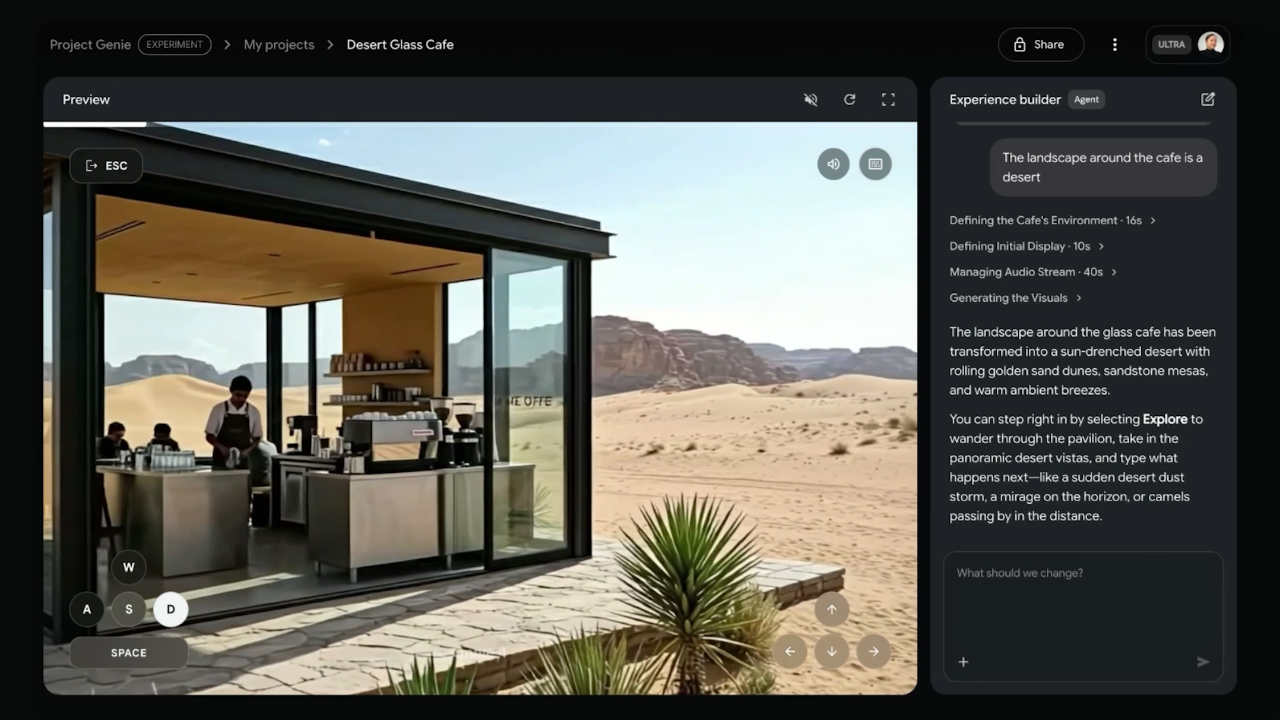
The same distinction becomes more consequential when the proposed visitor is a robot. A simulated environment could offer varied situations without building every physical setting. But the training benefit would have to survive the move into the real world. A plausible-looking collision is not enough to show that the robot learned the right response.
Google’s model card describes evaluations of visual quality, environmental realism, audio and responsiveness. It also identifies physical interactions, spatial accuracy and long-term consistency as continuing research problems. These evaluations address important capabilities, but the card does not report a demonstrated improvement in a deployed robot caused by training in Genie 4.
Kinza Yasar’s reporting for TechTarget explores this issue with industry advisers: simulated behavior must correspond well enough to physical behavior for training results to transfer. That is a condition on the proposed use, not a verdict that the research has no value. A useful imaginative experience and a trustworthy training environment face different tests.
For players and creators, the immediate opportunity is easier to describe. Genie 4 makes it possible to direct and explore short generated experiences with sound. A successful work can take that form openly. When it asks players to trust a clue, a score or a lasting consequence, the creator takes on an additional job: making sure the world remembers the promise.