

Imagine opening your sleep app after a rough week and seeing that your readings have moved away from your usual pattern. You can point to the nights things changed. You still have the question that sent you looking in the first place: does this mean anything, and who can help you figure it out? For some Oura members in the United States, the app already offers a way to message a medical chatbot and, with a separate paid plan, a doctor.
On November 10, Oura agreed to buy the company behind that service, Counsel Health, for $625 million in cash, subject to adjustments. The companies expect the deal to close by year-end if customary conditions are met. The announcement did not turn doctor chats into a standard ring feature. Oura and Counsel began offering the integration earlier this year. If it closes, the deal brings the business that provides those consultations into Oura. Oura executive chair David Shuman said Counsel’s relationships with organizations could also bring in people who aren’t already Oura members. The $625 million is a bet on a business that can reach people through more than ring sales.
The interesting part is how little the ring has to do for this to be useful. It can give a clinician a dated record instead of a patient’s memory of a bad week. The clinician still has to decide which readings matter, what the ring couldn’t see and whether a text conversation can answer the question. A shorter route to that judgment could be worth paying for. Another screen of explanation that leaves the patient to arrange everything else is a smaller gain.
From a reading to a conversation
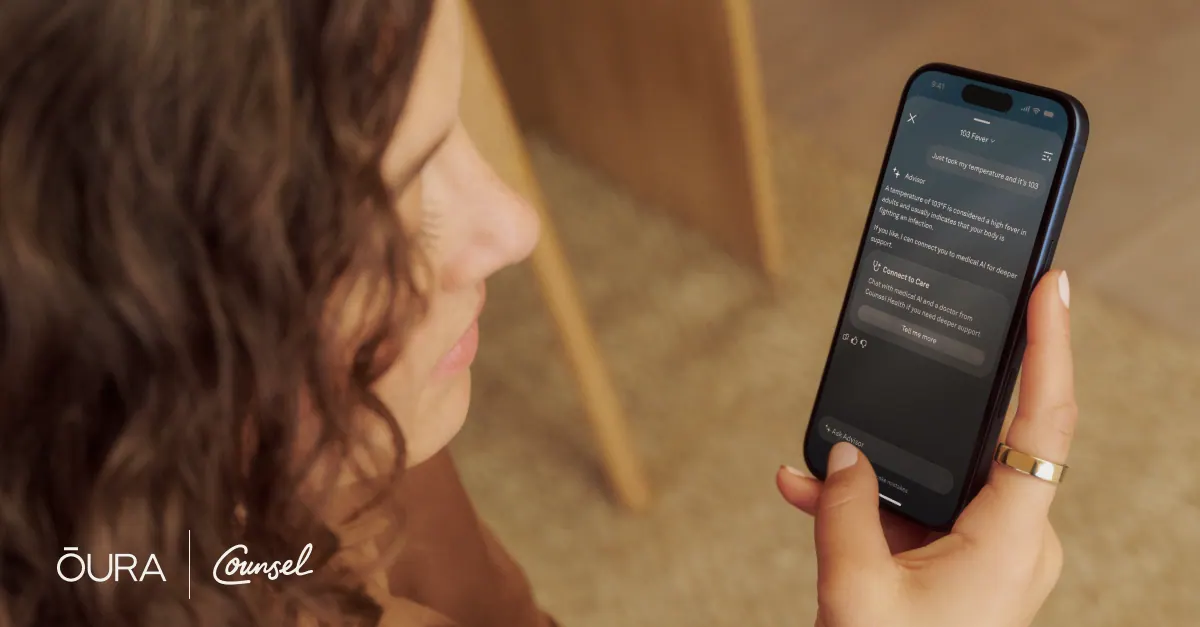
The app puts three services close enough together that it’s easy to lose track of who is answering. First there is the ring, which collects readings such as heart rate and sleep estimates. Then there is Oura Advisor, a wellness chatbot that can explain the app’s metrics but does not offer diagnoses or treatment. It may suggest a medical service when the question goes beyond wellness. Counsel is that separate service. Members can also reach it through the app’s Connect to Care option without waiting for Advisor to suggest it.
Counsel’s medical chatbot can take a history and ask follow-up questions. Its licensed physicians can diagnose, treat, prescribe or order tests when appropriate. The transition is a text handoff: Counsel says the physician can pick up in the chat, with information already collected and relevant ring trends available. Fierce Healthcare’s Dave Muoio describes a separate clinician workspace where Counsel surfaces that information. The companies describe fast connections, but their description doesn’t tell you how long it takes to resolve different kinds of problems.
Consider what a useful handoff would look like for the person with the rough week. They can tell the clinician when they started feeling different, and the clinician can look at the pattern across those dates. The patient doesn’t have to retell the whole story after switching from an app to a phone call. The clinician may still need a measurement the ring doesn’t take or information that never made it into the chat. Collecting more nights of sleep data doesn’t close that gap.
Mario Aguilar’s reporting for STAT, republished by The Boston Globe, captures the distinction. The two companies see a chance to make wearable data more useful in clinical care. But specialists previously interviewed by STAT pointed to a lack of standard protocols for dealing with some readings from consumer wearables, including blood oxygen and the variation in timing between heartbeats. A reading that departs from a person’s usual pattern is a starting point for a question. What to do with it depends on what else the clinician knows and can check.
What the second subscription buys
Oura lists Counsel in 43 U.S. states. Its current offer includes a 30-day trial of Counsel’s medical AI, beginning after enrollment and consent. Physician access requires the separate $159 annual plan, which Oura describes as including unlimited medical AI and doctor chats. That sits on top of standard U.S. Oura membership, which is $5.99 a month or $69.99 a year. At the standard annual prices, the two subscriptions add up to $228.99 before taxes, the ring itself and anything billed separately. Oura says insurance doesn’t cover the Counsel subscription, though it may cover prescriptions or treatments. Some early annual subscribers are still on their previous price for the current term.
The more useful comparison is with the care the person can already reach. In an early r/ouraring discussion, one subscriber said a text conversation helped them decide when they needed someone to see them in person, without paying another telehealth copay just to ask. Another commenter already had telehealth without a copay and questioned the extra subscription. The thread is anecdotal and the beta prices are out of date. The two experiences still illustrate why a fixed price can feel like a faster route to a doctor for one person and a duplicate bill for another.
There is also a difference between access to a doctor and having the issue handled. A clinician may be able to interpret information, make an appropriate referral or finish an encounter in the chat. When a problem calls for an examination, the user still needs an appointment elsewhere. The handoff can still save time if it gives the next clinician a useful record. It can add work if the patient is left to repeat the story and chase the same appointment. Neither the number of chats included nor the speed of the first reply tells you which experience people are getting.
The price in information
The integration saves people from assembling their own charts by asking them to share more than a chart. According to Oura’s support page, the outbound permission is bundled. The person who only wants to share sleep and heart rate cannot choose just those categories. Depending on what is available, the feed can also include reproductive and cycle information, lab results from Oura Health Panels, tags the member logged and context from the current Advisor conversation. Oura also lists identifying details such as name and date of birth. Counsel’s medical AI and the clinicians involved can use that information as part of the service.
There is a second decision about data moving back to Oura. That permission is optional. With it, information from Counsel, including consultation summaries, can become part of the Oura profile and inform later Advisor conversations. That may spare the user another round of explaining. It also means some information produced during care can stay in both places: the wellness app and the medical service. The two directions serve different purposes even though they’re presented in the same product.
The settings let members stop sharing in either direction separately. Turning off a transfer doesn’t automatically cancel the paid plan. Removing Counsel chat history from Oura doesn’t erase the medical record Counsel maintains. Counsel Medical’s privacy notice describes how it may use protected records for treatment, payment and health care operations. The details matter because people who say they want to “disconnect” can mean three different things: stop the next transfer, remove an old record or stop the next charge. Each has its own consequence.
This is where the quality of the handoff matters to privacy as much as to convenience. If the clinician can use a dated trend to ask a better question, the patient can see what sharing bought them. If the chat would have led to the same next step using the patient’s description alone, there was still value in reaching a person. The extra data is a separate proposition.
Who pays when the goal is better care?
The companies have another route beyond selling a subscription to ring owners. In September, Oura said Counsel planned to offer chronic care at no out-of-pocket cost to eligible Medicare beneficiaries starting in early 2027 through ACCESS. That is a separate program; it doesn’t make the $159 in-app plan a Medicare benefit. Oura says Counsel would confirm eligibility and manage care. Patients who also use the ring could consent to let Counsel use its data.
Under ACCESS, the Centers for Medicare & Medicaid Services is testing a different way for Original Medicare to pay for ongoing care. Participating providers receive recurring payments for managing qualifying conditions, with full payment tied to measurable health outcomes. For example, the agency describes improvement in blood pressure as one possible goal. A wearable trend or an automated check-in might help a team decide when to follow up. A program like this has to show something beyond getting people to open the app: a clinician can act on the information, follow up and check whether care helped.
Oura has reported a 4.6 out of 5 rating among members who saw a Counsel physician. That tells you something about the experience of the people who rated it. It doesn’t say whether their problems were resolved more often than with regular telehealth, or whether clinicians could keep the same pace at larger scale. A useful measure for the subscription would be how often users get a workable next step without a duplicate visit. For the Medicare program the stakes are longer term: whether patients’ conditions improve and whether the care teams can coordinate that work with their other providers.
For the person looking at a week of unfamiliar readings, the ring has already done its part by making a change visible. The acquisition is a bet that Oura can help with what comes next. The service earns that role when someone can get from the reading to an informed conversation and then to the care they need, with a clear idea of what it cost and who now holds their information.