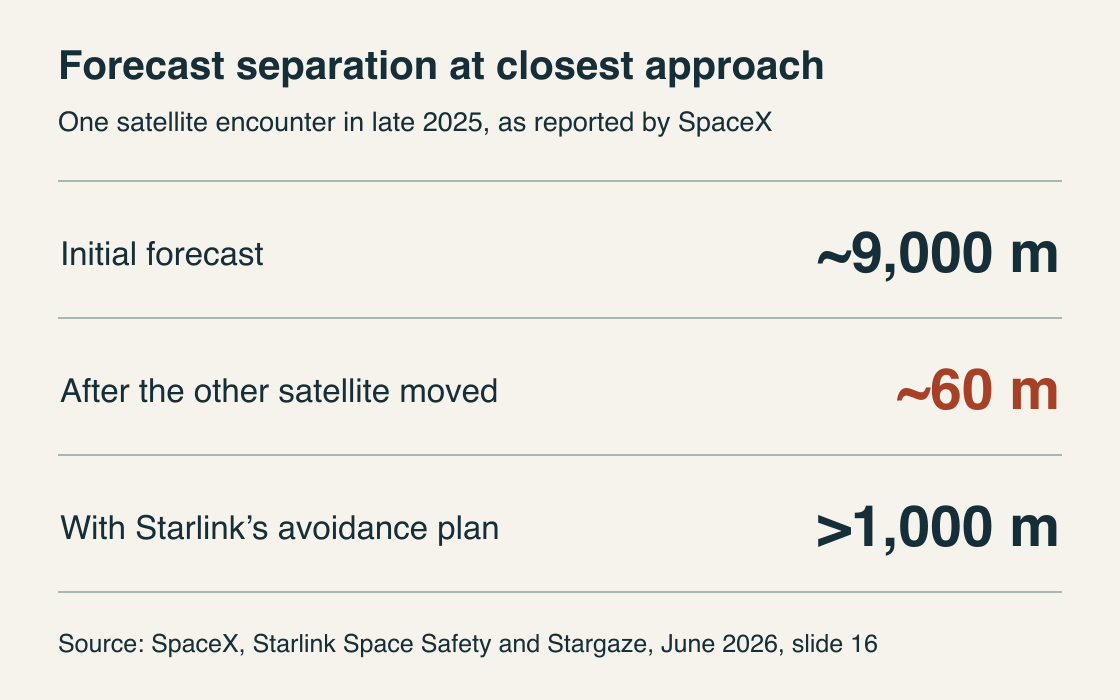
In late 2025, two satellites were forecast to pass about nine kilometers apart. One belonged to Starlink. The other belonged to an operator that had not shared its flight plan with SpaceX. Then the other spacecraft maneuvered. The maneuver came about five hours before the predicted pass. SpaceX’s Stargaze system detected the change and recalculated the other satellite’s path. The new forecast put the two satellites about 60 meters apart at closest approach.
Within half an hour, Starlink had an avoidance plan that put the predicted separation back above a kilometer, according to a technical presentation SpaceX gave the following June. All three distances refer to the same future pass. What changed between estimates was the route each spacecraft was expected to fly. Neither account gives the distance the spacecraft actually passed apart. What its account does document is a decision the first forecast gave the team little reason to make.
The system that picked up the change, Stargaze, uses cameras that Starlink satellites already carry to find their orientation. It gives SpaceX a way to catch a change in a neighbor’s orbit even when the neighbor’s operator has supplied no flight plan. And it gives another mission a practical use for the broadband fleet overhead. A team can submit its own spacecraft’s intended path, receive a warning based on those observations, and test where a proposed change would take it.
The pass that changed before it happened
The other operator was not sharing an ephemeris, the time-stamped predictions that tell others where a satellite is expected to be. SpaceX could still estimate its orbit from observations. That estimate remained useful for as long as the satellite flew roughly as expected. When it maneuvered, a forecast made before the change could still look perfectly reassuring on a screen. The pass itself was hours away. The wrong answer could sit there until someone saw enough new motion to replace it.
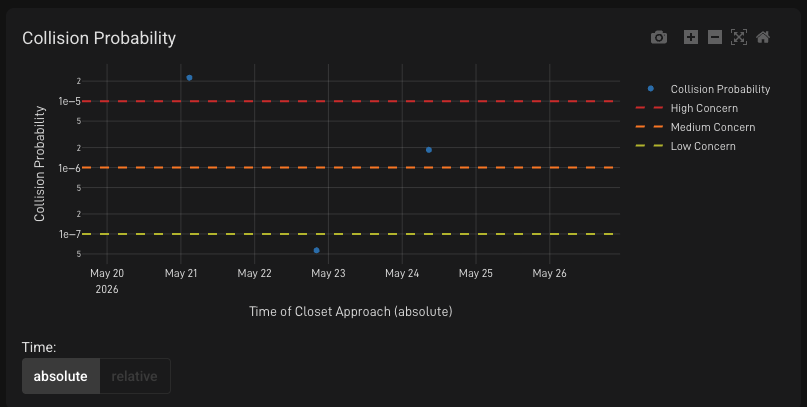
SpaceX first described the encounter on January 29, 2026. Its June presentation put the maneuver roughly four and a half hours before closest approach. The forecast separation fell from around nine kilometers to about 60 meters. With the revised paths and their uncertainties, the estimated probability of impact rose to about seven in a thousand. That estimate was large enough for Starlink to plan a change to its own orbit. With that plan included, the expected gap grew to more than a kilometer.
Sixty meters answers a question about the two best estimates of position. Each estimate also has a margin of error. The two satellites might pass farther apart than those estimates suggest, or closer together. A collision probability takes account of those uncertainties as well as the geometry of the encounter. Knowing only the distance would give a flight team too little information to judge how urgently it needed to act.
The public record is unusually precise about the reversal and sparse about the participants. SpaceX identifies neither the other spacecraft nor the reason for its maneuver in its case account. Both the January account and the June slides come from the company that operates Stargaze and the Starlink satellite. The case makes a good test of what a timely observation can change. It cannot tell us how many collisions the system has prevented across the fleet.
How a navigation camera notices a neighbor
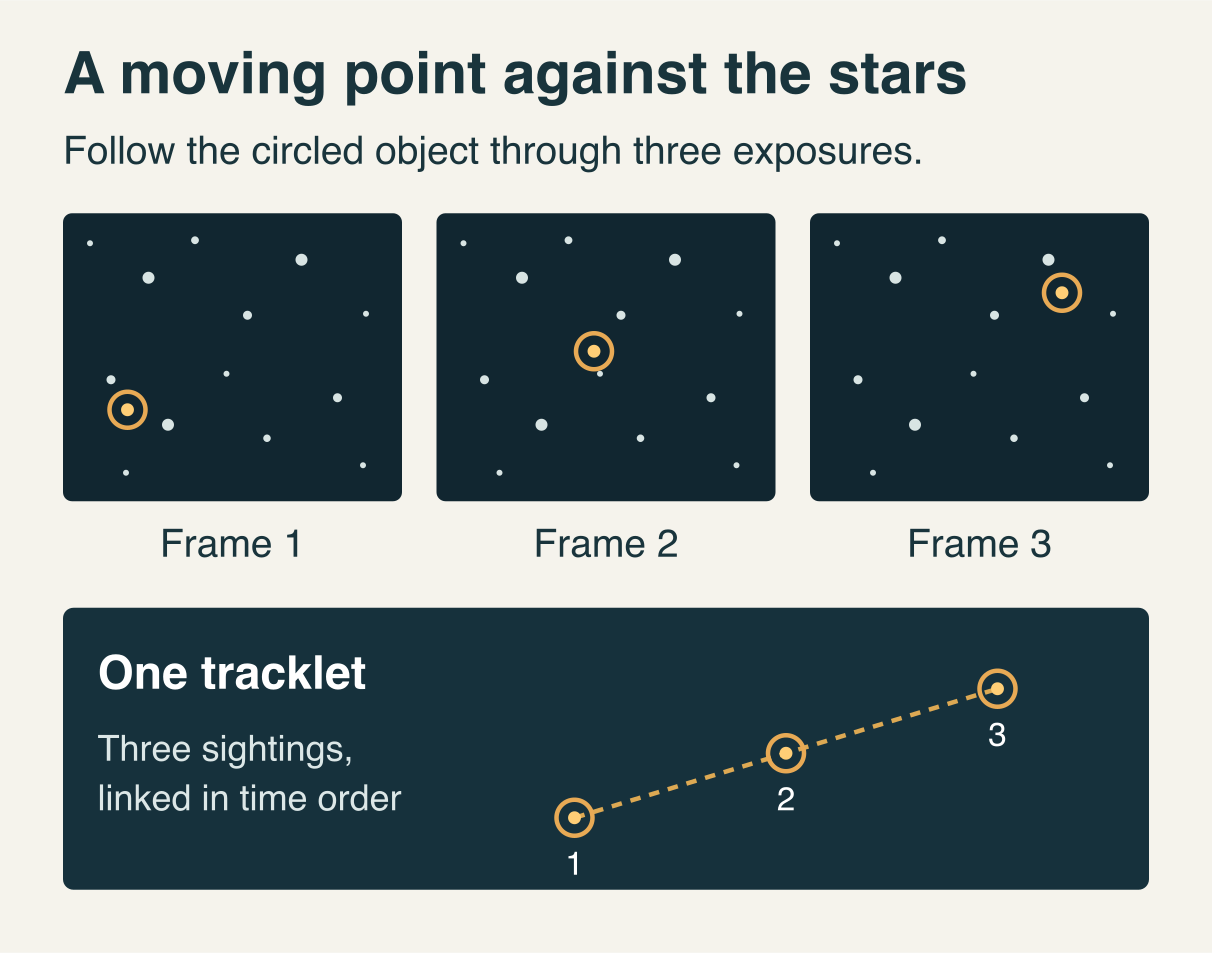
A star tracker has a familiar job aboard a satellite. It looks at the pattern of stars in its field of view and uses their known positions to work out which way the spacecraft is pointing. Occasionally a closer object crosses the same field. Seen in just one image, a small point of light gives little away. Seen in several images, its movement against the stars gives the camera something it can report.
In a September technical paper, SpaceX engineers describe software aboard each satellite that finds bright spots, removes the known stars, and links detections that move together from frame to frame. The result is a short series of sightings called a tracklet. It records how the apparent direction to an object changed while the camera could see it. The camera has no need to witness another spacecraft firing a thruster. A change in where the spacecraft subsequently appears can reveal that its old predicted path has gone stale.
The communications network does a second job here. An observing satellite can return its sightings through a ground connection or relay them through another Starlink satellite. On the ground, software checks whether a short series fits an object already being followed. As new observations arrive, it updates the estimated orbit and projects it forward. The next step is to compare that future path with the paths of other spacecraft and identify any close approaches.
The engineers measured the time between a camera completing a tracklet and the ground system updating an orbit. For 95 percent of updates, that took five minutes or less. A satellite still has to come into view and produce a usable sequence. Then someone has to receive and assess a warning, choose a response and have the means to carry it out. The half-hour figure in the 60-meter case refers to one particular Starlink avoidance plan. An operator looking after a different satellite cannot count on having a plan ready five minutes after a neighbor changes course.
What another flight team can use
Will Robinson-Smith of Spaceflight Now covered the announcement alongside a launch adding another 29 broadband satellites to Starlink. That pairing captures an unusual feature of the service. A larger constellation adds spacecraft whose operators must keep them out of one another’s way. The cameras and communications links on those same spacecraft can also provide observations to a mission that owns none of them. For a small team flying one satellite, the relevant question is what it gets to do differently on receipt of those observations.
SpaceX makes its screening service available free to spacecraft operators. A participating team supplies its own predicted path. The platform checks for close approaches and can return a conjunction data message, a notice identifying a pair of objects and the time they are expected to come closest. In some cases the team can see two estimates for the same pass. One uses the other operator’s submitted path. The other uses a path inferred from Stargaze observations. The message identifies which source went into each estimate.
Suppose the two estimates disagree. A team that can see where each came from has a specific question for its counterpart. Does the submitted path include a maneuver that the cameras have yet to see? Or has the spacecraft already changed course since the last file was sent? Those possibilities call for different responses. Even the absence of a probability has a meaning. The platform can report a separation while leaving the probability field blank when it lacks usable uncertainty information for both paths. A blank field offers no assurance that the risk is small.
A flight team can also submit a proposed path privately. Before committing fuel or changing an observing schedule, it can check whether moving away from one satellite would bring it closer to another. The platform keeps this trial separate from the trajectory the operator actually intends to fly. Other teams therefore do not have to plan around every option their neighbor considered. Once the operator chooses, sharing the updated plan lets others check their own routes against the new one. This is one reason an earlier warning is valuable even when the first proposed response turns out to be unsuitable.
There is evidence that use extended beyond SpaceX itself. In its June presentation, the company reported that more than 30 other operators had submitted predictions covering over 500 objects in the preceding week. Those figures show participation. They say nothing about how many of those operators moved a spacecraft, saved fuel or preserved a science observation. Of all the benefits proposed for Stargaze, the easiest one to substantiate is also among the most practical. An operator can check a real flight plan against a separately observed orbit while it still has choices.
The decision that still belongs to the mission
The European Space Agency documented what those choices cost during a different Starlink encounter in 2019. Its Aeolus satellite measured winds on Earth. As Aeolus and Starlink 44 headed toward a possible close pass, ESA calculated the risk and contacted SpaceX. The Starlink team told ESA it had no plan to move at that point. That exchange gave the Aeolus team a basis for planning a maneuver of its own.
ESA’s account follows the decision all the way back to the science mission. By the time the final decision came, the estimated collision probability was around one in a thousand. Aeolus fired its thrusters three times on September 2, half an orbit before the predicted encounter. Mission control then waited to hear from the spacecraft. It made contact about half an hour after the expected pass, and the team went on receiving wind measurements. For the scientists depending on Aeolus, that return of data was the outcome that mattered.
The Aeolus team had tracking and could coordinate years before SpaceX introduced Stargaze. What the newer system adds is another chance to notice when the orbit everyone is using has ceased to describe the spacecraft. Optical coverage has limits, and ground-based tracking supplies observations of objects Stargaze misses. More fundamentally, a camera can see where a satellite went. The operator may already know where it will send the satellite next. Sharing that intention can give a neighboring mission more time than even a prompt observation after the maneuver.
In the late-2025 case, one spacecraft changed course and its neighbor still had several hours to respond. SpaceX turned a change visible in its cameras into a new forecast, then used that forecast to plan a wider pass. For another mission, the payoff is the time between learning that the old prediction is wrong and having to act. A flight team can use those hours to call its counterpart, check a different route and decide whether to move.