
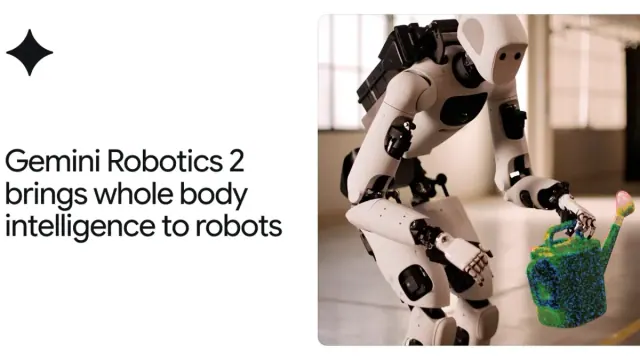
In a demonstration announced on July 30, 2026, Apptronik's Apollo 2 humanoid walked over to a table, picked up a watering can, stepped toward a shelving unit, and deposited the object into a green bin on a lower shelf. The sequence illustrated Google DeepMind's Gemini Robotics 2, a suite comprising three distinct models that partition embodied reasoning, whole-body motor control, and local edge execution.
The release marks a clear operational split in model availability. While developers can access the high-level reasoning model via Google AI Studio, the low-level action models that drive physical hardware remain restricted to early-access partners. The announcement does not include a public model-weight release.
How the Three Models Divide the Work
The suite organizes physical automation across three functional roles:
Gemini Robotics ER 2: A vision-language model (VLM) for embodied reasoning, multi-step planning, and human interaction. DeepMind states thatER 2can orchestrate sequences lasting minutes across hundreds of intermediate decisions, monitor execution progress, and coordinate tasks across multiple robots. It is accessible through Google AI Studio and in private preview on the Gemini Enterprise Agent Platform.Gemini Robotics 2: A vision-language-action (VLA) model that translates visual and language inputs directly into motor commands. It controls whole humanoids as well as bi-arm platforms equipped with hands or grippers. Access is currently limited to early-access partners.Gemini Robotics On-Device 2: A VLA model optimized to execute on robot hardware without internet connectivity, avoiding external network latency. This model is also restricted to early-access partners.
Adaptation and Deployment Limits
For hardware porting, DeepMind claims adaptation to new bi-arm setups—naming Dexmate, SO101, and Trossen platforms—typically takes a few hours using fewer than 200 demonstration examples. The announcement does not provide independent validation of those adaptation figures.
DeepMind also acknowledged practical boundaries: movement speeds remain limited, and multifinger dexterity continues to pose challenges. To evaluate risk mitigation, the group introduced ASIMOV-Agentic, a benchmark testing whether an agent can refuse unsafe tool calls from a VLA and request human intervention under uncertainty. DeepMind also reported enhanced proximity detection and safe-stop tool triggers, though these mechanisms represent company benchmarks and feature additions rather than formal safety certifications or proofs of real-world operational reliability.