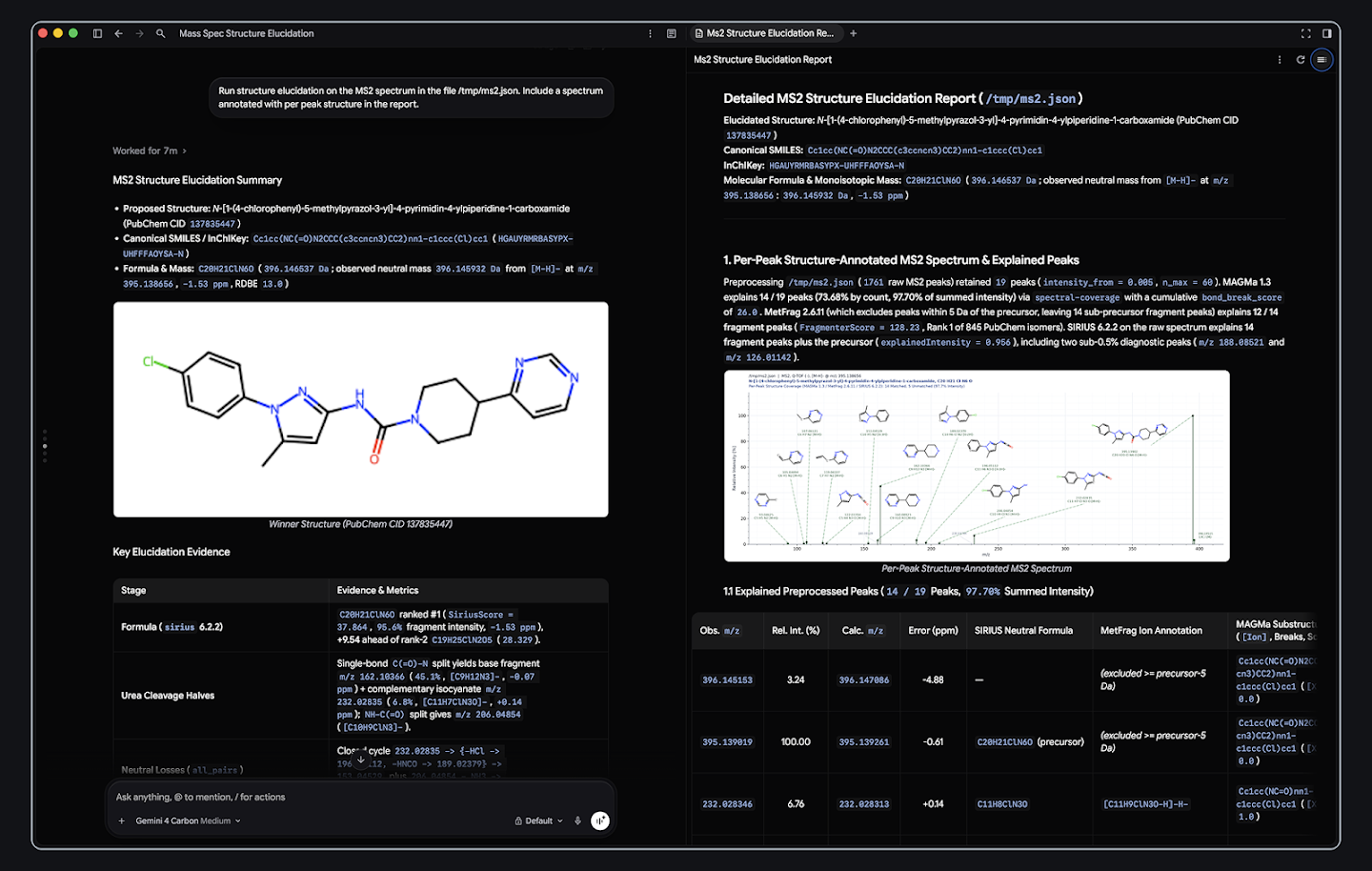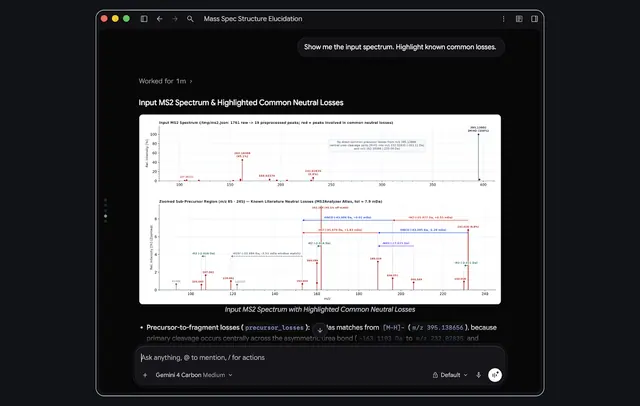
Google DeepMind released Mass Spec Skills for Antigravity on November 25. A chemist can give the plugin a tandem mass spectrum, a record of the fragments formed when a charged molecule breaks apart. The software compares those fragments with reference data and assembles a report linking a proposed structure to the measured peaks.
What a match means
A reference library can help an analyst recognize a compound that someone has already measured. DeepMind tested 100 compounds already represented in a public library, excluding recordings with too little fragmentation. Each model had three attempts per spectrum. With internet access and the plugin, Gemini 3.8 Flash, 4 Argon and 4 Carbon each identified the exact molecule in about 97% of attempts.
Attempts that ran longer than an hour counted as failures. DeepMind excluded temporary infrastructure and quota errors.
A molecule absent from the databases may yield a plausible formula and peak assignments, while its identity remains open. Mirror-image molecules can produce nearly identical fragments, so a chemist may need another measurement to distinguish them.
The plugin is available in the Antigravity app. Enterprise users can sign in with a Google Cloud business account. Google also invites eligible scientists to apply for one of 10,000 places offering six months free on its highest usage tier, subject to selection and capacity.