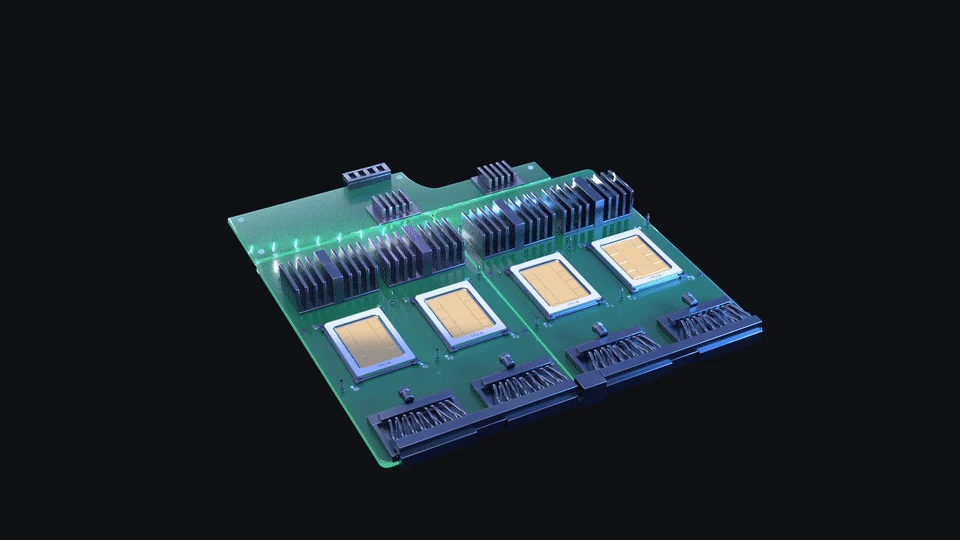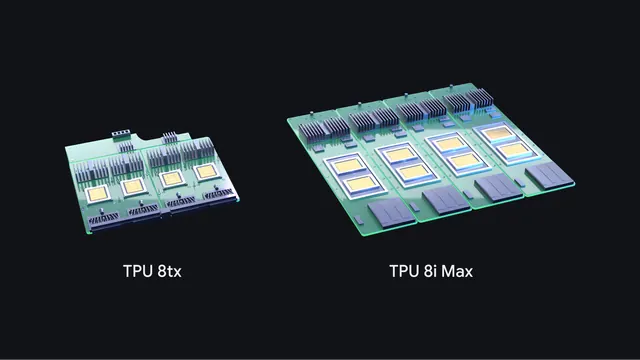
Google announced two additions to its eighth-generation Tensor Processing Unit lineup on November 9. TPU 8tx is built to protect sensitive information while a model processes it. TPU 8i Max combines two TPU 8i chips in one package to give large models more compute and memory bandwidth.
TPU 8tx keeps data protected during processing
The 8tx uses the same silicon as TPU 8t, paired with fifth-generation AMD EPYC host processors. Google says its hardware isolates sensitive data and model weights while they are in use, adding protection at a point where encrypting stored data or network traffic alone does not help.
Google is targeting governments and regulated companies that need to run models with private data. The 8tx uses a faster interconnect than the 8t, and Google says the system can also handle smaller training jobs. A team could fine-tune and serve a model on the same system.
TPU 8i Max doubles key resources
By putting two 8i chips in one package, Google says 8i Max doubles compute, fast on-chip memory and the bandwidth of its high-bandwidth memory compared with TPU 8i. The package fits within the same rack footprint as the 8i system. The extra bandwidth targets workloads that repeatedly move large amounts of data through memory, such as models that process long documents or video.
Google introduced the 8t for training and the 8i for low-latency inference in April. Both new systems are listed as coming soon. Google’s product and pricing pages give no launch regions, public prices or general availability dates for either configuration.