
The most interesting AI model released this month cannot write an email, explain a joke or generate a line of code. Ask Jev for prose and the request misses the point. It returns a choice, a score or a probability—nothing more.
That sounds like a step backward after years of models competing to do everything. I think it is interesting for exactly that reason.
TypeSafe AI introduced Jev on September 15 as the first of what it calls “System One models.” The company describes it as a smart if statement: give the model some messy context and a bounded question, then receive a typed answer that ordinary software can use. A support system might ask which queue owns a ticket. A security product might ask whether an event looks suspicious. A sales workflow might score the urgency of a lead.
There is no paragraph to parse and no JSON object that may arrive with a missing bracket. TypeSafe says Jev is fast, inexpensive and incapable of hallucinating outside its output type.
The last claim needs careful handling. Jev can guarantee the shape of an answer. It cannot guarantee that the answer is true.
The model that stops before the sentence
Jev currently exposes three primitives. Choice selects among as many as 255 supplied options and returns a probability distribution. Score places an item on a defined scale. Noul evaluates a yes-or-no proposition. In every case, the developer decides the space of valid answers before the model runs.
That changes the relationship between the model and the application.
With a conventional language model, developers often describe a policy in a prompt, request a structured response and hope the model stays inside the schema. The model is still generating a sequence of tokens; the braces and field names are part of the performance. Tool calling and constrained decoding have made this much more reliable, but the model’s natural habitat remains a string.
Jev begins on the other side of that boundary. The output type is not a polite request attached to the prompt. It is the interface.
I like the discipline this imposes. “Resolve this customer complaint” is not a useful software instruction. A Jev-style workflow forces a team to separate the decision into smaller questions: What kind of complaint is this? Is churn threatened? Which remedy is permitted? Code—not the model—can then apply a policy, call an API or send the case to a person.
This is less magical than an autonomous agent. It is also much easier to inspect.
The speed comes from refusing the larger job
TypeSafe lists a price of $0.042 per million input tokens and no output-token charge. It reports service latency between 70 and 500 milliseconds, and says Jev can be up to 193.6 times faster and 444.6 times cheaper than frontier-model workflows in its tests.
Those numbers come from the vendor’s own four workflow evaluations, so they should not be read as a neutral league table. TypeSafe also says the examples sit toward the high end of the advantage Jev may deliver. The model’s weights, parameter count and underlying architecture have not been published, which limits outside verification of the technical explanation.
Still, the basic source of the saving is plausible. Jev is not composing and decoding an answer word by word. If the actual product need is a routing decision, refusing to write the surrounding prose removes work.
This is a useful correction to one habit in AI product design: reaching for the most capable conversational model even when the job is classification. A frontier model may make sense when a case requires synthesis or explanation. It is harder to justify when a system only needs to decide whether a ticket belongs to billing or fraud.
The important comparison is not “Can Jev beat GPT-6 at reasoning?” It is “How much model does this decision actually need?”
A valid type is not a true answer
ITmedia AI+ writer Keiichi Inoue found the cleanest way to puncture the marketing. In a simple dice problem, Jev returned a valid, high-confidence response—and chose the wrong answer.
Nothing broke at the interface. That was the problem.
TypeSafe’s “zero hallucinations” language refers to structured-output validity: a Choice call will return one of the supplied choices rather than inventing another field or wandering into an essay. That is valuable. It is not the everyday meaning most people attach to hallucination, which is being wrong while sounding certain.
A malformed response often stops at a parser. A typed mistake can travel through software with no such friction. The database accepts it. The next service trusts it. The workflow may execute before anybody notices.
Jev therefore does not remove the need for evaluation; it makes task-specific evaluation more important. A team has to learn how often the model is right on its own cases, how errors are distributed and which decisions are safe to automate. A threshold such as 95 percent means little until the reported probability has been compared with real outcomes in that environment.
There is a second warning in Jev’s confidence field. Researcher Stanislav Yurin analyzed 738,164 Choice answers and found that the reported confidence closely followed a transformed version of the leading option’s probability, rather than acting as an independent estimate of correctness. Adding irrelevant choices could even increase the displayed confidence under some conditions.
That does not make the probabilities useless. It means they are model outputs, not warranty labels.
The workflow may be doing more work than the model
TypeSafe’s own evaluations contain another revealing result. When the company decomposed complex policies into typed questions and deterministic steps, other models also became faster and cheaper than when they were asked to handle the workflow in one large prompt.
Some of Jev’s apparent advantage is therefore an advantage of better software design.
This is not a criticism. It may be the product’s most useful contribution. Generative AI encouraged teams to hide business logic in long natural-language instructions because that was faster than building a conventional system. Jev pushes in the opposite direction: define the states, name the allowed decisions and put policy back in code.
A practitioner test by Nikhil Mudholkar makes the trade-off concrete. On 1,565 bilingual business emails, he reported 96.4 percent classification accuracy for Jev, compared with 97.5 percent for Gemini 3.5 Flash-Lite and 98.5 percent for Gemini 3.8 Flash. Those are one author’s results, not a benchmark I would generalize from. They nevertheless show the useful shape of the product: Jev did not win on raw accuracy, but its speed, low price and explicit uncertainty made it interesting as a first-pass filter.
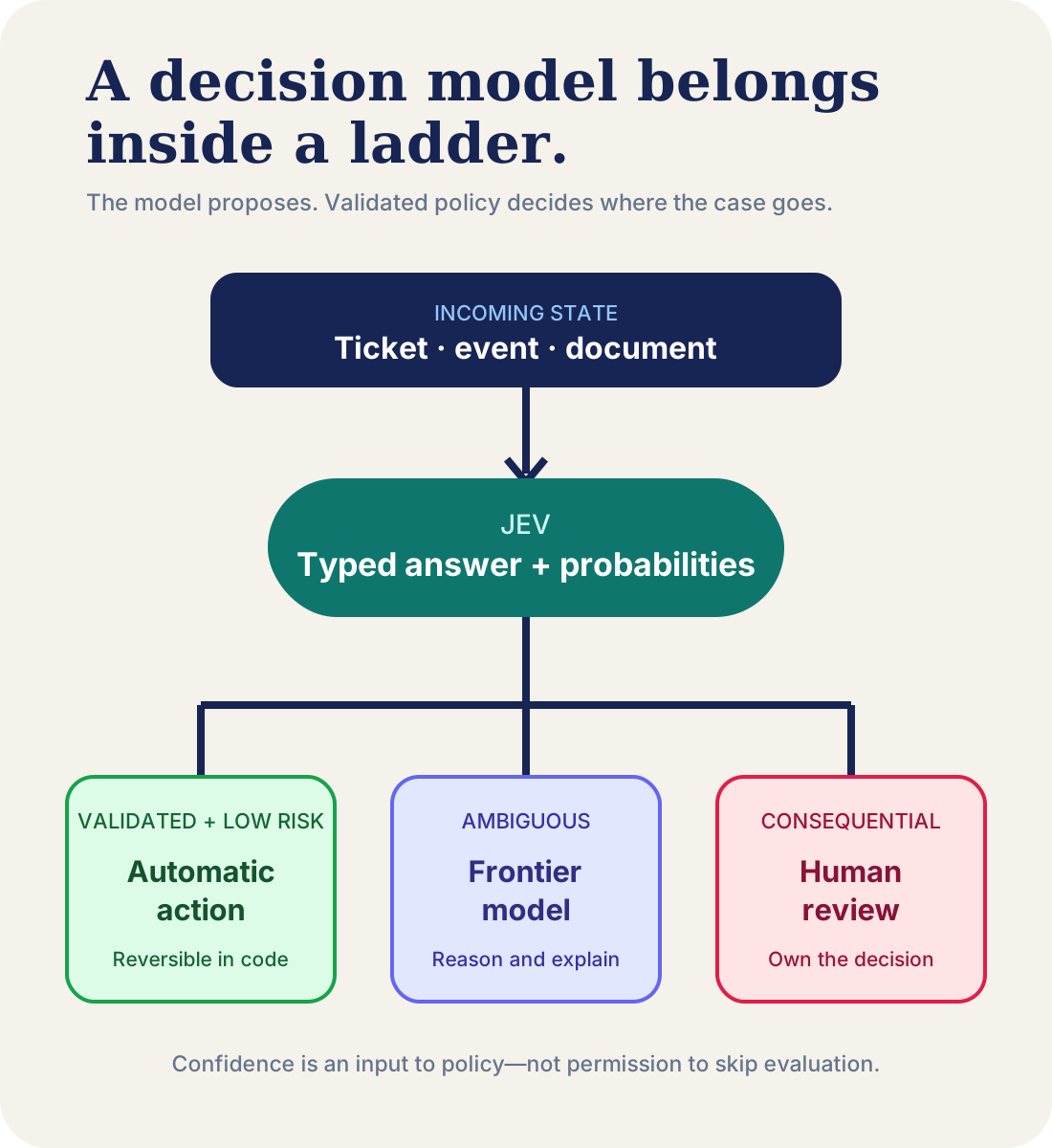
The most sensible design is a ladder. Let a bounded model handle high-volume, reversible decisions that it has been validated on. Send ambiguous cases to a more capable model. Reserve consequential or unusual cases for a person. The thresholds should come from observed errors, not from a confidence number that looks reassuring in a demo.
Where I would—and would not—use it
I would consider Jev for routing support tickets, prioritizing logs, tagging inbound documents and deciding which tool an agent should try next. These are frequent decisions with finite options, and many can be corrected later.
I would be cautious where the decision itself needs an explanation. Jev currently offers no natural-language rationale. It also does not accept images, which rules out many visual inspection tasks. And I would not let it make an irreversible financial, employment or safety decision simply because the response is well typed.
The early-access status matters too. TypeSafe’s most dramatic performance evidence is internal, its evaluation labels were synthesized from answers by GPT-6 Astra and Claude Fable 5.1 rather than audited ground truth, and the confidence behavior still needs independent calibration work. This is a promising interface, not settled infrastructure.
The category has to earn its name
Specialized decision engines existed long before the current model boom. Some were useful; many lost to general-purpose tools because maintaining a separate schema and service was not worth the trouble. Jev will have to prove that “System One model” describes a durable technical category rather than an appealing new label for classification.
The evidence I want next is unglamorous: production error rates on real outcomes, calibration curves across industries, latency under sustained load and examples of teams saving money without quietly moving the hard cases elsewhere. I also want to see whether small open models can deliver enough of the same benefit through constrained outputs.
Even if a competitor copies the idea, Jev has already made a useful argument. Not every place in an AI system needs a model that can talk. Sometimes the better component is one that knows its allotted decision, exposes uncertainty and then gets out of the way.
That is not artificial general intelligence. It may be better software.