

An empty prompt is a peculiar product. It offers almost unlimited possibility, then asks the user to supply the idea, the instructions and often the source material too.
People who enjoy prompting do not mind. Everyone else has work scattered across PDFs, presentation drafts, school notes, receipts and forgotten folders. The useful context already exists; it is simply trapped in files.
Baidu’s decision to combine Wenku, its document platform, and Baidu Drive into a Personal Super Intelligence Business Group deserves attention for this reason. As South China Morning Post first reported in January, the company put the two businesses under vice-president Wang Ying in one of its larger recent reorganizations. Baidu later confirmed the creation of the group, known as PSIG, in its financial disclosures.
The grand name invites grand expectations. The more practical idea is better: Baidu is betting that a consumer assistant should meet people where their work is stored instead of asking them to begin again in a blank conversation.
Storage already solved the first distribution problem
New assistants have to create a habit. A drive does not. People return because their files are there.
Wenku and Baidu Drive occupy different but complementary parts of that habit. Wenku is a place for documents, templates and reference material. Drive is personal storage. One is organized around useful content; the other around the user’s own archive. Combined, they give an AI product both a surface for creating work and a reason for people to keep coming back.
That is a meaningful distribution advantage. A standalone chatbot begins every session by asking, in effect, “What do you want?” A file-aware assistant can begin with “What do you want to do with this?” The second question is narrower, but far easier to answer.
A student does not need to design a workflow from scratch if the notes are already open. An office worker does not need to explain the structure of a report if the draft and supporting files are in the same product. The model has an object to act on.
I think this is one reason the race to build a universal AI app is sometimes framed too abstractly. Intelligence is not enough to create use. Products need context, timing and an obvious next action. File storage is mundane, but it supplies all three.
GenFlow turns the archive into a workspace
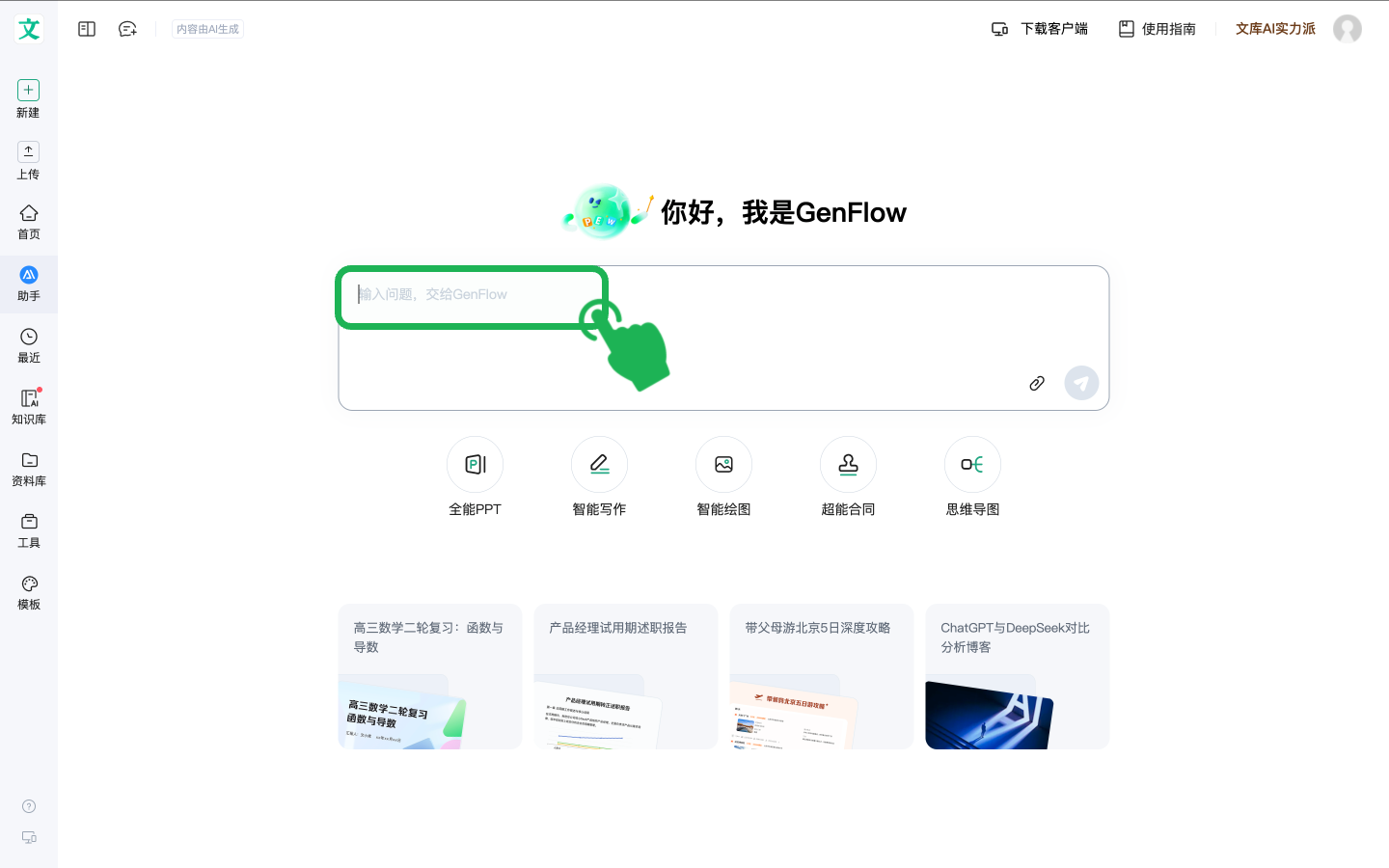
Baidu’s GenFlow interface shows how the company wants this change to feel. The visible product options are not invitations to discuss philosophy with a model. They are work verbs: write, make a presentation, draw, organize a knowledge base, draft a contract.
The shift is from retrieval to transformation. A conventional drive helps a user find and download a file. An AI layer can summarize it, compare it with another document, extract a structure or turn it into a new format. The stored object stops being the end of the task and becomes its input.
That sounds obvious, but it changes the economics of a storage product. Capacity and synchronization are commodity features. A system that repeatedly helps finish work has more opportunity to charge for the outcome and more reason to retain the user.
Baidu reported that AI daily-active-user penetration across Wenku and Drive rose 27.4% year over year in June 2026 after additional GenFlow upgrades. The company did not provide the absolute number in the cited filing or define the denominator in enough detail to translate that percentage into sustained use. A person who taps a generated summary once is not necessarily a converted AI customer.
The figure is encouraging evidence of exposure, not proof of habit.
The reorganization follows a financial need
PSIG also fits the story Baidu is telling investors about becoming an AI-first company rather than relying on its legacy internet-advertising business.
In its fourth-quarter filing, Baidu reported RMB 2.7 billion in AI Applications revenue and more than RMB 10 billion for the full year. Those numbers cover a broader portfolio than Wenku and Drive, so they should not be credited to PSIG. They do establish that Baidu wants applications to stand as a business category, not as free features attached to search.
By the second quarter of 2026, the contrast inside that strategy was visible. AI Applications revenue was RMB 2.5 billion, up 3% from a year earlier. AI Cloud Infrastructure revenue reached RMB 7.3 billion, up 50%. Both are company-reported figures, and the segments are not directly comparable products, but the gap poses a clear question: can Baidu turn AI use into application growth as effectively as it sells the infrastructure underneath it?
Putting Wenku and Drive in one group gives one executive responsibility for answering that question. Product decisions no longer need to travel between a document business and a storage business with separate priorities. At least on paper, the team can design a workflow that begins in one product and ends in the other.
On paper is the important phrase.
A bundle is not a workflow
Large companies merge adjacent products all the time. The result is often two logos in the same subscription and a banner encouraging users of one service to try the other.
PSIG becomes meaningful only if the boundary between Wenku and Drive disappears during a real task. A user should be able to select material from storage, create something in Wenku, preserve sources and permissions, and save the result without feeling the machinery underneath. If each step opens a different product, asks for another import or changes the available AI controls, the reorganization has created a bundle rather than an assistant.
This is where Baidu’s existing assets become both an advantage and a burden. Mature products bring users and content. They also bring old interfaces, entitlement systems, file formats and teams accustomed to their own roadmaps. Joining them at the org-chart level is much easier than joining them in the product.
The best evidence will not be another feature count. It will be repeated multi-step use: people moving from a stored file to a finished document, presentation or decision without leaving the system.
The context advantage creates a trust problem
The more useful PSIG becomes, the more carefully it must define what the assistant can see.
A blank chatbot has a crude but understandable boundary. It knows what the user types or uploads in that conversation. A drive contains tax records, identity documents, photographs, company files and years of accidental accumulation. “Use my files” is not one permission. It is hundreds of decisions about folders, accounts, collaborators and purposes.
No supplied source shows that Baidu trains on or broadly accesses private Drive contents, and it would be wrong to imply otherwise. The issue is a product-design requirement, not an allegation.
If an assistant works across stored material, the interface needs to show which files are in scope, what operation will occur, where the result goes and whether access persists. A helpful agent that makes its boundaries difficult to understand will feel less helpful precisely because it is close to sensitive context.
This is the paradox of file-based AI. The archive makes the model useful before the user has written a detailed prompt. The same archive makes every mistake feel personal.
What would prove the bet
Baidu has already confirmed the organizational move and reported increased AI penetration. Neither tells us whether PSIG will become a consumer gateway.
I would look for three things. First, retention: do people use GenFlow again after the first assisted task? Second, cross-product completion: can they move among stored sources, generated work and final files without manual shuffling? Third, revenue: does applications growth begin to reflect the increased AI use, rather than remaining far behind infrastructure growth?
Permissions deserve their own measure. Users should be able to understand and change access without learning an internal product architecture. Trust cannot be buried in a settings page after the assistant has already indexed the room.
The empty chat box will remain useful. It is a clean place to think and ask. But it is not automatically the best front door to everyday work.
Baidu’s more interesting wager is that the winning assistant may look less like an oracle and more like a familiar folder that finally knows what to do with everything inside it.