
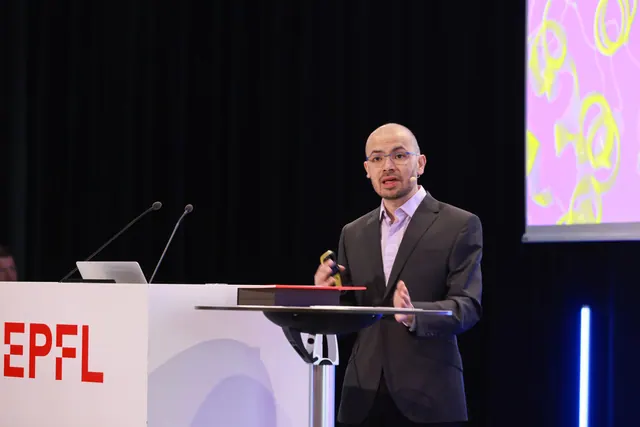
Google announced its latest AI reorganization in the reassuring language companies use when everyone involved is important. Demis Hassabis will become chair of Google DeepMind and chief scientist of Alphabet. Koray Kavukcuoglu, previously Google DeepMind’s chief technology officer and Google’s chief AI architect, will run the unit as a senior vice-president reporting to Sundar Pichai. Hassabis will continue to lead Isomorphic Labs and advise the research and model teams.
Nobody was publicly pushed out. Nobody lost prestige. Yet the practical change is hard to miss: the person responsible for Gemini models, frontier research, the Gemini app and developer products now reports directly to Google’s CEO.
Axios described the move as Google’s biggest AI leadership overhaul in years, setting it against delayed releases, researcher departures and pressure from OpenAI and Anthropic. Google did not connect the reshuffle to those problems. That distinction matters. It would be lazy to turn an org chart into a confession.
Still, org charts are arguments. This one says Google no longer wants scientific stewardship and product execution mediated through the same office.
One title had swallowed two incompatible jobs
Since Google merged DeepMind and Google Brain in 2023, Hassabis has carried two mandates that pull in different directions.
One is the job he was built for: choosing ambitious scientific problems, protecting long research cycles and persuading talented people to work on questions whose commercial value may be years away. That culture produced work such as AlphaFold. It depends on room for failure and on the belief that a strange idea will not be killed because it cannot be attached to next quarter’s product plan.
The other mandate is closer to industrial production. Gemini has to be trained, evaluated, priced, served and inserted into Search, Cloud, developer tools and consumer apps. Release dates matter. Latency matters. A model that looks impressive in a research review but cannot be deployed reliably across Google’s products is not finished.
Those are not higher and lower forms of work. They are different tempos. A research leader asks whether a direction could matter in five years. An operating leader has to decide which team owns a broken launch dependency on Friday.
Hassabis said he was handing over day-to-day responsibilities to focus on strategic and global questions around AGI and science. I take that statement seriously. I also read it as a neat description of the burden Google is removing from him. The chair and chief-scientist roles preserve his ability to shape the company’s long view without making him the final routing point for every conflict between a model team and a product team.
The consequential part is the line to Pichai
Titles attract attention, but reporting lines usually tell the more useful story. Kavukcuoglu will not run a research enclave at arm’s length from Mountain View. He reports to Pichai, and his remit connects the model to the products that consume it.
That structure should reduce ambiguity. If a Gemini release is blocked by an infrastructure decision, a product requirement or a research trade-off, there is now a shorter escalation path. Axios reported that Kavukcuoglu had already been closely involved in recent launches and had proved able to navigate Google’s internal politics. Formal authority is catching up with the work he was apparently doing.
Google also has a scale problem disguised as an advantage. Pichai says the Gemini app has more than 950 million monthly users, while Gemma models have passed 900 million downloads. Those are company-reported numbers, but even allowing for the usual caution around corporate metrics, they describe an operation far removed from a protected lab. Google’s AI group is supplying consumer software, developer infrastructure and a company-wide product transition at once.
At that scale, “move faster” is not a motivational poster. It means fewer places for a decision to stall.
The cost is that Google DeepMind becomes more obviously a Google operating unit. Axios reported that some employees saw the new structure as another reduction in the organization’s independence. That interpretation is plausible, though not definitive. DeepMind’s formal separation had already narrowed after the Google Brain merger. This change makes the center of operational gravity explicit.
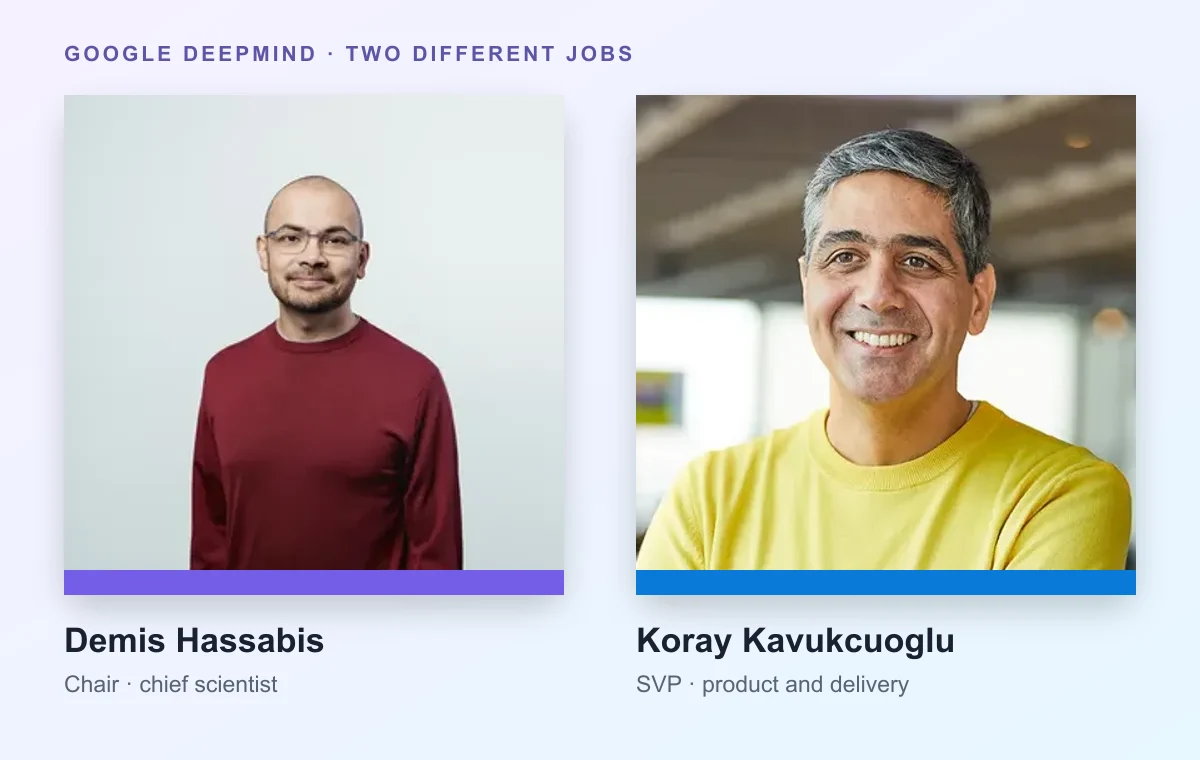
Hassabis is not being removed from the story
It would be a mistake to describe Hassabis’s new role as ceremonial. Alphabet still needs a scientist who can speak credibly to researchers, governments and institutions about long-horizon AI. Scientific standing is not decoration in a field where companies are asking society to trust them with unusually capable systems.
Hassabis also continues to lead Isomorphic Labs, where the distance between AI research and scientific application is central rather than incidental. Moving him toward AGI strategy, science and health may be a better use of his comparative advantage than asking him to referee every Gemini launch.
There is also a talent-retention logic here. Google can tell researchers that the company still has a senior figure empowered to defend fundamental work, even as Kavukcuoglu tightens product execution. The arrangement attempts to keep two promises alive: that DeepMind can still pursue important science, and that Google can ship competitive products on schedule.
The difficult question is whether those promises can remain separate in practice. Hassabis can advise. Kavukcuoglu controls the organization that allocates people and compute. When a speculative research program competes with a product deadline, formal operating authority matters.
The other departure makes the reorganization feel larger
On the same day, Google said Jeff Dean and Sanjay Ghemawat would leave to form an independent public-benefit corporation focused on machine learning, science and engineering. Google will be a founding investor and cloud partner and plans to collaborate on research infrastructure.
That is not a clean break, and Google said the announcements were unrelated. Even so, the departure carries symbolic weight. Dean and Ghemawat helped build the systems culture on which modern Google rests. When people with that history decide the next piece of foundational work is better attempted in a new institution, it is reasonable to ask what the existing institution has become optimized to do.
The answer may simply be “operate at planetary scale.” Google still has proprietary chips, global infrastructure, enormous distribution and profitable businesses capable of funding expensive research. Those assets are real. But they favor coordination and deployment. A giant integrated company can support experiments no start-up could afford; it can also make an experiment wait behind twenty urgent product dependencies.
The sensible reading and the uncomfortable one
The sensible reading is that Google has aligned authority with reality. Kavukcuoglu was already close to delivery. Hassabis wanted more time for science and strategy. Pichai now has a direct operator responsible for the model-to-product chain. A mature AI organization should not require its most prominent scientist to be its best release manager too.
The uncomfortable reading is that Google is finishing the absorption of DeepMind. The lab’s name survives, and its founder moves upward, but operational control moves closer to the corporate center. Research will have to defend itself inside a system increasingly measured by shipping cadence and product reach.
I do not think either reading cancels the other. The reorganization can be rational and still change the kind of institution DeepMind is.
The next useful evidence will not be another upbeat memo. Watch whether Gemini releases become more predictable without becoming more conservative. Watch whether long-horizon research keeps receiving compute when it has no immediate product owner. And watch whether senior researchers continue to believe they can do their best work inside the company.
Google has separated the scientist from the operator. Now it has to prove that the scientist still has something more substantial than a chair.