
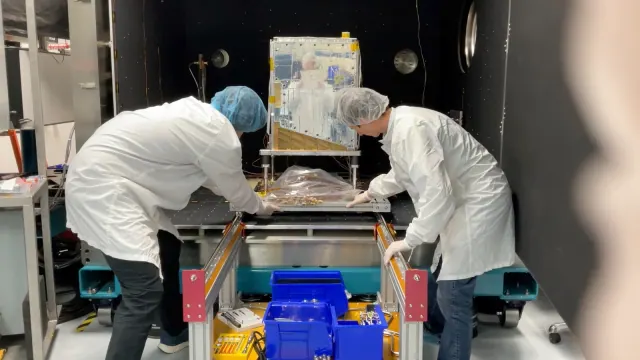
Google put its first Project Suncatcher hardware into orbit on October 1, sending a small test payload aloft aboard a Transporter 18 rideshare with Planet. Reporting from NPR indicates that the four Tensor Processing Units aboard are scheduled to run Gemma queries in bursts of roughly fifteen minutes, a deliberate ceiling imposed by how fast the package sheds heat. Those short bursts will test how the hardware behaves in flight before Google attempts a computing service.
I see a far more persuasive commercial rationale when the data being processed originates in orbit rather than on Earth. An Earth-observation satellite has to fit the images it sends home into available transmission capacity and ground-station contacts. Filtering or analyzing those frames directly in orbit can eliminate traffic from a physical link the mission already pays to maintain. Moving an ordinary terrestrial computing job into orbit does the reverse. It adds an uplink and downlink cycle to an application that previously lived next to high-capacity terrestrial fiber. Both models operate hardware in space, but their economic balance sheets start from opposite directions.
Abundant orbital sunlight does not pay for the spacecraft that collects it. A spacecraft earns its keep if it delivers an actionable answer faster or cuts down the volume of bytes that must cross a congested link. To turn that mechanism into a viable business, the operational savings have to cover the cost of launching, cooling, protecting, and operating the orbital computer. The commercial question is where the data comes from—and what happens when software decides to discard it.
What Four Processors Prove in Orbit
Google's stated objectives for this mission focus on environmental survivability. Google describes vibration tests, proton-beam exposure, and thermal-vacuum testing before launch. These tests address different hazards: launch stresses the structure, radiation can disrupt electronics, and cooling must work without surrounding air. Flight measurements will show how the assembled payload handles its actual operating environment.
This prototype remains a solitary, self-contained experiment rather than a miniature data center. Google plans a separate two-satellite mission for 2027 to evaluate high-speed inter-satellite laser communications. That experiment addresses another part of the proposed architecture: moving data between machines on different spacecraft. Even if the four co-located chips run Gemma successfully, Google will still have to test the connections on which a distributed cluster would depend.
The satellite's power architecture reinforces that experimental status. NPR's reporting clarifies that the current vehicle carries storage batteries to ride out cycles of shade in an ordinary low Earth orbit. The near-continuous solar illumination that Google highlights in its long-range research vision would require an orbit chosen for more consistent sunlight. Today's prototype therefore has to manage a power constraint that the proposed future constellation aims to reduce.
Finding thermal or radiation problems early could help Google avoid expensive design mistakes. Resolving component survival, though, leaves the market questions open. Customers do not buy accelerator survival; they buy delivered throughput, latency, and reliable answers at a predictable price.
Why Solar Power Cannot Carry the Balance Sheet
In an assessment published shortly after the launch, ABI Research analyst Andrew Cavalier argued that space-native preprocessing and sensor fusion represent far more plausible early deployments than offloading terrestrial data-center tasks. Cavalier pointed out that raw energy savings from orbital solar panels struggle to overcome the total cost of building, launching, and managing orbital computing nodes. That is the distinction I find most useful in assessing Suncatcher: energy savings matter only after the rest of the system has been paid for.
Cooling makes that distinction tangible. A terrestrial facility can ultimately transfer heat into surrounding air. A spacecraft must carry heat to surfaces that radiate it into space; Google's engineering account describes heat pipes and a radiator. NPR reports that the prototype's radiators are among its heaviest components. More power for computation also means more heat to remove, so additional solar electricity brings a cooling burden with it.
An independent analysis by physicist Slava G. Turyshev provides an instructive illustration of these physical proportions. In a preprint modeling a one-megawatt IT workload in a high-sunlight orbit, Turyshev calculated that radiating away the resulting thermal load under baseline parameters would require approximately 2,500 square meters of radiator surface. That figure belongs to Turyshev's modeled system, with its chosen temperatures and assumptions, rather than Google's design. It illustrates how a cooling requirement can become a launch-cost problem: the operator must get the radiator into orbit before the first query executes.
Google's 2025 feasibility study depends on a large reduction in launch costs, modeling a scenario around $200 per kilogram by the mid-2030s. The resulting cost comparison is conditional on that future price. Travis Beals, the Google research scientist leading the project, acknowledged in an interview with NPR that he does not expect orbital computing to undercut terrestrial computing costs within the next five years.
Earth-origin computing workloads face another structural penalty: they require moving inputs up before answers can come down. A delay-tolerant job that reuses uploaded data might absorb that penalty more easily than an interactive application. But model serving still requires a route for user inputs to reach the machine and for answers to return. The cost comparison has to include those connections.
A space-native workload starts with its data already in orbit. If imagery or radar observations can be triaged, compressed, or transformed into a useful alert while still in flight, fewer bytes may need to come down. The computer can then earn its payload slot by reducing demand on a communications link the mission already needs.
The Onboard Chip Already Waiting at the Sensor
Processing space data in space is not a novel concept, and Google is not entering an empty field. Planet, Google's operational partner for the Suncatcher launch, sent its high-resolution Pelican-2 satellite into orbit in January 2025 equipped with an onboard NVIDIA Jetson computing module. Planet designed that setup to evaluate how local edge processing could shorten the interval between image capture and customer delivery.
The European Space Agency has explored onboard AI with PhiSat-2, a 6U CubeSat launched in August 2024 that completed commissioning in the second quarter of 2025; ESA reported its science phase in July. PhiSat-2 carries multispectral optical sensors alongside an onboard computing payload running modular machine-learning applications. Its applications include cloud detection and image compression. By identifying scenes obscured by cloud cover while the craft is still in orbit, the satellite can decide not to downlink frames that contain no usable ground information, leaving transmission capacity for clear scenes.
These missions put the preprocessing idea into hardware already attached to an observing spacecraft. They also pose a competitive challenge to a separate orbital cluster. If the satellite can filter cloud-covered images itself, why should an imaging operator send them across another link to a dedicated Google TPU cluster?
The onboard processor can use the observing spacecraft's existing infrastructure and receive data locally. A separate computing platform adds another spacecraft and a link between the two. I would therefore judge a Suncatcher service against the cost of completing the same task on the sensor's own processor, as well as against processing on the ground. Saving downlink capacity alone does not establish which arrangement is cheaper.
A dedicated orbital cluster could provide more capacity for combining observations from several spacecraft, or run a model that exceeds an individual satellite's power and cooling capacity. Those are possible reasons to add a cluster, not capabilities demonstrated by this prototype. Google’s launch announcement does not describe a customer service for such a pipeline. The immediate alternative is the edge processor already flying beside the sensor.
When Fewer Transmitted Bytes Mean a Worse Product
Filtering data before transmission creates an overlooked commercial vulnerability: an observation discarded without another retained copy cannot be recovered later. When an onboard model categorizes a scene as uninteresting, blank, or cloud-covered, it acts on its current weights, operating thresholds, and specific task definition. If that raw observation is discarded to save downlink capacity, it ceases to exist for any other purpose.
The operational history of ESA's PhiSat-2 illuminates this tension. The mission originally planned to downlink only Level-2 data products containing the AI processing results. During commissioning, the team changed that plan to provide the full collection of less-processed Level-1 products alongside those outputs.
ESA explained that the additional products were useful for AI development and training. That decision changes how I read the promise of sending fewer bytes home. A derived result answers the question the onboard application was built to ask. Less-processed imagery gives researchers material for training another model or asking a different question later. Transmission can look redundant from the perspective of one application and valuable from the perspective of the next.
This distinction cuts to the core of value creation in Earth observation. Consider a hypothetical satellite monitoring agricultural land. An onboard model might flag one kind of crop damage and drop scenes that fall below its threshold. If those same images contain an unusual environmental change outside that task, the filter could discard evidence a different analyst would want. If the spacecraft overwrites its local buffer without sending the scene home, the customer cannot audit the failure, re-examine the anomaly, or fine-tune an updated detector.
Bandwidth savings look appealing when measured solely as megabytes saved on an operational dashboard. But if an automated filter suppresses rare, high-value signals, those saved megabytes represent a net destruction of commercial value. A faster alert does not compensate a customer for missing the event they needed to detect. The acceptable loss depends on the product: a narrow alerting service and a reusable imagery archive have different reasons to keep an observation.
An operator could retain samples of rejected frames or cache uncertain cases for later transmission, giving customers some way to examine what the filter missed. Such choices consume storage and downlink capacity. The promised saving is therefore tied to a retention policy, and customers need to know what that policy lets them recover.
What a Customer Would Have to Pay For
A commercial assessment has to include the spacecraft and accelerators, cooling structures, launch, communications, and operations over the hardware's useful life. It also needs assumptions about failures and replacement. A comparison based only on electricity leaves much of what the customer ultimately pays for out of the calculation.
The next flight results will be useful if they show how much work the hardware can sustain within its power and temperature limits. Turning that into a service requires a further comparison: how long the complete task takes, how much imagery survives for reuse, and what each completed task costs through an onboard processor, a separate orbital cluster, or a ground facility. A faster inference run is only one part of that journey.
For a cluster combining data from several spacecraft, the extra analysis would also have to justify moving those observations between satellites. That is where the promised capacity and the added communications expense meet. A customer needs a better answer at an acceptable total cost, not merely evidence that a larger model can run in orbit.
I still find data generated in space the strongest early case for orbital AI. It starts with an existing constraint—the communications link between an observing spacecraft and its users—and gives computation a specific job: making better use of that link.
A separate orbital data center earns no advantage if the sensor's own processor can complete the same job at a lower total cost. If Google can show that an orbital TPU cluster can ingest distributed data from multiple sensors, synthesize complex observations faster, and preserve the underlying evidence that analysts need, Suncatcher could define a new layer of orbital infrastructure. The decisive result would be a better observation delivered at a cost customers will pay, with enough evidence retained to answer their next question. Four chips surviving in orbit would be a useful beginning; that is the service they would still have to grow into.