
Imagine running a small consultancy and discovering that a client has not paid an invoice. Finding the invoice, checking the account and drafting a polite reminder are useful jobs for an assistant. Reading another notification that merely tells you to do those jobs is less helpful. Both can look like activity in an AI app. Only one has moved the work forward.
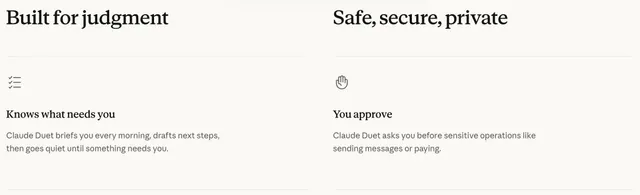
Claude Duet, announced by Anthropic on October 21, is an attempt to close that gap. Its research-preview waitlist starts with US Claude Pro and Max subscribers. It uses Opus 5.5, an existing model, in a product intended to notice work and prepare it without waiting for each new prompt.
The important test is whether that arrangement reduces the attention a person must spend getting a useful result. Duet can earn its place even if a human approves the final action. It can also disappoint while completing many intermediate steps, if the user must repeatedly inspect, correct and restart them.
An Assistant That Chooses When to Interrupt
Anthropic gives Duet a cloud computer and browser, allowing work to continue after the user puts away their devices. Memory and connected apps carry over from the existing Claude account. That makes it possible to hand off a task in a continuing thread rather than rebuild the background every morning.
The product FAQ adds a material constraint: background checks consume the same plan allowance as other Claude work. Larger assignments need more rounds of model work. The launch post describes checks every few hours, with users able to steer what warrants a message. Being available around the clock therefore does not mean observing every new event immediately.
That cadence fits some administrative work better than others. In the hypothetical invoice example, a reminder prepared later in the morning may be entirely useful. A customer problem requiring an immediate response has a different deadline. A person deciding whether to delegate needs to know how long the job can wait before judging whether a missed interruption is a failure.
The allowance also introduces an opportunity cost. An existing subscriber may welcome an assistant included in the plan, but background preparation competes with other work that subscription could support. The relevant comparison is the value of the finished reminder or brief against what the person gives up elsewhere. There is no published universal Duet task count from which to calculate that trade-off in advance.
This is why simply asking for more frequent checks is an incomplete answer to weak proactivity. More checking might catch a useful item earlier. It might also spend allowance finding nothing that changes a decision. The best frequency depends on the consequences of delay and the usefulness of what comes back, not the appeal of an assistant that appears constantly busy.
A Useful Brief Can Still Leave You Waiting
Claire Vo’s October 21 How I AI episode, published in Lenny’s Newsletter, provides a useful first-person counterweight to the launch presentation. Its public description praises the onboarding, task lists, documents and other outputs, and channels, while identifying insufficient nudging, model latency and missing desktop and shared-user support as obstacles in her work. She describes trying inbox and Slack work, a sales pipeline, a presentation and personal ticket finding.
Those are one practitioner’s early impressions, not a measured success rate. Nor does a complaint about a desktop application mean there is no computer access: Anthropic offers Duet on the web as well as in standalone phone apps. The distinction matters for someone whose workday happens in a browser but who wants a dedicated desktop companion.
Vo’s framing exposes two separate demands on an assistant. Work handed off before a meeting can be valuable even if it takes time, provided the result arrives before it is needed. Work done interactively becomes frustrating when the person must remain present through slow exchanges. Identical response times can have very different consequences in those two situations.
Consider the consultancy again. A draft waiting when the owner next checks their phone can remove a chore. A sequence of requests for small clarifications may keep pulling them away from paid client work. Neither the number of messages nor the amount of generated text tells them which experience they are getting.
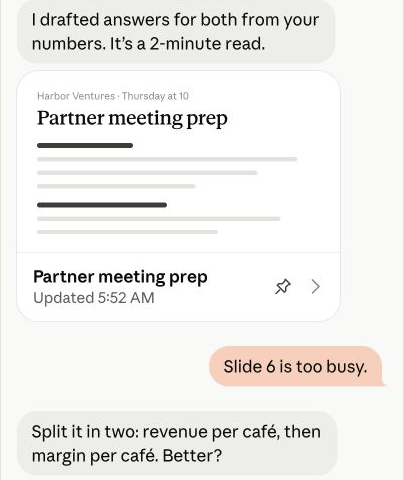
A returned document helps when it makes progress inspectable. A prepared brief is something a person can read and use; a status update saying that preparation continues is a promise of future value. Before delegating, the owner can specify the desired output and deadline, then judge whether Duet returns something usable at that point. This is a practical way to distinguish productive waiting from another unfinished obligation.
The Approval Is Part of the Work
Anthropic says Duet waits for approval before sending messages, paying, signing documents or deleting things. Securities trades and transfers between accounts remain prohibited even with permission. Its launch materials also describe protections for sensitive outgoing information. These are the company’s stated boundaries, rather than independent guarantees that every action will be handled correctly.
For the invoice reminder, preserving approval can be an advantage. The owner retains the decision about whether the relationship calls for a gentle note or a firmer one. The assistant still creates value if it has assembled the right invoice and an appropriate draft, leaving a small, informed choice.
The advantage disappears if the owner has to repeat the whole investigation to trust the proposal. An approval button cannot establish that the invoice is unpaid, that the recipient is right or that the amount matches the account. Those are separate questions a useful handoff should make easier to answer. Otherwise the product has moved the chore into a new interface.
Anthropic’s earlier research on trustworthy agents explains why the surrounding product matters alongside the model. It describes an agent as a system combining intelligence, operating instructions, tools and an environment. A capable model alone does not determine which accounts it can reach or what actions it can take there.
The company’s Claude Code auto-mode engineering article identifies another relevant problem: frequent approval requests can train people to stop reading them carefully. That article concerns a coding product. Its permission rules and evaluation results do not establish Duet’s reliability. Its lesson for this workflow is narrower: review must be meaningful enough to deserve the attention it asks for.
A good invoice handoff would put the proposed action and the information needed to check it together. That is a standard for judging the experience, not a claim that the preview already supplies a complete verification screen for every connected service. The user’s remaining effort belongs in the value calculation. Anthropic also says the preview cannot yet show its own browser. Reviewing a returned document is therefore different from watching all the browser steps that produced it.
Keeping Passwords Hidden Does Not Settle Authority
Anthropic links Duet’s credential handling to its Managed Agents design. In that separate engineering account, credentials are kept away from the environment where generated code runs, with tools mediated through other infrastructure. This can reduce the exposure created by handing raw secrets to an agent.
It does not remove the need to decide what the agent is allowed to accomplish with an authenticated account. A system need not reveal a password to send the wrong message through an already connected service. Secret handling and authority answer different questions: who can obtain the credential, and which actions can be carried out using it?
The distinction is especially important when an assistant reads outside material before acting. Anthropic’s browser-security research describes prompt injection: instructions embedded in content that try to redirect an agent away from the user’s request. A message or webpage can be relevant evidence for a task while remaining an untrusted source of instructions.
That older research is background on a class of risk, not a measured attack rate for Duet. Likewise, the launch’s planned support for saved 1Password logins is still described as coming soon. It should not be treated as a feature every preview user can already use.
For the consultancy, connecting another account should have a concrete purpose. Invoice preparation needs relevant billing information and a way to prepare correspondence. Connecting unrelated systems merely because they are available increases what the owner has to understand before making an informed approval. The useful scope follows the job.
Give It a Job You Can Judge
For someone admitted to the preview, a bounded recurring task offers a clearer trial than asking Duet to run an entire working life. The aim is to find one kind of preparation that remains useful after the owner has checked it. Across a few repetitions, note the account checks still needed, corrections requested, deadlines met and other Claude work displaced. Compare that effort with doing the job directly. If supervision consumes the saving, narrow the assignment or stop that trial.
| Proposed job | What would make the trial useful? |
|---|---|
| A daily unpaid-invoice review | Correct accounts and draft reminders, with little repeat investigation. |
| Preparation for tomorrow’s meeting | A usable brief delivered before the preparation deadline. |
| Spotting a time-critical customer issue | A checking cadence that actually meets the required response window. |
| A contract or payment handoff | A precise proposal the responsible person can confidently inspect before acting. |
These are evaluation criteria, not tasks TechReadly has tested in Duet. The product remains a waitlisted research preview; Team and Enterprise plans are excluded for now. An individual subscription should not be mistaken for a shared operating process in which several employees have clear review responsibilities.
The strongest case for Duet does not require it to handle everything. Anthropic’s launch includes a company-selected tester account in which an upcoming client call conflicted with a flight and the assistant offered to move it. One important catch like that could justify many uneventful checks. A professional may reasonably value preventing a costly oversight more than producing a large volume of routine drafts.
That positive case sets a more useful bar than either total autonomy or constant activity. If Duet prepares the consultancy’s reminder, catches an awkward meeting conflict and leaves the owner with a few informed decisions, it has reduced work. If it leaves the owner checking the same accounts while also supervising another conversation, its background activity has yet to earn a continuing role.