
For years, knowledge workers have engaged in an awkward, multi-tab ritual. We query an AI chat window for an outline, paste the prose into an empty document canvas, spend fifteen minutes stripping out stubborn markdown formatting, and manually assemble a slide deck to report what the model suggested. The chatbot was treated as an external brainstorm partner, while Microsoft 365 or Google Workspace served as the system of record where actual corporate decisions were formalized and filed.
With the launch of Claude Docs and Claude Slides in beta, Anthropic is trying to erase the seam between generating an idea and storing the artifact. As Ina Fried framed it for Axios, the debut directly raises the stakes for Microsoft by blurring the line between an intelligent conversational assistant and a traditional workplace productivity suite.
Yet looking at the release through the lens of enterprise procurement reveals a deeper operational question. Does folding document and presentation surfaces into Claude transform Anthropic into an enterprise office-suite competitor, or does it merely provide a more polite staging ground for model output before files are exported to the legacy tools where corporate work actually lives?
The strategic threat to incumbent suites is real, but it does not come from a prettier canvas. It comes from putting the conversation, the agent run, and the deliverable in one place. I can imagine doing more of my thinking there. I cannot yet imagine a compliance team treating that same space as the final system of record.
Collapsing the Canvas
The structural shift began on September 16, 2026, when Anthropic announced that its specialized workspace product, Claude Cowork, would merge directly with standard conversational chat into a unified Claude experience. Alongside this unification, the company rolled out Claude Docs and Claude Slides in beta for paid tiers, while integrating its Claude Design capabilities directly inside standard conversation threads.
Anthropic is betting that users should not have to decide whether a problem belongs in chat, an agent, or a document editor before they begin. In the merged interface, users can draft text, collaborate, build and present slides, then export the result to Microsoft Word, PowerPoint, PDF, or Google Docs where supported.
| Feature Area | Legacy Chat Experience | Unified Claude Beta (Announced 2026-09-16) |
|---|---|---|
| Primary Surface | Linear conversational stream | Unified chat, document canvas, and presentation view |
| Artifact Handling | Ephemeral code blocks and text snippets | Persistent Claude Docs and Claude Slides (Beta) |
| System Division | Manual triage across Chat, Cowork, and Design | Consolidated single context retaining skills and connectors |
| Long-Running Work | Session terminates on tab closure | Background execution intended to proceed after closing client |
| Export Paths | Raw clipboard copy-paste | Native export to Word, PowerPoint, PDF, and Google Docs |
| Administrative Posture | Standard workspace enablement | Controlled enablement; 30 days' advance notice for Enterprise |
According to Anthropic's release disclosures, documents are configured by default to start private, with manual sharing options available for designated individuals or broader organizational directories. Connectors, background skills, custom projects, and generated artifacts are designed to persist inside the same operational context. Most ambitiously, the company describes scheduled and long-running workflows capable of executing behind the scenes after a user closes their laptop lid.
The rollout is deliberately slow. Access began on web, desktop, and mobile for individual Pro and Max subscribers, with Team and Free tiers left for later. Anthropic also promised enterprise administrators at least 30 days of notice before the interface changes, along with switches for enabling Claude Docs, Slides, and Design inside their organizations.
The Context Advantage
To understand why this product posture catches Microsoft's attention, consider how files are actually assembled inside corporate bureaucracies.
In standard enterprise workflows, documents are static graves for dynamic thinking. An analyst reviews five spreadsheets, questions a database, debates strategic priorities inside an internal messaging thread, and pastes the synthetic conclusion into a static corporate template. The minute that document is saved, the underlying context evaporates. Readers see the verdict, but the breadcrumbs—the rejected counterarguments, the specific data pulls, and the prompt iterations that refined the prose—are entirely detached from the file.
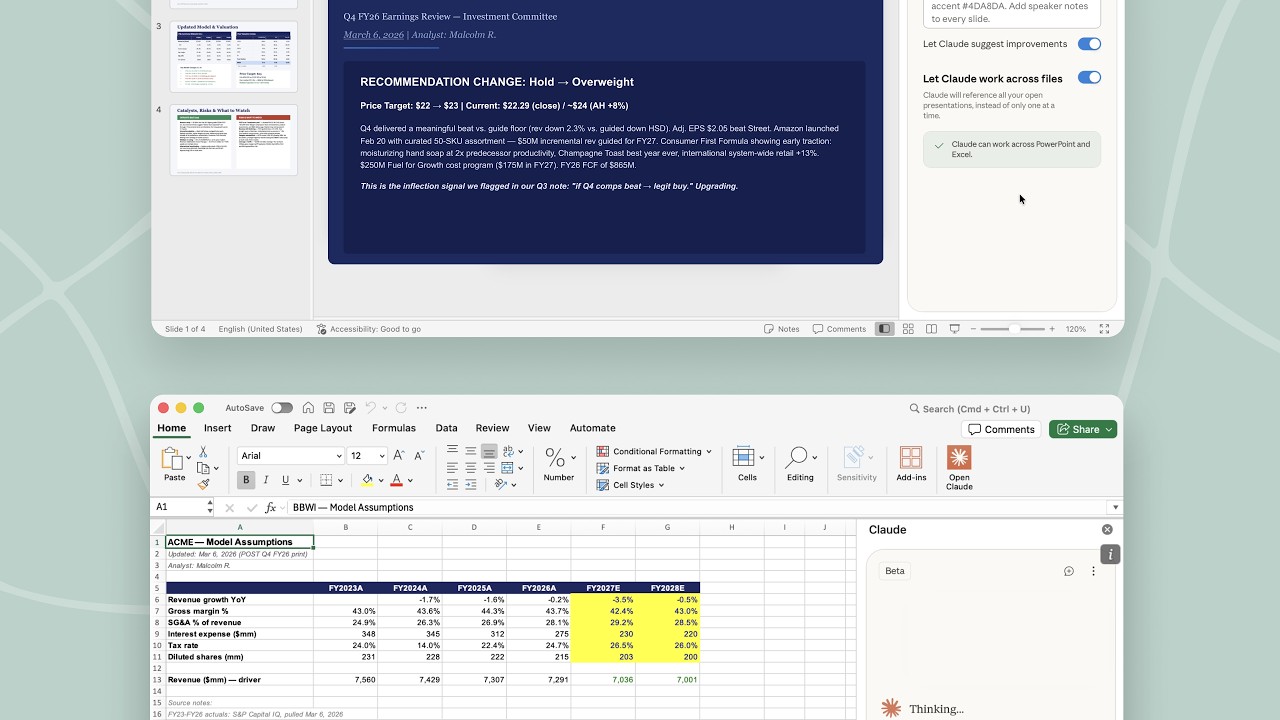
Microsoft and Google have mostly added AI as a sidecar to the familiar file. The document remains the master container; the assistant sits in a narrow sidebar, reads whatever is in reach, and answers a local prompt.
Anthropic's architectural reorganization flips that dynamic entirely. The operational context—comprising connectors to company repositories, system skills, prompt histories, and dynamic model runs—is the primary environment. The document is simply a functional byproduct of the cognitive session. Because the conversation, the background agent run, and the artifact live inside the identical boundary, the model does not need to be repeatedly re-briefed on what it just wrote.
If a project brief shifts, the user can return to the environment that authored it and ask Claude to revise the work with its connectors and previous drafts still in view. Anthropic also says long-running work can continue after the laptop closes. In that model, the deliverable is no longer just a stack of styled paragraphs; it is the visible output of an ongoing work session.
Where Office Suites Actually Live
It is tempting to see a fluid canvas producing formatted slides and declare the desktop suite obsolete. That gets the reason companies pay for Microsoft 365 wrong.
An office suite is not primarily an editor. It is an intricate, institutional operating system engineered around compliance, risk mitigation, and systemic compatibility. The visible interface—the ribbon, the margins, the slide templates—is merely the thin user-facing veneer over decades of organizational infrastructure.
Consider the baseline requirements an enterprise IT buyer evaluates before designating an application as an authentic system of record:
- File Compatibility: Flawless round-trip preservation of legacy enterprise templates, deeply nested spreadsheet formulas, dynamic charts, and strict typography without rendering degradation upon export.
- Identity and Access Governance: Granular administrative controls capable of enforcing access restrictions down to specific document sections, linked objects, and regional tenant boundaries.
- Audit Trails and Discovery: Legally defensible revision histories, compliance holds, e-discovery indexing, and logs showing who viewed, edited, or extracted company data.
- Extensible Interoperability: Deep support for third-party add-ins, offline reading and editing parity, and open participation paths for external partners who do not possess a subscription to the host platform.
None of these capabilities are trivial, and the initial Claude Docs materials do not establish parity with them. Anthropic can export text and slides into Word, PowerPoint, PDF, and Google Docs, but that export button gives away the current hierarchy. When work crosses a legal boundary, needs executive sign-off, or must be kept for a regulator, it still leaves Claude for a traditional container.
There is another problem: folding the agent run into the document can make provenance harder to see. When the text depends on automated prompts, external connectors, and non-deterministic model steps, a polished paragraph can hide a messy chain of custody. If an executive asks why a metric changed in a regulatory filing, the company cannot point to an uninspected background run. It needs source citations, checkable math, and an audit trail.
Staged Deployments and Enterprise Reality
Anthropic’s cautious rollout schedule reflects an acute awareness of these institutional sensitivities. Enterprise software buyers do not tolerate surprise interface migrations that disrupt daily work or expose proprietary project channels without warning.
By instituting an explicit 30-day notice period for Enterprise administrators alongside tenant-level feature enablement toggles, Anthropic is trying to prevent the friction that often accompanies consumer-focused AI rollouts. This administrative safety buffer provides security officers the time needed to review data egress through connectors, evaluate user sharing scopes, and determine whether Claude Docs meets corporate data retention standards.
Limiting the initial release to Pro and Max tiers also gives Anthropic a test track. Individual power users and small professional accounts tolerate beta quirks and export errors better than heavily audited procurement teams. Holding back Team and Free tiers, while giving enterprise domains an opt-out, is a reminder that Anthropic is still running a product experiment rather than shipping a finished enterprise utility.
The central trade-off of this phase centers on ecosystem participation. In a standard corporate project, documents are circulated among cross-functional stakeholders: product managers, compliance attorneys, external vendors, and executive approvers. If reviewing, annotating, or modifying a Claude Doc mandates an active paid Claude seat within a matching organization, friction accumulates instantly. The moment a collaborator cannot access the workspace, a team member will inevitably click "Export to Word," and the entire conversational context Anthropic fought to capture is severed.
A Better Workbench Is Not Yet a Filing Cabinet
Does Claude Docs turn Anthropic into an office-suite vendor, or does it merely provide the chatbot a more capable workspace to wrap up its thinking?
For the foreseeable enterprise purchasing cycle, the realistic answer is the latter. Claude Docs does not displace the institutional systems of record that anchor corporate IT portfolios. It serves as an expressive, unified workbench—a substantially more efficient scratchpad where complex analysis, agent runs, and raw drafts converge into structured artifacts without forcing the user to juggle disparate windows.
Yet dismissing this release as a simple interface upgrade understates Anthropic's trajectory. The historic moat protecting legacy office suites was the immense friction of leaving them. Users remained inside legacy word processors because drafting elsewhere incurred a severe productivity penalty.
Anthropic is methodically reversing that friction. By consolidating chat, tool execution, and artifact design into a single pane, it offers an environment where initial creation, synthesis, and iteration happen faster and with greater situational awareness than a blank desktop canvas can provide. If Claude can reliably orchestrate background jobs, synthesize cross-repository data, and assemble publication-ready briefs, knowledge workers will spend their working hours inside Claude and treat legacy office tools as passive distribution pipes.
The genuine competitive threat to incumbents does not require Anthropic to out-build Microsoft at spreadsheet macros or enterprise records retention. It merely requires Anthropic to make its workspace the surface where actual thought, decision-making, and iteration occur.
Whether Anthropic can move beyond an excellent drafting bench depends on the unglamorous enterprise work it does next. The useful signals will not be flashier presentation formats. Watch for better audit logs, round-trip exports that do not break, co-authoring that works for people without Claude seats, and policy controls a skeptical security chief can live with. Until then, Claude Docs is a powerful place to build the future of work—right before exporting it back to the past.