
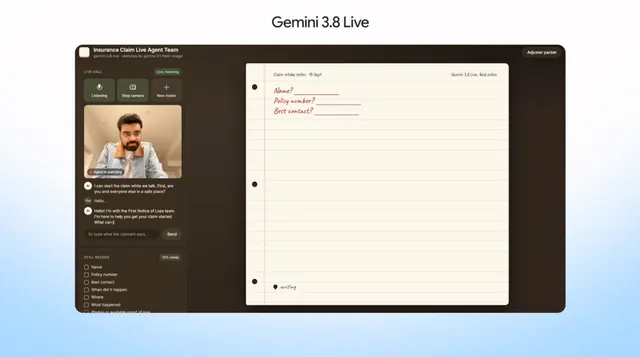
The September 24 launch adds generated video to Gemini 3.8 Live, Google’s real-time dialogue system. That is a product change, but the harder buyer question is whether seeing an animated speaker helps a customer complete a task. Google describes use cases and publishes a serving-capacity example. The materials reviewed here do not show a controlled comparison of avatar and audio-only service outcomes.
My standard is straightforward: a generated face should earn its place through measurable improvement on a defined task, and the company deploying it must remain clearly accountable for the agent’s decisions. Google’s quota guide shows that video changes capacity planning. Research on anthropomorphic AI suggests trust and blame are worth measuring, but it does not establish how Live Avatar affects either.
What Google’s capacity guide actually says
The Live Avatar product combines the Gemini 3.8 Live dialogue model with generated video synchronized to speech. Google says the system can show preset personas, process visual input alongside audio, and make asynchronous tool calls while conversation continues. Custom avatars made from a reference image require enterprise allowlisting. These are capability and access descriptions from Google, not an independent latency or reliability evaluation.
Google DeepMind’s model card says Gemini 3.8 Audio is based on Gemini 3 Pro. It lists audio, image, video and text inputs, up to 128,000 tokens of context, and audio and text outputs up to 64,000 tokens for the Live models. The model card describes the base audio models; the product announcement describes Live Avatar as a visual layer on Gemini Live. The distinction matters because the video capacity figures appear in a separate Cloud serving guide.
For Google Cloud’s Provisioned Throughput route, the documentation sets a specific threshold: at least 10 Generative Processing Units (GSUs) must be purchased for provisioned capacity to process video-avatar requests. Below that threshold, an avatar session spills to PayGo. This requirement applies to that capacity route; it is not a minimum for every form of access.
The same guide explains why a simple per-turn estimate can mislead: Provisioned Throughput counts new input and output alongside accumulated session memory. The memory grows across turns until the configured limit, while generated avatar-video output is excluded from that stored context.
To illustrate how capacity scales, Google Cloud published a worked baseline calculation representing 10 concurrent five-minute sessions, each spanning 30 conversational turns with a 6,000-token session context trigger. In this scenario, turns include 20 text tokens, 200 audio tokens, and 50 image or video tokens on input, against 100 text tokens and 200 audio tokens on output. When avatar generation is enabled, the model factors in a fixed burn of 6,192 output avatar tokens for every 25 output audio tokens, applying a dedicated video avatar burndown rate.
Under those assumptions, Google calculates 69 GSUs for the workload. Avatar video is the largest listed per-turn quota component. Its output tokens are excluded from stored session context, but still count in the quota calculation. This is a capacity estimate for one stated traffic shape, not a dollar cost, universal minimum, or completed-task benchmark.
Capacity is not a dollar bill
The public Gemini API price card and the Cloud quota example describe different things. The first lists token or minute rates for Live inputs and audio output; the second estimates Provisioned Throughput capacity for an assumed workload. They should not be combined into a dollar estimate without the applicable Cloud pricing, region, commitment and deployment details.
On Google’s developer API rate sheet for the Gemini Live API, published rates reflect raw modal consumption: $0.75 per million text input tokens, $3.00 per million audio input tokens (or $0.005 per minute), and $1.00 per million vision input tokens (or $0.002 per minute). On output, text costs $4.50 per million tokens, while output audio is priced at $12.00 per million tokens (or $0.018 per minute). Crucially, the public developer price card for Gemini Live does not list a dedicated per-token or per-minute rate for Live Avatar video output.
The API price table reviewed here does not list a separate Live Avatar video-output rate. That omission does not mean video output is free. Buyers need a complete quote for their chosen service path, then should compare total cost per successful resolution rather than infer task economics from a token rate or quota figure alone.
The underlying Live API has its own cost dynamics: Google says Gemini 3.8 Live continuously charges for incoming audio while it listens, and accumulated context can increase per-turn processing unless compressed. Those costs apply to the voice session too. The avatar-specific addition shown in the Cloud guide is output-video quota; the guide does not translate that quota into a universal dollar surcharge.
The right comparison holds the agent and task steady, changing only whether video is present. If the avatar does not improve completion, comprehension or handoff enough to offset its additional serving requirements, it adds cost without a demonstrated service benefit. Google’s published capacity example helps estimate one workload; an enterprise still needs its own workload, price and success data.
Trust and responsibility are part of the test
A face can affect how people read an interaction, but neither the product demonstration nor the research answers whether Live Avatar helps a customer complete a service task.
A 2026 study by Victoria Oldemburgo de Mello, Jason Plaks and Michael Inzlicht in *Collabra: Psychology* gives buyers a reason to measure more than satisfaction. In the first experiment, 309 participants who remained after exclusions interacted with an LLM whose conversational behavior varied in anthropomorphic cues. The researchers reported a small difference in a behavioral trust game (d = 0.22), alongside changes in self-reported trust. The study tested conversational behavior, not generated video or Gemini Live Avatar.
In a second study, participants read descriptions of an AI home assistant across positive and negative scenarios. Higher anthropomorphism increased blame assigned to the AI. Across individual participants, blame assigned to the AI and its creator was negatively correlated (r = −0.68). The authors stress that the experimental manipulation did not produce a groupwide reduction in company blame; the association largely reflected individual differences. That is a reason to retain clear responsibility in product design, not proof that a video face shifts blame in the same way.
That distinction changes the practical question. The study is not evidence that a live face will make users accept bad advice or shift blame in a service interaction. It is a reason to test whether users understand the system’s limits, whether they can tell when it is uncertain, and whether they continue to hold the deploying company responsible when an answer is wrong.
Pontes and Thaichon’s 2023 experiments likewise found that avatar appearance and anthropomorphic language could interact with perceived competence, authenticity and brand credibility in e-commerce chatbot scenarios. Those tests used static scenarios. Both papers therefore suggest what an enterprise might measure, but neither supplies a performance result for Google’s real-time product.
Identity controls do not settle disclosure
Google’s release includes two visible safeguards: custom avatars are allowlisted, and Google says generated audio and video contain SynthID watermarks. Custom avatars made from reference images require enterprise approval; other enterprise users can choose from preset characters. The public descriptions reviewed do not detail the verification process enough to assess it independently, and they do not establish what disclosure a customer sees during an interaction.
Google describes SynthID as an imperceptible watermark woven into audio and video output. That is a company description of its provenance tool, not proof that it survives every screen capture, crop, transcode or repost. Nor does an imperceptible marker by itself tell a customer in the moment that an agent is synthetic.
Enterprises still need an interaction-level disclosure, identity and consent rules, and a clear route to a human when the agent cannot resolve a request. Those controls address decisions that a watermark cannot: what the customer is told, who may approve a likeness, how errors are escalated, and which company owns the outcome.
Google’s model card lists hallucinations, occasional slowness or timeouts, and ongoing work to improve jailbreak resistance. It says the audio variants’ safety assessment relies on Gemini 3.7 Flash evaluations and reports no meaningful new capabilities or material performance increase over that model. These are vendor assessments of the model family, not avatar-specific reliability or safety tests. Google also claims lip-sync and facial expression across 97 languages. The research reviewed here does not show whether that presentation makes errors harder to detect, so that effect belongs in a deployment evaluation rather than in the article’s factual claims.
How to tell whether the avatar helps
Google’s public release and model materials describe capabilities, but the sources reviewed do not isolate how much an avatar changes task outcomes. That leaves an empirical question for buyers and for future independent evaluation.
The cleanest initial comparison is the same Gemini 3.8 Live agent with and without video, on the same tasks and user population. A baseline against an older form or unrelated chatbot would confound the value of the face with differences in model and workflow.
A useful test would log the actual serving route and full cost, including context, concurrency and any spillover, then divide it by verified task completions. It should also compare first-contact resolution and handoff quality, time to completion, and whether customers understood important instructions. For a visual task such as an interactive walkthrough, comprehension may matter more than a broad satisfaction score; for a routine question, the face may add little. These are evaluation choices to run, not benefits established by the launch.
What Would Make the Face Worthwhile
The public evidence supports neither a broad endorsement nor a blanket rejection of Live Avatar. Google has described a generally available enterprise feature and published a capacity example in which video output materially shapes the provisioned-quota estimate. It has not published a controlled measure of the avatar’s added effect on task completion, comprehension, trust or cost per resolution in the materials reviewed here.
The accountability research adds a reason to design the evaluation carefully, while its different stimuli limit what it can tell us about this product. The face should be tested as an interface choice: compare like-for-like tasks with audio-only and video, keep the agent and workflow constant, and measure whether the second condition improves an outcome people need. Record the full serving cost and make sure the customer knows when they are interacting with AI and who is responsible for the result.
That is a practical threshold for adoption. A face earns its compute when it helps with a task that benefits from visual presence, improves a verifiable outcome, and does so at a cost and accountability standard the enterprise can defend. Until then, the strongest conclusion is narrower: Live Avatar is available, its infrastructure consequences are documentable, and its incremental service value still needs to be measured.