
When OpenAI introduced the Agents API in public beta on September 10, 2026, the marketing pitch promised a familiar cloud transition: turn the bespoke, fragile scaffolding that wraps an LLM into an API call. In first-party documentation, OpenAI positions the service as exposing the same managed harness and infrastructure that powers Codex. It takes over session state, task orchestration, context compaction, crash recovery, and delegation between subagents.
To teams that have spent the past eighteen months hand-crafting state machines, parsing truncated tool calls, and nursing flaky Docker wrappers, this shift looks immediately appealing. Yet the phrase "managed agent" risks obscuring the boundary between plumbing and product intent.
The critical question for platform engineers is simple: What work actually disappears when OpenAI operates your harness, and what work stays behind?
OpenAI is renting out the loop, not the outcome. The mechanical overhead of running multi-turn loops moves to OpenAI's servers, but three foundational engineering obligations remain on your side: defining what counts as a finished task, setting the security boundaries within which tools can execute, and verifying that the final output matches real-world requirements. You can buy the state machine, but you cannot outsource accountability for what the state machine does.
What an Agent Harness Actually Does
In plain English, an agent harness is the runtime engine wrapped around an AI model to keep it working through a multi-step task.
A raw language model possesses no persistent memory and cannot execute software. It simply accepts tokens and generates tokens. If a task requires several steps—such as cloning a repository, inspecting a log file, editing code, running test suites, and handling error traces—something outside the model must manage that lifecycle.
That outside software is the harness. Historically, an engineering team had to build and maintain several interlocking components to create this loop:
First, the harness acts as the state manager. It records the interaction history across dozens of turns, persisting session tokens so that transient network interruptions do not terminate an hours-long job.
Second, it controls context compaction. Because models operate within finite context windows and charge for every input token processed, a harness must prune, truncate, or summarize previous tool responses when the prompt nears saturation limits, all without discarding critical instructions or environmental variables.
Third, it provides an execution runtime. The harness captures the model's structured tool calls, routes them to a local container or remote shell, captures standard output and standard error, and feeds those strings back to the model as the next prompt.
Fourth, it governs recovery and control flow. If a command hangs, times out, or returns a non-zero exit status, the harness decides whether to inject an error prompt, trigger an automated retry, or spin up a specialized subagent to investigate the blockage.
Writing a basic while-loop that executes a tool call takes an afternoon. Making that loop resilient against memory exhaustion, silent tool failures, context bloat, and orphaned processes is an ongoing infrastructure chore. In its documentation, OpenAI states that the Agents API abstracts these duties. Developers pass instructions and tool definitions, select an execution environment, and let OpenAI coordinate the runtime cycle.
Inside the Model Layer and Upstream Execution
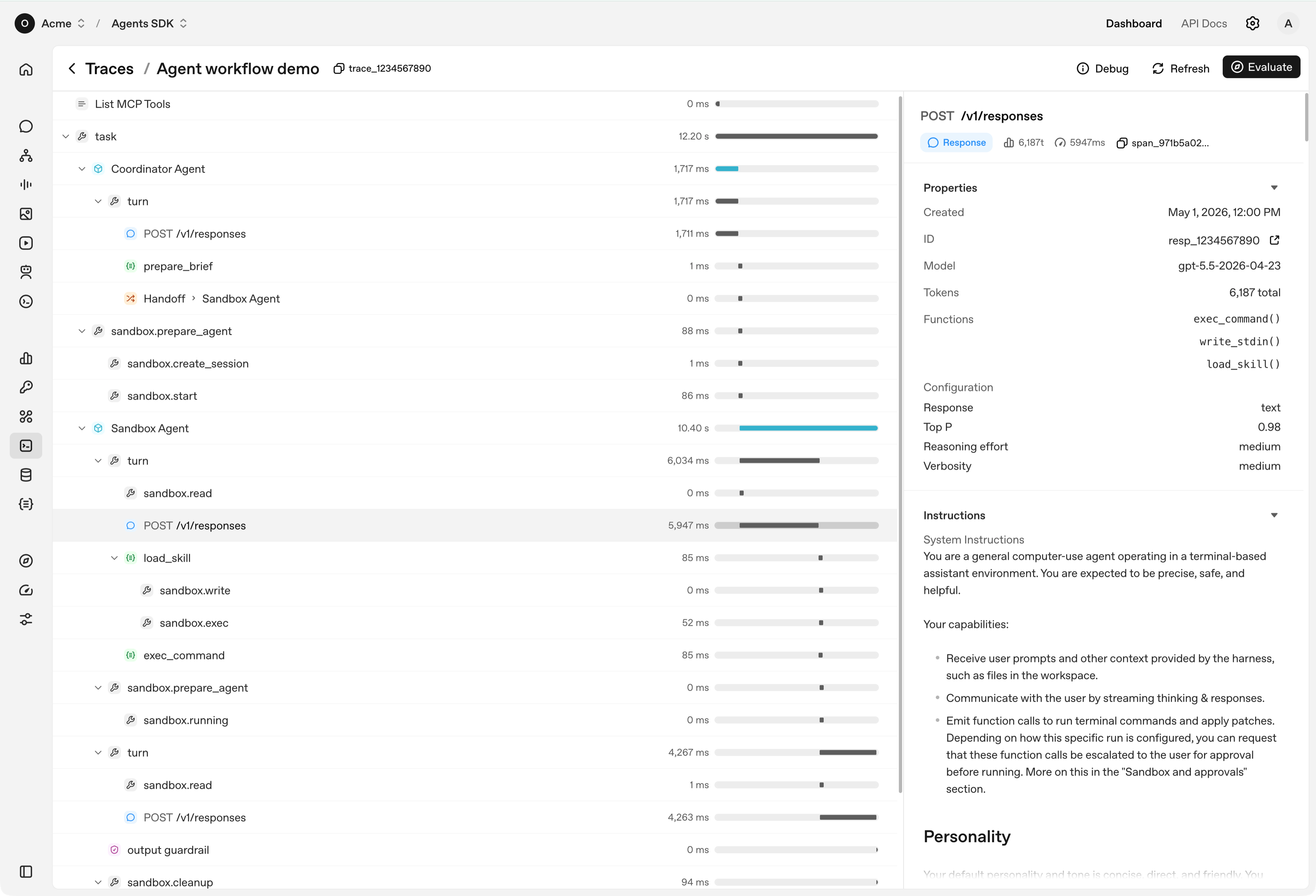
Under the Agents API architecture, developers supply system directives and tool configurations, then select where the actions take place. OpenAI offers three execution targets: an OpenAI-hosted sandbox, a partner sandbox, or the developer's self-hosted infrastructure.
When teams opt for OpenAI-hosted sandboxes, the cloud provider absorbs the orchestration burden, but with specific operational semantics:
OpenAI charges no separate base subscription fee for the Agents API itself. Instead, costs accrue through standard model token calls, individual tool triggers, and metered hosted-container execution. Launch documentation specifies that OpenAI-hosted containers are billed by compute tier and time, subject to a five-minute billing minimum.
This billing structure shifts how engineering leaders must calculate the economics of agent deployment. In a conventional API call, token volume dictates expense. Within a hosted harness, runtime duration introduces an orthogonal cost vector.
In an analysis of the release, Bill Cava of Generative Labs pointed out that container charges can appear mathematically negligible next to a premier frontier reasoning model running an intensive job, yet rapidly dominate the overall invoice if an organization routes simple, high-frequency workflows through a low-cost, lightweight model. A lightweight task taking thirty seconds of compute inside a container with a five-minute billing floor immediately alters the cost-per-task equation.
The way a vendor harness compacts context also changes the bill. In an independent, 300-trial study examining three execution harnesses across two models on a 50-task slice of Terminal-Bench Pro, researchers Naman Vats and Oleg Golev showed how sensitive agent operating costs are to harness logic.
The study found that overall task completion stayed within a relatively narrow bracket, while token cost per solved task varied dramatically. In its extreme MiniMax comparison, Goose used 28,142 tokens per solved task and OpenCode used 1,546,977—roughly 40 times more.
This finding cannot be applied directly as a metric against OpenAI's specific API implementation, particularly since the Vats and Golev study reflects a narrow benchmark slice, divergent internal accounting schemes, and research conducted by authors involved in agent infrastructure design.
The study is still enough to show that compaction, retry loops, and prompt handling can radically change the bill. With a managed API, teams also surrender direct control over those choices.
The Downstream Chain: The Three Jobs You Keep
Delegating operational plumbing does not absolve developers of application architecture. In his assessment of the launch, Cava argued that offloading runtime orchestration leaves builders with three irreducible responsibilities:
- Defining Done: An agentic harness will happily cycle through subagents and bash commands until it exhausts its token limits or hits a loop ceiling unless the caller supplies explicit, machine-testable acceptance criteria. A model cannot inherently determine whether a code refactor satisfies business requirements or merely silenced an immediate linter error. Developers must construct the unit tests, integration benchmarks, and evaluation assertions that signal to the harness that the task is finished.
- Enforcing the Fence: OpenAI provides network security switches for its hosted environments—specifically offering modes where outbound access is enabled, disabled, or restricted to an allowlist of specific network hosts. However, configuring those restrictions and determining tool permissions remains an external security mandate. Independent security researcher Simon Willison observed that the trustworthiness of automated network fences remains an open operational question across the industry, given recent historical security incidents involving agentic sandboxes escaping bounded contexts. If an agent with database-write capabilities operates in an environment with unmonitored egress, the developer—not the harness host—remains liable for downstream state corruption or credential leakage.
- Checking the Work: A managed harness produces an answer, but it cannot guarantee the validity of the work product. OpenAI's API coordinates execution; it does not vouch for truthfulness, logic integrity, or security posture. Downstream verification—validating that generated output adheres to company data formats, compliance regimes, and architectural principles—remains anchored outside the vendor loop.
Beyond these application duties, technical teams evaluate the Agents API amid concrete operational constraints. At the launch snapshot date of September 21, 2026, the service remains in public beta. TechReadly's release record indicates that zero data retention (ZDR) is not supported in the initial beta release. For enterprises bound by strict regulatory, patient, or client confidentiality standards, deploying proprietary source code or production database credentials to a managed environment without zero-data-retention guarantees is an immediate operational barrier.
Platform Leverage and Infrastructure Trade-offs
The emergence of a managed harness shifts leverage across the modern enterprise AI stack.
Infrastructure providers and developer tooling startups that built businesses selling raw agent wrappers, state-machine packages, or primitive container orchestrators face severe commoditization. If basic execution, subagent handoffs, and session continuity can be bought as a turnkey service from the model vendor with no platform markup fee, assembling custom open-source glue becomes harder to justify.
Conversely, developer value moves decisively toward the verification and observability layer. Organizations do not struggle because they cannot script an agent loop; they struggle because they cannot audit an agent's failure modes.
When evaluating whether to adopt the Agents API or retain an internally managed harness, technology leaders should measure their workloads against concrete operational criteria:
First, examine trace exportability. Can your platform extract granular, step-level traces of every prompt, compaction decision, bash execution, and raw response, or are those traces locked inside vendor dashboards?
Second, assess session recovery and isolation semantics. If a container crashes mid-task, how cleanly are environment variables, file artifacts, and partial outputs preserved?
Third, evaluate permission receipts and compliance controls. Does the harness generate auditable, cryptographically verifiable logs documenting every outbound tool call and user authorization check before state changes occur?
Fourth, measure pricing predictability. Because OpenAI-hosted execution introduces container time metrics alongside token usage, batch workloads with high container idle times may incur sudden cost expansion compared to locally managed serverless runtimes.
| Capability Layer | OpenAI Managed Harness | Self-Hosted / Internal Harness |
|---|---|---|
| Session & State Management | Managed automatically by OpenAI backend | Requires custom databases, redis locks, and state-machine code |
| Context Compaction | Proprietary algorithm abstracted behind API | Fully configurable; custom summarization and pruning logic |
| Execution Environment | Hosted sandboxes (5-min minimum), partner sandboxes, or BYO | Fully controlled internal containers, VMs, or serverless pods |
| Network Governance | Enabled, disabled, or host-allowlist modes | Tailored corporate VPC firewalls, mTLS, and internal proxy layers |
| Data Retention | Public beta; no Zero Data Retention (ZDR) at launch | Governed entirely by internal data governance policies |
| Pricing Components | Model tokens + tool calls + container compute tiers | Model tokens + internal compute/cloud hosting baseline |
Buy the Loop, Own the Ledger
Faced with the build-versus-buy fork for agentic infrastructure, my operational judgment is clear: I would rent the loop before I would rebuild it, but I would not let the same vendor's runtime, model, and dashboard become the only record of why an agent acted.
Reinventing context compaction routines, subagent messaging bridges, and container reconnects is low-margin undifferentiated engineering. If an engineering group spends half its sprint cycles debugging why a background bash process lost connection to a local orchestration loop, renting OpenAI's harness instantly frees up platform capacity.
However, full-stack surrender is dangerous. If you execute actions via OpenAI's models, manage state inside OpenAI's closed harness, run bash commands within OpenAI's sandboxes, and inspect the outcomes exclusively via OpenAI's trace views, you have created a severe operational dependency. You forfeit independent visibility into context degradation, accept uninspected compaction algorithms that silently reshape your system prompts, and tether your company's core automation processes to an environment without zero-data-retention guarantees.
Platform leaders should approach the Agents API pragmatically: leverage OpenAI's managed runtime as an ephemeral execution engine, but maintain strict external ownership of your tool authorization policies, your integration test harnesses, and an independent telemetry store that logs every agent action.
What would change this assessment? Two future signals would shift my recommendation: First, if OpenAI introduces verifiable zero data retention and fine-grained, external trace streaming, the compliance argument against hosted adoption evaporates for regulated enterprises. Second, if real-world enterprise deployments reveal that closed-box context compaction systematically drives up token consumption compared to transparent open-source compaction frameworks, the economic penalty will mandate building and maintaining custom harnesses regardless of developer convenience.
Until then, treat the Agents API for what it is: a capable, outsourced engine room that still demands an experienced captain on deck.