
A product manager leans into a laptop microphone at 10:43 on a Thursday morning and tosses out an offhand thought: "We could probably deprecate the old CSV exporter if the analytics dashboard ships before November." Three people nod on mute. One engineer types a thumbs-up into the video call chat. Nobody takes a formal minute, and nobody files a ticket before the call ends.
In an organization running on human memory, that remark usually dissipates harmlessly until someone raises it again at an engineering review. But in an organization instrumented with autonomous workplace agents, that same sentence is volatile fuel. If an orchestration layer reads a raw transcript without understanding conversational weight, it might schedule a deprecation notice, alert customer support, or draft a release email to five hundred enterprise tenants.
The dangerous failure mode for enterprise artificial intelligence is rarely an ungrammatical summary. The dangerous failure mode is a grammatically flawless, highly proactive follow-up built entirely upon something nobody in the room actually agreed to do.
That tension sits at the center of Superhuman’s decision to acquire the AI meeting recorder Fathom. When TechCrunch reported the deal on September 14, 2026, the surface narrative looked like familiar software consolidation: an email-first productivity suite buying a standalone meeting bot to round out its portfolio. Yet the underlying mechanics tell a different story. Superhuman did not buy Fathom simply because its engineers could not connect an automatic speech recognition API to a large language model. It bought an established, conversational ingestion layer because workplace agents cannot initiate meaningful work without real-world context—and acquiring that context requires an entire stack of ingestion, speaker attribution, and verification plumbing that standalone tools have spent years tuning.
The Ingestion Bottleneck: Why Audio Resists the Prompt Wrapper
On paper, an AI meeting notetaker looks like an afternoon project for a capable platform team. You take an audio stream from Zoom, Google Meet, or Microsoft Teams, pipe it into a modern transcription engine, pass the transcript to a reasoning model with a prompt instructing it to extract action items, and post the output to Slack or an inbox.
Superhuman itself tried that path. According to reporting by Ivan Mehta in TechCrunch, Superhuman tested an internal meeting-notetaker product before deciding to acquire Fathom instead. Superhuman Chief Executive Officer Shishir Mehrotra acknowledged that building an effective meeting notetaker was technically deeper than it appeared from the outside.
The technical depth Mehrotra referenced is not found in the baseline language model. It resides in the upstream ingestion pipeline. To understand why, one must look at the structural difference between written enterprise data and spoken enterprise audio:
| Data Surface | Input Fidelity | Provenance Mechanism | Default Decision State |
|---|---|---|---|
| Email Thread | High; explicitly addressed senders and recipients | Explicit RFC-compliant headers; verifiable message IDs | Formalized; sent text represents an authored statement |
| Shared Document | High; structured paragraphs and inline diffs | Version history; granular user attribution per block | Semi-formal; published edits indicate proposed or settled text |
| Meeting Audio | Low to Variable; background noise, overlapping speech | Acoustic diarization; bot presence; visual call hints | Fluid; mix of speculation, social banter, and binding commitments |
Raw speech is messy. People interrupt one another, speak in half-sentences, change their minds mid-phrase, and use vocal inflection to signal sarcasm, doubt, or absolute certainty. An off-the-shelf transcription model operating without extensive acoustic and contextual post-processing frequently mangles speaker diarization—the technical task of determining exactly who spoke which phoneme at which second.
If an assistant misattributes a sentence in an internal meeting note, a human reader might brush it off as a clerical error. But if an agent builder is designed to parse that transcript and trigger an external API call, misattributing a speaker becomes an operational defect. If an intern says, "Let's give them a 20 percent discount," and the software attributes the quote to the Vice President of Sales, an automated billing agent might act on an unapproved concession.
Fathom, launched in 2020, had accumulated more than $30 million in venture funding and secured a valuation of $94 million in 2024, according to PitchBook data cited by TechCrunch. It reported more than 400,000 monthly active users and claimed over 1 million people had recorded calls on its platform. Those figures show that Fathom had found a repeatable use case. They do not tell us how accurate its transcripts or action items are.
Superhuman opted to purchase an operating ingestion engine rather than spend quarters chasing edge cases in audio capture, real-time platform compliance, and speaker labeling. They bought an established sensory organ for their platform.
The Agentic Core: Context as Operational Fuel
Superhuman’s platform spans email, documents, calendars, databases, and an agent-builder environment. Its next bet is that software should not wait for a fresh prompt; it should notice an event, assemble the next piece of work, and stage it for review.
To initiate work without a prompt, however, an agent requires context. And in most enterprises, the highest-density context does not originate in an email thread. Email is where agreements are formalized or disputed; the calendar is where work is blocked out; databases are where outcomes are logged. But the actual moment of decision—the debate that settles a scope reduction, the verbal handshake on a deadline, the explicit refusal of a vendor's terms—happens inside a live meeting.
Consider an ordinary project kickoff. Over the course of forty-five minutes, five people discuss six prospective features. They discard three, defer two, and commit to one. If an AI agent only has access to the team's email history and shared documents, it remains blind to the rationale that narrowed those choices. The user must manually bridge the gap by typing a context-setting prompt: "We decided on Call A to drop Feature X; please draft an update to the engineering leads."
If the agent platform controls the meeting recorder, the workflow changes structurally:
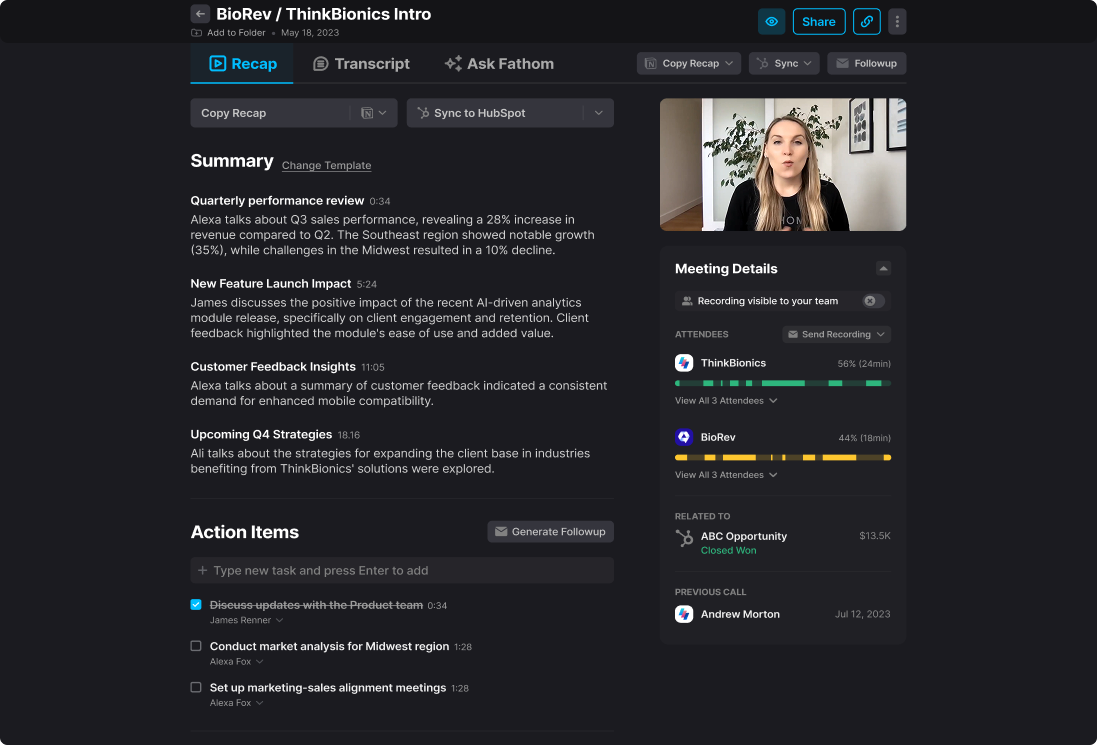
- The recorder captures the raw audio, isolates speakers, and compiles a time-indexed transcript.
- The semantic parsing layer isolates prospective commitments, separating exploratory brainstorming from binding agreements.
- The platform’s cross-suite agent identifies the designated owner and maps the stated timeline against their existing calendar.
- The agent drafts a project brief in the suite's document editor, updates the status field in the team's database, and stages an introductory email to external stakeholders.
This is the promise that Richard White, CEO of Fathom, pointed toward when discussing the transaction. He cited Superhuman’s distribution—a user base described in reports as encompassing 40 million accounts—as the critical vehicle to turn meeting capture into automated downstream productivity.
Yet product leaders must treat this vision with rigorous skepticism. The workflows described by Superhuman and Fathom are planned platform integrations, not shipped, verifiable software realities. Announcing an acquisition is an expression of architectural intent. It does not mean the underlying software reliably knows when an utterance constitutes a command.
The Provenance Problem: Distinguishing Speculation from Authority
The most difficult technical challenge facing Superhuman’s unified stack is not language fluency. Modern frontier models can draft an immaculate follow-up email in seconds. The foundational challenge is epistemic: How does the software know which sentence in a transcript carried genuine authority?
Spoken human dialogue relies on subtle social cues that language models struggle to parse deterministically:
- "I wonder if we should pull the release date back two weeks?" (Speculation framed as an inquiry)
- "Let's look into pulling the release date back two weeks." (Directive to investigate, not a directive to act)
- "We are pulling the release date back two weeks." (An authoritative decision)
- "Fine, let's pull it back two weeks." (A reluctant concession that may depend on unstated prerequisites)
If an automated agent treats all four statements as identical triggers for an ERP update or an email blast, it introduces institutional chaos.
To make cross-product agent workflows safe for enterprise adoption, Superhuman cannot treat Fathom’s transcripts as flat text blocks dumped into a retrieval-augmented generation pipeline. The combined system must introduce an explicit provenance and validation stack.
First, the software must preserve strict token-to-audio traceability. When an agent stages an action—such as an automated email stating that a client delivery date has been moved—the user interface cannot simply present the draft with an unhelpful "Generated by AI" label. It must provide an explicit citation linked directly to the exact moment in the recording: *Proposed based on statement by Jane Doe at 14:22 in 'Q3 Strategy Sync'.*
Second, the product requires clear correction loops. If a manager reviews an automated follow-up and notes that the model mistook a hypothetical scenario for an instruction, the correction must update more than that single draft. It must feed back into the organizational graph, marking that conversational thread as unratified. Without an explicit, friction-free mechanism for users to dispute an agent’s interpretation of a spoken remark, errors will compound across email, documents, and databases.
Third, access control and consent boundaries become existential. Fathom’s value as a standalone notetaker was personal utility: a participant wanted an accurate summary for their own records. When that data feeds an enterprise-wide agent fabric, permissions become thorny. Does an offhand personnel remark made in a closed managerial 1-on-1 leak into the context window of an automated performance-review drafter? Does a casual conversation about commercial pricing boundaries become available to an automated agent servicing a routine sales inquiry?
If Superhuman merges Fathom’s ingestion layer without rigorous, compartmentalized consent and permission scopes, it will construct an institutional memory that enterprises actively fear.
The Distribution Equation: Platforms Versus Specialized Point Solutions
The Superhuman-Fathom transaction also shows how hard it is for a single-purpose AI tool to remain independent once larger platforms can use its output everywhere else.
Fathom had built an enviable, highly rated product. Reaching 400,000 monthly active users and securing a $94 million valuation in a venture market crowded with dozens of transcription utilities is no small feat. Yet a standalone meeting notetaker faces a brutal retention dynamic. A user who receives a crisp call summary still has to highlight text, switch browser tabs, paste action items into an email client, open their project tracker, and manually draft tasks.
Once the initial novelty of automated transcription wears off, the standalone utility becomes another monthly line item that must justify its presence against embedded native solutions like Microsoft Teams Copilot or Google Meet’s integrated summaries.
Superhuman, conversely, possesses the operational canvas. It owns the keyboard shortcuts where knowledge workers spend hours triageing messages, the document surfaces where briefs are assembled, and the calendaring engine where time is allocated. By absorbing Fathom, Superhuman bypasses the agonizing process of building audio capture infrastructure from scratch, while Fathom escapes the trap of remaining an isolated output terminal.
Still, technology decision-makers must separate commercial announcements from operational deployments. Superhuman has not published audited figures proving how many of its 40 million reported accounts are daily or monthly active users, nor has it released independent benchmark data detailing the reliability of its planned cross-suite agent actions.
Until those integrated features ship to enterprise customers, the strategic thesis remains unproven. If Superhuman keeps Fathom walled off as a plugin that merely drops bullet points into an email, the acquisition will have done little more than purchase distribution.
The real test of the acquisition will be visible in the user interface over the next twelve months. If Superhuman succeeds, its software will not merely offer to summarize your 9:00 AM call. It will quietly show you an email draft to your client at 9:45 AM, pinpoint the exact sentence from your engineering lead that authorized the revised deadline, highlight the conditional caveat you uttered under your breath, and ask you for one single keystroke to verify that the thought was, in fact, an order.