Google announced Gemini 4 Argon on September 30, beginning a phased rollout through its Fairwind program for trusted cyber defenders. Those users and Google’s internal teams will receive access without cyber guardrails. Wider access for developers, enterprises and consumers remains planned, starting with paid API customers and Google AI Ultra subscribers; Google has not announced a date.
Argon expands more than Google’s security offering. The company positions it for extended coding, research and document workflows, and raises the output-token ceiling from 64K to one million. That limit describes what a model can generate in a trajectory, rather than the amount of input context it accepts.
Announced introductory API rates are $2 per million input tokens and $10 per million output tokens, with cached inputs discounted by 95%. Google says the corresponding standard rates will rise to $4 and $20 after the introductory period, whose end date is unspecified. The pricing announcement accompanies the restricted rollout; it does not establish general API availability.
Google describes using Argon internally for debugging, algorithm design and large code migrations. One example involves moving C/C++ projects to Rust. The company says rewrites of critical systems undergo automated and manual audits, emulation tests and review before production deployment, rather than treating model-generated code as ready to ship.
Cyber defense tests
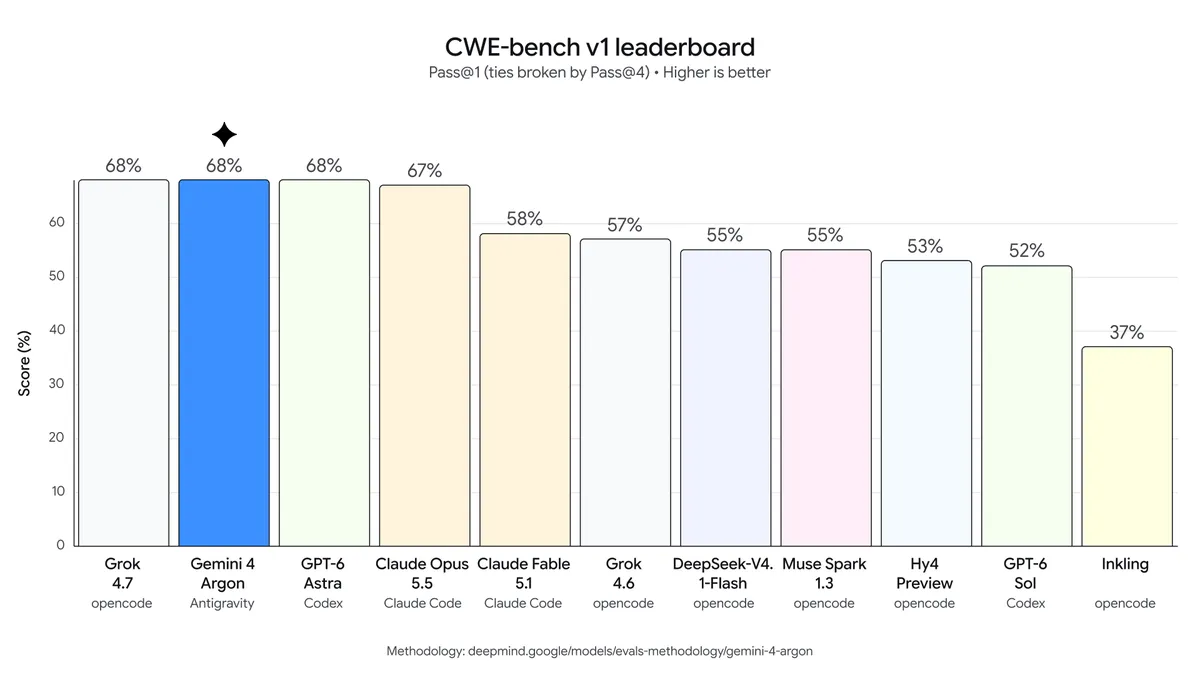
Google reports that Argon scored 68% pass@1 on CWE-bench v1, tying the highest result in its chart. The evaluation concerns remediation of software vulnerabilities. The chart uses different harnesses across models, including Antigravity for Argon and Codex for Astra, so the result combines model and surrounding-tool performance.
The release follows Gemini 3.8 Flash Cyber, which Google also distributed through Fairwind. Google says Argon improves vulnerability discovery over that model and is already being used by Wiz’s Scan for Good initiative. Those are company-reported uses and comparisons.
Before broader access, Google says it is strengthening misuse protections, resistance to malicious instructions embedded in retrieved material, monitoring of model actions and reasoning, and isolation of training and evaluation environments. Early defender feedback is part of that work. The next announced step is a wider release after this phased testing, with timing still open.