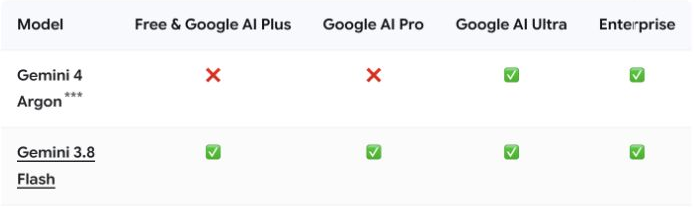
Google announced public access to Gemini 4 Argon on October 13, widening distribution following an initial cybersecurity preview restricted to defenders on September 30. Announcing the launch, Google DeepMind Senior Vice President and Chief AI Architect Koray Kavukcuoglu detailed availability across Google's developer platforms, consumer subscriptions, and research initiatives.
API Pricing and Billing Boundaries
Gemini 4 Argon is available through the paid Gemini API tier, including AI Studio and Android Studio. Google AI Pro does not include Argon access in AI Studio; paying for API usage is separate from the consumer subscription. Google also offers AI Ultra subscribers access to try the model in AI Studio.
Google has established temporary promotional pricing for standard API requests through November 30, with rates scheduled to double on December 1:
| Billing Component (per 1M tokens) | Rate Through Nov. 30 | Rate Starting Dec. 1 |
|---|---|---|
| Input Tokens | $2.00 | $4.00 |
| Output Tokens (including thinking) | $10.00 | $20.00 |
| Implicit Cached Input | $0.10 | $0.20 |
Google notes that explicit prompt caching is currently unsupported, leaving implicit caching as the only available cache mechanism.
Context Window and Generation Architecture
Gemini 4 Argon operates with a unified context window of 1,048,576 tokens. Google's documentation specifies that this 1M-token capacity covers the total combined volume of input prompt tokens, internal thinking tokens, and generated output tokens, rather than separate 1M-token allocations for input and output.
Key architectural and runtime specifications include:
- Thinking and Output Limits: The default thinking level is medium, and the default output limit is 65,536 tokens. The output limit counts thinking and answer tokens together.
- Extended Output Execution: Generating past the 65,536-token boundary requires enabling background execution and specifying a higher
max_output_tokensvalue. Google handles continuation hops server-side. Each hop adds amodel_outputstep; clients must join the text from those steps to obtain the full response. - Multimodal and Tooling Capabilities: Google lists agentic video understanding as generally available (GA) and provides built-in support for Managed Agents.
Subscription Tiers and Developer Tool Support
On the consumer side, Google began rolling out Gemini 4 Argon on October 13 to Google AI Pro and Google AI Ultra subscribers across the Gemini web and mobile applications, as well as AI Mode. Google describes this as a rollout, rather than confirming that every eligible account already has access.
For technical workflows within Google's Antigravity developer environment, availability is tightly segregated:
- Antigravity Tier Eligibility: Gemini 4 Argon is available exclusively to Ultra and Enterprise subscribers. Users on Free, Plus, and Pro tiers cannot access the model within Antigravity, and Google has not published an availability timeline for lower tiers.
- Environment Exclusions: According to official Antigravity documentation, Argon is explicitly not supported inside the standalone Antigravity IDE. Access is instead restricted to the Antigravity desktop application, the command-line interface (CLI), and Antigravity IDE extensions.
- Academic Research Allocation: Google has opened an academic program offering 10,000 selected scientists six months of complimentary access to Antigravity's highest usage tier. This initiative remains contingent on application screening, eligibility, selection, capacity, and rolling onboarding.