
MiniMax launched M3.1 Flash on October 19, pricing its API at $0.15 per million input tokens, $0.60 per million output tokens and $0.015 per million cached input tokens. The company says it is available through its API, M Plan subscription and MiniMax Code desktop app. Its official launch post schedules model weights for October 23.
MiniMax identifies the anonymously served Space Bunny as an early version of the model. It reports faster inference and a 70% reduction in overall agent-task usage costs compared with its predecessor. Those are the company's workload claims; they do not mean every application's bill falls by 70%.
The Formal Model Replaces the Preview Name
Current API documentation describes a one-million-token context window and adjustable thinking depth, which controls how much reasoning work it attempts. The M Plan overview says requests using MiniMax-M3.1-Flash-Preview are now served by MiniMax-M3.1-Flash.
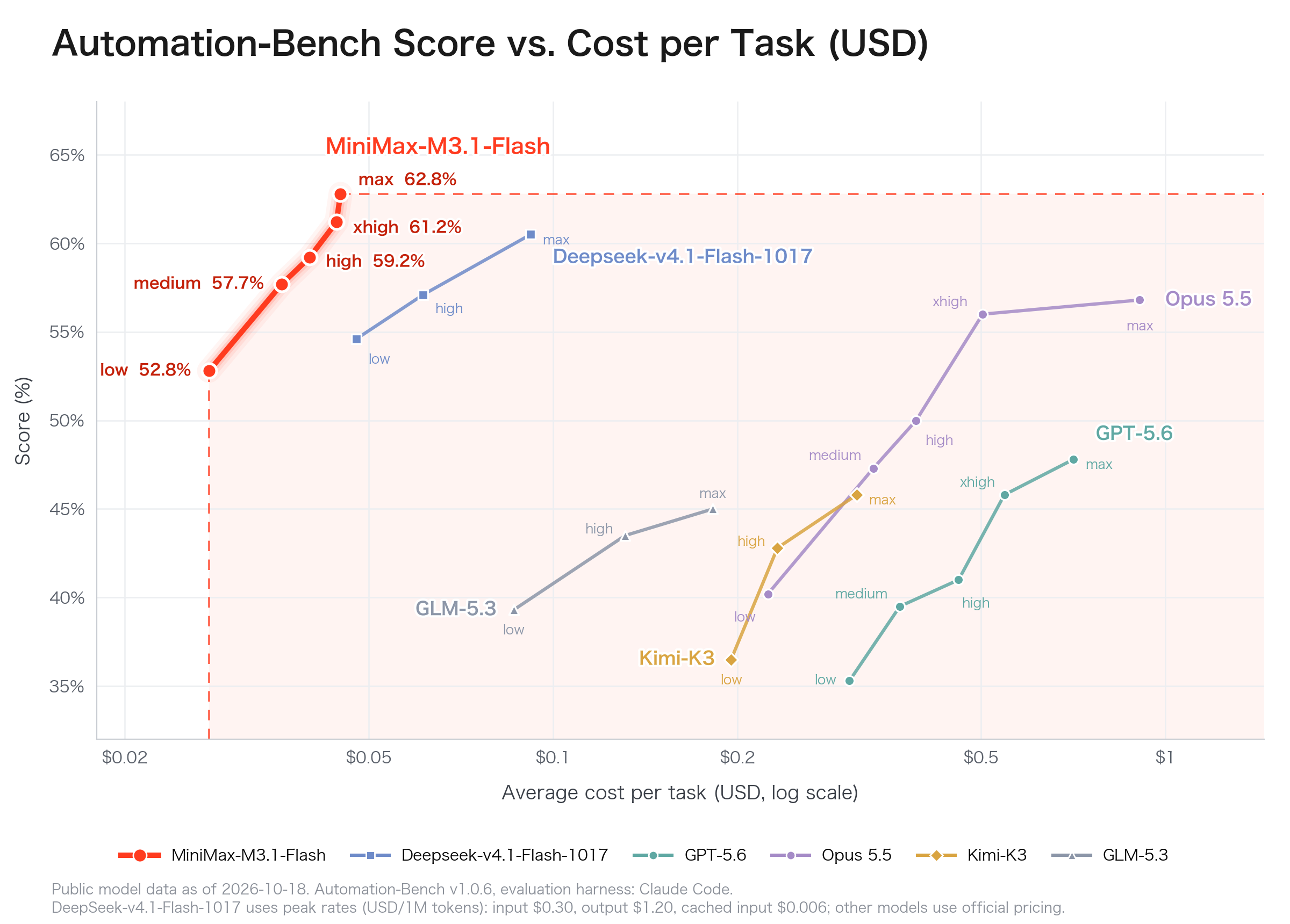
The launch includes company benchmark results across coding, computer use and automation. Its cost-versus-score chart compares reasoning settings on Automation-Bench; it does not establish the time or cost to finish an arbitrary production task.
Subscription Limits and Migration
M Plan access uses a shared allowance across MiniMax Code and connected third-party tools. Non-video use needs remaining capacity in both a five-hour window and a weekly window. A five-hour reset does not restore the weekly allowance, and request rate limits are separate.
Existing Token Plan subscribers can keep their current benefits while automatic renewal remains enabled, or optionally move to M Plan. During the current subscription period, turning renewal off cannot be undone. Moving to M Plan is also irreversible: the new tier’s terms apply, and historical discounts and extra benefits, including legacy unlimited (∞) limits or 150% weekly allowances, no longer apply. Pay-as-you-go API keys and subscription keys remain separate billing paths.