
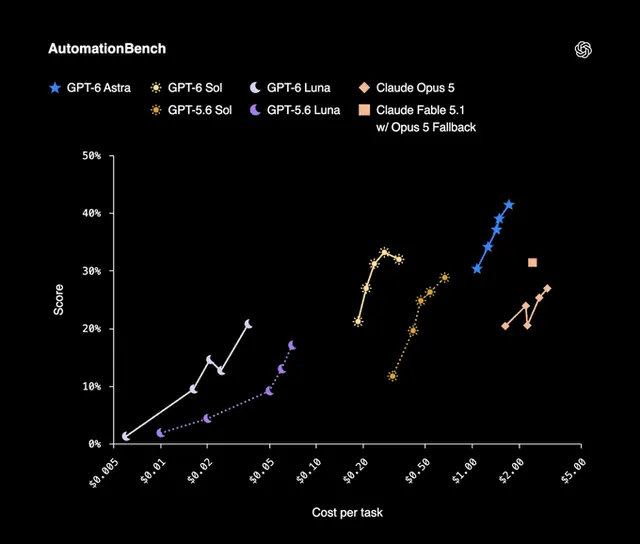
OpenAI announced the two models on September 22, 2026. It positions Sol and Luna as faster, more affordable options for work at scale, using methods it says are similar to those behind GPT-6 Astra.
Pricing and API access
Both models accept text and image inputs and return text through OpenAI's Responses and Chat Completions APIs. Developers can call them as gpt-6-sol and gpt-6-luna.
OpenAI's standard pricing for prompts up to 272,000 input tokens is:
| Model | Input | Cached input | Output |
|---|---|---|---|
gpt-6-sol | $2 per 1M tokens | $0.20 per 1M tokens | $10 per 1M tokens |
gpt-6-luna | $0.10 per 1M tokens | $0.01 per 1M tokens | $0.50 per 1M tokens |
OpenAI compares those rates with its GPT-5.6 promotional prices and describes them as a 50% reduction. It also says improvements to caching and inference let GPT-6 deliver a 90% discount on cached input-token reads. Those savings and the underlying efficiency claims come from OpenAI's own release and pricing materials.
OpenAI describes Sol as the more capable of the two new models and Luna as the more cost-efficient option for focused, high-volume work. The company reports gains over GPT-5.6 in professional work, factuality, coding and computer use, but the comparisons use OpenAI's testing conditions and, in some cases, public reports for other models. They do not establish everyday production performance or cache-hit rates for every workload.
Where the models are available
OpenAI says GPT-6 Sol and Luna are available in ChatGPT Work and Codex for Plus, Pro, Business, Enterprise and Edu users, with the product rollout happening gradually. Free and Go users can access GPT-6 Luna in the desktop app. The launch page says neither model is yet available in the standard Chat surface.
For developers, the immediate change is a lower-cost way to run multimodal and agent workloads through the API. Teams still need their own tests for latency, reliability, context reuse and total task cost before changing production defaults.