Z.ai launched GLM-5.4 on November 23, making its latest flagship available through GLM Coding Plan subscriptions. The company’s model documentation says the general Model API will follow a security assessment; downloadable weights are planned after further safety work.
For subscribers on weekly quota plans, Z.ai says GLM-5.4 provides 1.5 times the available usage of GLM-5.3. That describes more available use, rather than a 50% increase in the rate at which the model consumes credits.
What changed in the model
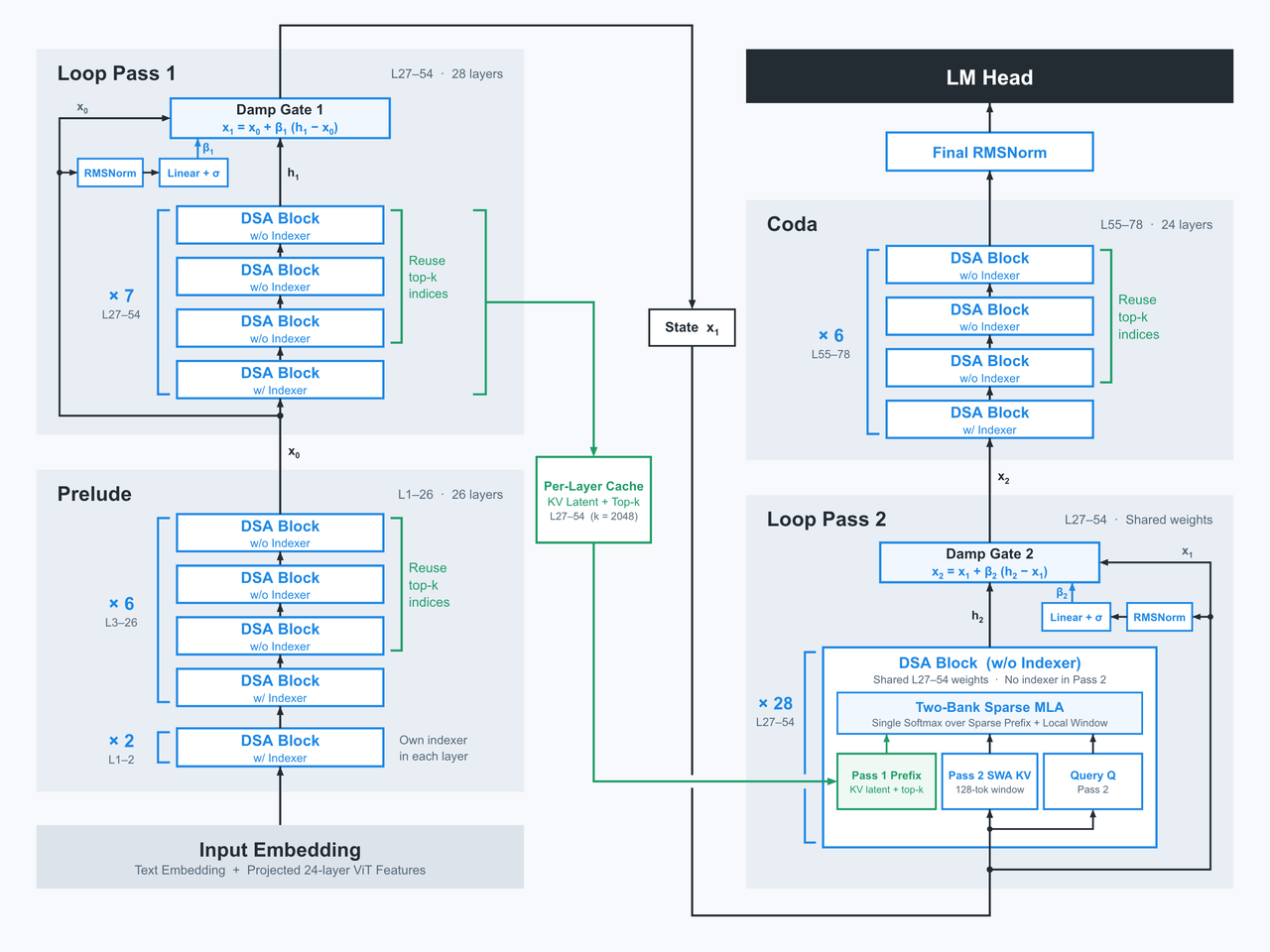
GLM-5.4 is Z.ai’s first flagship built around a Loop Transformer. The company says it runs a shared group of 28 layers from the GLM-5 base model through two iterations, reusing the same learned weights to do more processing without adding parameters to that block. It describes the work as an architectural change at the 750-billion-parameter scale.
Z.ai says the model can use code for tasks beyond conventional software development, including games, video editing and mechanical design. Its published specification lists video, image, text and file input, with text output, a 1 million-token context window and a maximum of 128,000 output tokens. Producing code that creates a video is separate from directly returning video as the model’s output.
The company also acknowledges that GLM-5.4 can enter unusually long reasoning loops. Its performance and speed claims come from its own testing.
Access and subscription limits
The launch points users to ZCode, Z.ai Chat and the Coding Plan. AutoClaw separately confirms integration, with the 1.5-times allowance for its V2, V3 and Team Edition Coding Plan users.
The international Coding Plan documentation lists subscriptions starting at $18 a month. Individual plans have both five-hour and weekly credit limits: Lite provides 2,000 and 10,000 credits respectively, Pro 12,000 and 60,000, and Max 28,000 and 140,000.
Those credits translate into different token totals depending on input, cached input and output. Z.ai lists lower credit multipliers for GLM-5.4 than for GLM-5.3, and charges half the standard credit rate outside weekday peak hours, defined as 2–6 p.m. in UTC+8. The 1.5-times comparison is not a fixed token allowance for every workload or a cash price for the forthcoming general API.