Star growth comes from the GitHub Trending weekly snapshot. Figures are preserved as of October 10, 2026. The editor’s pick highlights one project from this edition.
Editor’s pick · Apache-2.0
OpenRig
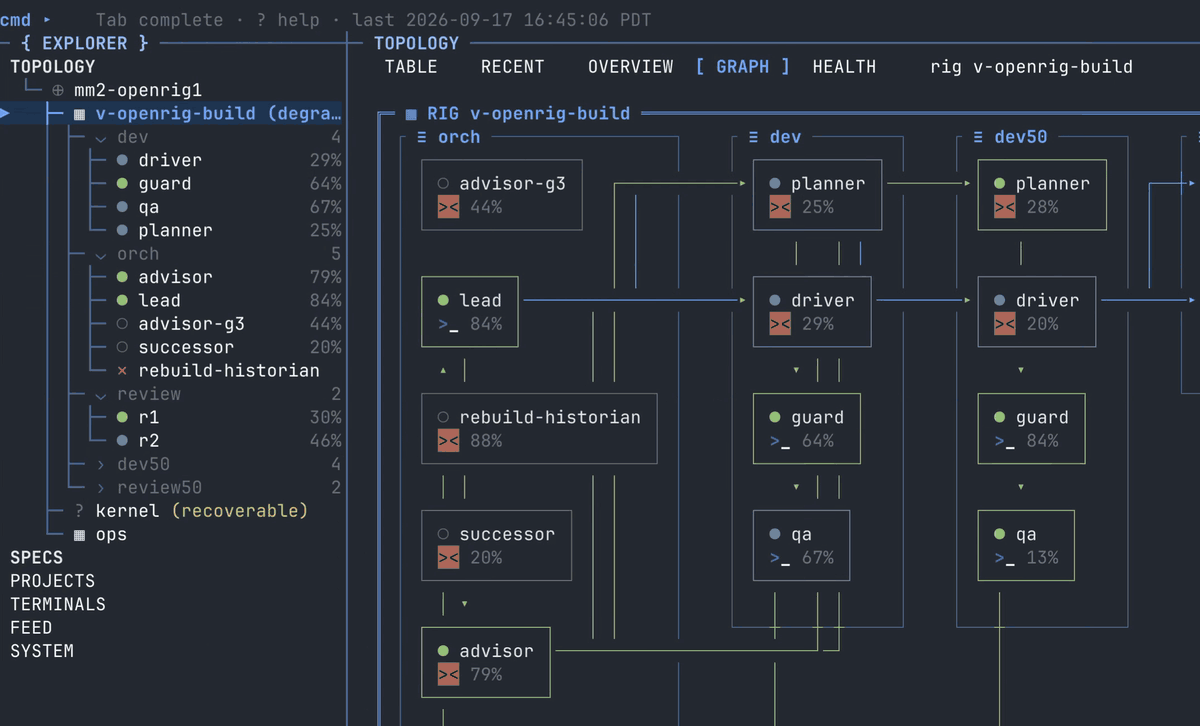
OpenRig is an open-source multi-agent harness designed to coordinate AI coding agents into structured teams rather than isolated terminal sessions. Defining agent topologies declaratively in YAML using its RigSpec schema, the framework orchestrates sessions across tmux through a local HTTP daemon, a command-line interface, a terminal UI, and Model Context Protocol servers. It provides managed roles, pods, edges, and continuity policies across supported runtimes such as Claude Code and Codex, allowing a lead agent to coordinate specialist workers, track queues, snapshot state, and hand off decisions while preserving workspace context.
The tool is aimed at software engineers and engineering teams looking to run collaborative AI coding agents across shared repositories. It specifically targets practitioners managing concurrent Claude Code and Codex instances who require persistent session topology, automated context sharing, and shared terminal views without manual session juggling.
Before you try it
Adopting OpenRig requires Node.js 22 or 24 alongside tmux on macOS or Linux systems; macOS environments on Apple silicon specifically require Node.js 22, and Node.js 20 is unsupported. Native Windows is not supported, and while Windows Subsystem for Linux 2 is documented by the project, OpenRig does not currently run automated tests against WSL2. Setup writes provider hooks and workspace trust settings; the project advises reading the changes and backing up relevant files before installation. Model-provider access and inference costs are separate from the open-source software; users can choose the providers they already use.
Latest activity at snapshot
v0.6.8 release · Oct 9; repository push · Oct 9 (UTC)
License
Apache-2.0
Also selected · Apache-2.0
HyperFrames
HyperFrames is an open-source rendering engine that turns HTML, CSS, media assets, and seekable animations into deterministic MP4 video files. Operating without a required JavaScript bundling step, the system parses data-attribute timing structures in standard HTML pages, advances frames sequentially in headless Chrome, and encodes video output via FFmpeg. To integrate into agent-driven development pipelines, the framework provides modular agent skills and plugin packages that guide tools such as Claude Code, Codex, and Cursor through end-to-end video planning, markup authoring, animation timeline wiring, and rendering.
The framework is built for developers, technical content creators, and automation engineers seeking programmatic video generation without relying on React-based rendering stacks. It also caters to teams equipping coding agents with structured workflows to generate product promos, release diff walkthroughs, and animated data visualizations directly from codebase assets.
Before you try it
Implementation requires a runtime environment with Node.js 22 or higher and a local installation of FFmpeg. While local command-line rendering operates under an open-source Apache 2.0 license, external asset generation models or hosted HeyGen cloud and AWS Lambda rendering pipelines incur independent cloud and infrastructure billing. Domain skills installed through the `skills.sh` registry can lag behind the repository's `main` branch by several hours, requiring direct package updates when tracking the newest definitions.
Latest activity at snapshot
v0.8.143 release · Oct 8; repository push · Oct 9 (UTC)