Shown star changes use two real snapshots seven days apart; a project without both is marked “Not measured”. Figures are preserved as of October 16, 2026. The editor’s pick highlights one project from this edition.
Editor’s pick · AGPL-3.0; exercise media separately licensed
openGym
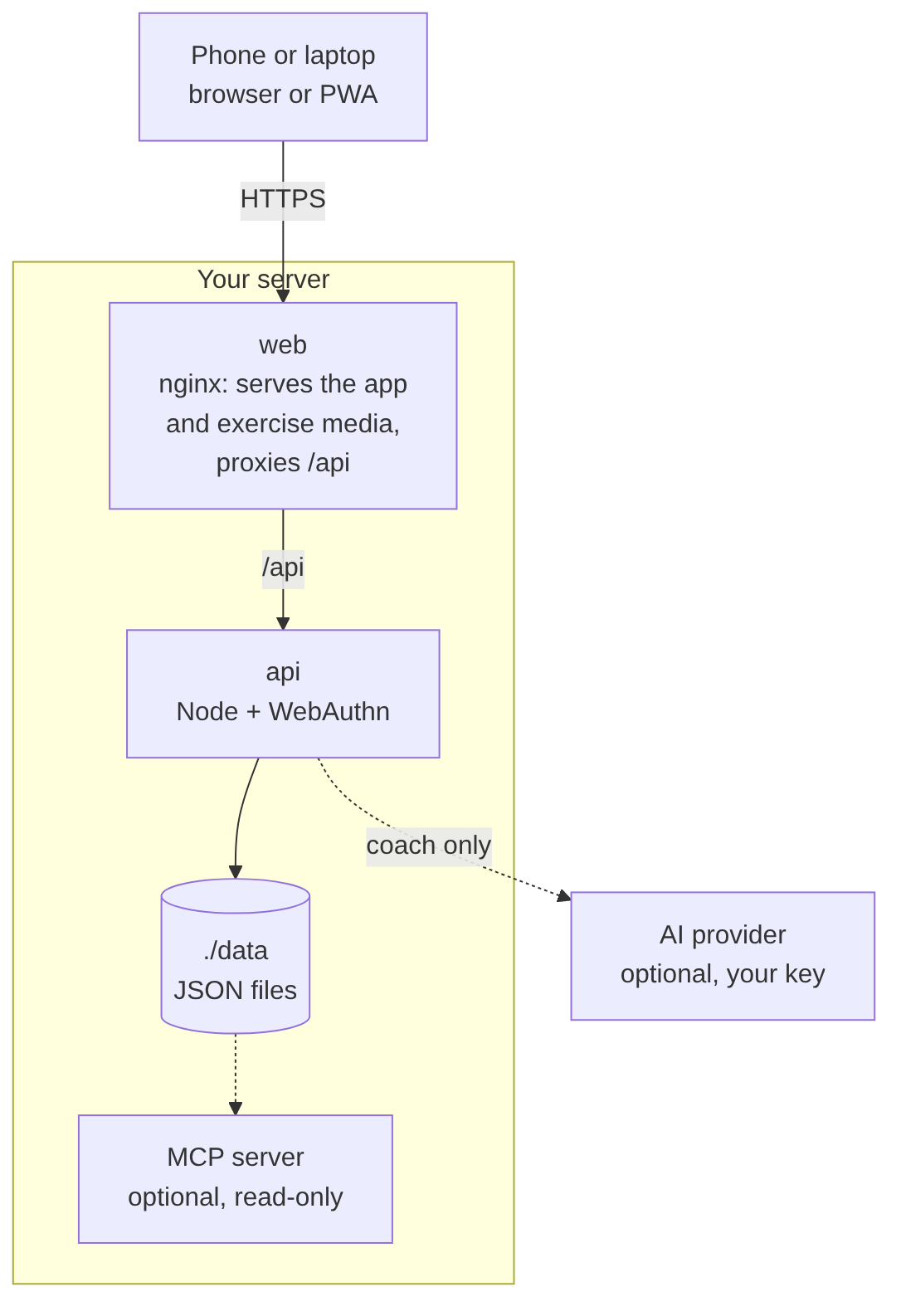
openGym brings workout planning, set logging and body-weight history onto a server you control. It supports importing training records from FitNotes, Strong and Hevy, and exporting profile data as JSON. The browser interface can be installed as a progressive web app, with passkeys for signing in across devices. Its default installation does not require an AI model; a separate, optional coach can propose routine changes for the user to approve.
People who already maintain a home server and want a workout log they can back up, export and move without depending on a fitness-app subscription.
Before you try it
The documented self-hosting route uses Docker Compose. Phone access with passkeys requires HTTPS and the correct domain configuration; you are responsible for hosting and backups. The optional AI coach uses your own provider configuration, with any provider charges separate. The code is AGPL-3.0, but the exercise pictures and animations have separate restrictions: the repository does not grant permission to extract them for another website or product.
Latest activity at snapshot
Repository push · Oct 15 (UTC), at the Oct 16 collection snapshot; not a release date
License
AGPL-3.0; exercise media separately licensed
Also selected · MIT
text-to-cad
text-to-cad equips a coding agent with local workflows for building and inspecting 3D models, exporting STEP, STL, GLB and 3MF files, and preparing engineering drawings. Its cadgen runtime uses Python and build123d; the accompanying skills describe how an agent should create, measure and review geometry. It is useful when a model should remain an editable file rather than a generated picture.
Developers and makers who want to iterate on parametric parts with a compatible coding agent and inspect the resulting geometry before fabrication.
Before you try it
Requires uv and a compatible agent; cadgen declares Python 3.11 or later. Runtime downloads need a network connection. The project distinguishes the released latest branch from development on main. Usage telemetry is enabled by default and can be disabled. Model access and fabrication services have their own costs. Generated geometry and manufacturing checks still need human review; the beta package does not establish that a part is safe to manufacture.
Latest activity at snapshot
Repository push · Oct 15 (UTC), at the Oct 16 collection snapshot; not a release date