
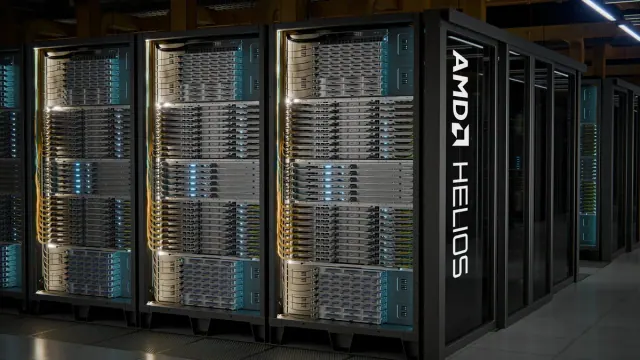
At its Advancing AI 2026 event on July 23, 2026, AMD introduced Helios as a pre-integrated option for data center AI deployments. The Helios system packages host processors, accelerator compute, scale-up and scale-out networking, and software into a single deployment block. For infrastructure architects, the design moves capacity planning from individual PCIe or OAM server nodes to integrated power and fabric footprints.
| Component Layer | Hardware / Software Profile | Status |
|---|---|---|
| Compute Accelerators | 72 AMD Instinct MI455X GPUs | In production |
| Host Processors | 18 6th Gen AMD EPYC "Venice" CPUs | Launched / In customer validation |
| Network Fabric | AMD Pensando front-end, scale-up, and scale-out switches | Integrated in rack design |
| Software Platform | AMD ROCm open software stack and ROCm.ai | Enabled for MI455X |
AMD claims that Helios achieves up to 30% more inference tokens per dollar than an Nvidia Vera Rubin NVL72 rack. According to AMD footnote disclosures, this comparison is an internal model estimate calculated in July 2026 using the Kimi K2 Thinking workload at 32K input and 8K output lengths, based on projected hourly GPU market pricing rather than measured production billing across independent clouds.
Hardware distribution will rely on original equipment manufacturers including Bull, HPE, Lenovo, and Supermicro, alongside manufacturing infrastructure partners Sanmina and Wiwynn. Partner timelines show that active data center operations will lag initial factory production:
- OpenAI plans to bring Helios racks online beginning in the fourth quarter of 2026, with installations accelerating through 2027 while optimizing GPT-class workloads via Triton and
ROCm. - Anthropic outlined a strategic partnership to deploy up to 2 gigawatts of
MI455XGPUs in Helios systems, alongside engineering work using Claude to optimize AMD software. - Meta has begun lab validation of sixth-generation
EPYChost platforms and preliminary testing of Helios racks ahead of planned gigawatt-scale deployments. - Cerebras is collaborating with AMD to link low-latency inference hardware with Helios rack infrastructure.
These partner targets reflect intended deployment scale rather than operational grid draw or active clusters. Infrastructure teams evaluating the architecture will depend on OEM delivery schedules and cluster validation under live training and inference workloads.