
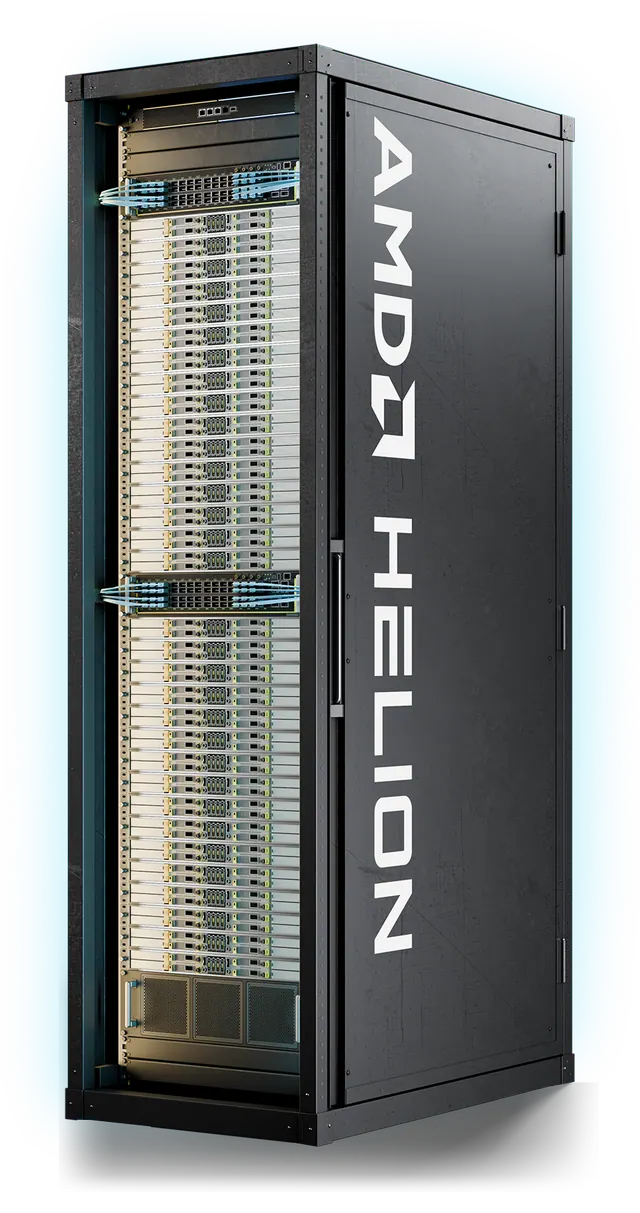
AMD announced the Helion design on October 12, positioning the architecture around the emerging computing demands of multi-step AI agents. Its CPU-only configuration connects agent execution to separate model-inference infrastructure; the enterprise configuration brings CPU and GPU nodes into one rack. AMD says configurations are under development with ecosystem partners and are planned to become available in November 2026.
Hyperscale Execution vs. Enterprise All-in-One
The Helion blueprint establishes two core hardware configurations tailored to different operational scales:
- CPU-Only Hyperscale Configuration: Built around 6th Gen
EPYCprocessors, this layout scales up to 32,768 CPU cores within a single rack. It is designed to run agent logic, tool integrations, and execution environments at scale, connecting across the data center network to separate external inference systems. - All-in-One Enterprise Configuration: Combines
EPYChost processors, general-purpose compute nodes, and up to 16 InstinctMI350PGPUs. The GPUs are arranged as two independent eight-GPU nodes; the specification does not include a scale-up fabric bridging the two GPU nodes together.
To manage model interactions, the architecture includes a token router designed to direct outgoing model calls dynamically across self-hosted open-source models and external frontier APIs.
Rack Infrastructure and Workload Positioning
The physical Helion layout is based on Open Compute Project (OCP) Open Rack Standard Version 3 (ORv3) specifications. Depending on facility requirements, the reference architecture supports both air-cooled and direct-liquid cooling options.
On the compute layer, the rack integrates EPYC 9006 series processor blades, with configuration profiles accommodating dense, balanced, or high-frequency CPU demands. AMD explicitly distinguishes Helion from its Helios platform, noting that while Helios targets large-scale frontier model training, Helion is designed specifically for enterprise agent orchestration and local inference.
AMD plans to contribute the Helion specifications to OCP for community development and adoption.