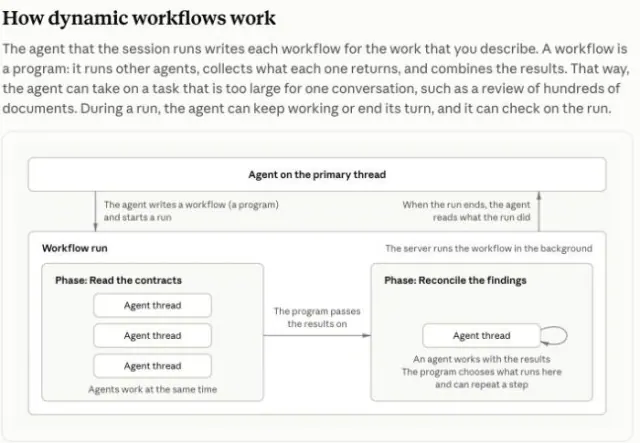
Anthropic introduced dynamic workflows in Claude Managed Agents in its October 9 platform update. Available in beta under the managed-agents-2026-04-01 header, the feature lets an agent write a program that runs other agents in phases, passes their results between steps and repeats work when needed.
The documentation describes work such as reviewing hundreds of documents, audits and migrations. A program can divide the work across agents before reconciling their findings, and can handle a failed agent or let the failure end the run.
Background Programs and Shared State
Dynamic workflows put orchestration in a program running on the server. The primary agent can continue other work or end its turn while a run executes, then inspect the results when it ends. Ordinary subagent delegation instead lets the primary agent interact directly with child threads; an advisor provides guidance while the primary agent keeps doing the work.
Developers enable workflows through the multiagent_20261001 type in the agent definition. Workflows and subagents are enabled by default with that type, as are inline agents. Developers can also supply predefined agents. Only the primary session agent starts workflow runs.
The agents share the session sandbox and files, while each thread keeps its own conversation history. Inline agents use the session agent's model and a subset of its tools, MCP servers and skills, with tool permission policies retained. Separate conversations therefore do not provide separate filesystems.
Budgets and Completion
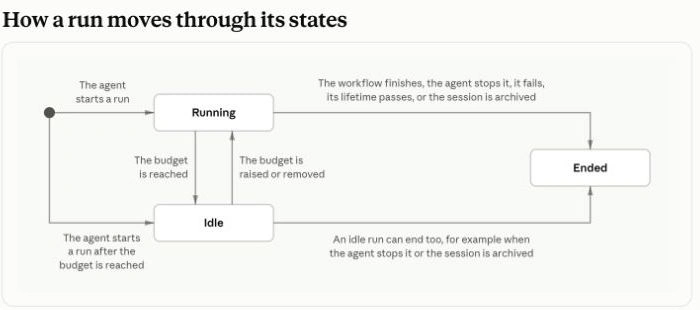
Runs report progress through workflow_run.* events on the session event stream. The workflow runs documentation gives runs a default lifetime of 24 hours, including time paused or waiting on the client. An agent can set a shorter lifetime.
A completed result means the workflow finished running; individual threads may still have failed or could not be created. Developers need to inspect those threads for failed work. An idle session also does not establish completion: every run must have ended, followed by the agent ending its turn, without the client's own interruption causing that idle state.
A run has no separate price of its own. Its agents' tokens are billed at their models' rates, alongside the session's other charges. Model requests count toward the session budget. At the budget, open runs pause, but each working thread finishes its in-flight model request, so spending can pass the budget by one request per working thread.
Raising or removing the budget resumes runs paused by that budget unless an interruption has also paused them. The lifetime continues to pass while a run is paused, so a paused run can still time out.