
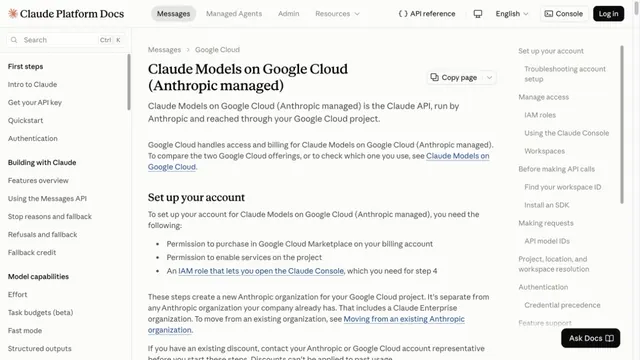
Anthropic launched Claude Models on Google Cloud (Anthropic managed) on October 22. Developers can reach the Claude API through a Google Cloud project, authenticate with Google Cloud credentials and put the charges on their Google Cloud bill. Fast mode for Claude Opus 5.5 is available on the new route.
It adds another way to buy and operate Claude workloads. Google’s existing managed offering remains separate: Google runs that stack through its Agent Platform, while Anthropic operates the new service on its own systems.
A Different Account and Billing Path
Getting started requires a Marketplace subscription, enabled project services, the appropriate IAM permissions and completed Anthropic organization setup. The new organization is separate from any Claude API or Claude Enterprise organization a company already has.
Developers use Google credentials rather than Anthropic API keys. Anthropic’s SDK client for this route, AnthropicGoogleCloud, is in beta. The service supports capabilities including prompt caching, files, tools and Managed Agents, but has exceptions: MCP tunnels and the supplied self-hosted sandbox workers are not supported, and memory stores do not work with self-hosted environments.
Anthropic meters usage and reports it to Google in Claude Consumption Units, each worth one US cent. That is a billing unit, not a flat price per request or per token. Google Cloud Marketplace handles billing, while Anthropic controls rate limits. Eligible spend counts toward a Google Cloud commitment under Marketplace rules. This is usage-based API purchasing, with list prices or negotiated offers, rather than a new Claude consumer subscription.
Migration Includes a Data Boundary Decision
The two Google Cloud offerings use different endpoints, client classes and IAM grants. Existing files, workspaces, credentials and settings do not automatically transfer to the new Anthropic organization. An existing discount must be arranged before use; it cannot be applied retroactively.
Anthropic is the new service’s data processor. Some supporting services, including trust and safety systems, process data outside Google Cloud. The global endpoint is not a promise that every operation stays within Google’s infrastructure. Zero Data Retention is available on request, and an arrangement on another Anthropic organization does not carry over.
Google’s documentation points customers needing Google-operated inference and data inside Google Cloud’s security boundary toward its Google-managed offering. The billing account alone does not determine that boundary.
There is also an operational distinction for agents: revoking an identity’s Google Cloud access does not stop sessions or scheduled deployments it already created. Running work must be stopped or paused separately.