
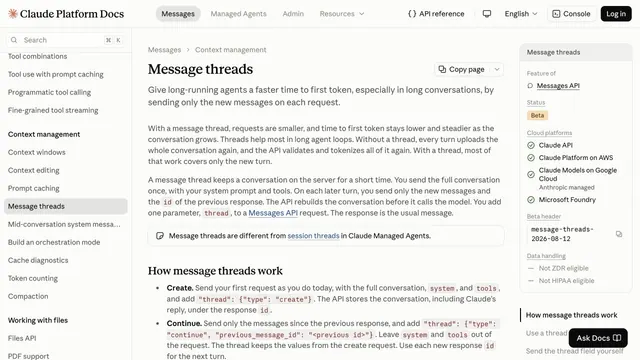
Anthropic introduced message threads in beta on November 2, aiming to reduce the delay before an agent receives its first output token in long conversations. The change targets repeated request processing: instead of uploading the entire history on every turn, an application can send new messages and the previous response’s identifier.
Anthropic says message threads are already enabled by default for most Claude Code users. For requests carrying 500,000 to 1 million tokens, it reports about a 35% reduction in median time to first token. That is a company-reported result for that request range, not a measured speedup for every workflow.
The beta is available on the Claude API, Claude Platform on AWS, Claude Models on Google Cloud operated by Anthropic, and Claude in Microsoft Foundry. Requests use the message-threads-2026-08-12 beta header.
Temporary State, Unchanged Billing
A thread normally expires five minutes after its last request, with each stored response restarting that window. Anthropic deletes it within an hour after its last use. Storage is best effort, so developers must retain the conversation themselves and resend it when continuation fails. This is a request-processing shortcut rather than a durable conversation database.
Threads leave token prices and rate limits unchanged and do not automatically enable prompt caching. A smaller upload therefore does not, by itself, mean a lower token bill.
The feature is not eligible for zero data retention or HIPAA readiness. Anthropic says thread contents stay in memory, encrypted with a server-managed key, and are never written to durable storage. There is no API to list, read or delete a thread.
Applications also need to account for append-only history and fixed request settings. Changing the model, system instructions or tools requires a new thread. Message batches, token-counting requests, compaction and organizations using inference hooks are among the unsupported combinations.