

I did not expect to like the name Alibaba Token Hub. “Token” has become one of those technology words asked to do too much work. It can describe a unit of model input, a billable item, a piece of generated output or, in an entirely different industry, a financial asset. Put “hub” after it and the phrase risks saying nothing at all.
Then I looked at what Alibaba had put inside the group.
The new ATH business group combines Tongyi Laboratory, which develops Qwen; the model-as-a-service operation that sells access to models; the consumer Qwen app; Wukong, Alibaba’s enterprise agent unit; and a team intended to explore new AI applications and business models. It sits at the top level of the company alongside cloud and e-commerce groups. Alibaba CEO Eddie Wu leads it himself.
That is not a naming exercise. It is an attempt to organize the company around the full life of a model output: research creates it, cloud infrastructure delivers it, and consumer or enterprise software gives someone a reason to pay for or repeatedly use it.
The promise is a tighter feedback loop. The risk is that one loop becomes a very large queue outside the CEO’s office.
Read the reporting lines, not the slogan
AI work inside a conglomerate naturally fragments. A research lab is rewarded for stronger models and respected releases. A cloud group wants sustained compute demand and predictable enterprise contracts. A consumer team wants daily use. An enterprise-product team needs security, integration and a sales story.
All four may claim to pursue the same AI strategy while optimizing for different things.
ATH brings those arguments into one organization. Tongyi can see which capabilities the Qwen app and Wukong actually need. The service team can plan around model releases. Application usage can feed priorities upstream. In the ideal version, Alibaba shortens the distance between a research decision and a commercial result.
Putting Wu in charge makes the priority unmistakable. It also acknowledges that the conflicts cannot be solved by a liaison committee. Decisions about compute, release timing, openness, pricing and distribution affect several of Alibaba’s largest businesses. The CEO is taking ownership of those trade-offs.
South China Morning Post’s report is especially useful here because it places ATH next to, rather than simply inside, Alibaba Cloud. That distinction matters. If the model group lived under cloud, its natural job would be to increase cloud consumption. As a peer organization, it can also optimize for consumer reach, developer adoption or enterprise software—even when those goals complicate the cloud unit’s immediate economics.
Why organize around a token?
Alibaba says ATH is built around creating, delivering and applying tokens. Strip away the branding and there is a coherent business idea underneath.
The same model output can be sold in several ways. A developer buys API usage. A company pays for an agent that consumes model output inside a workflow. A consumer uses an assistant that turns the output into shopping, travel or productivity activity elsewhere in Alibaba’s ecosystem. The token is the common input to those revenue paths.
That framing also disciplines the conversation. Benchmark leadership is useful, but a business group eventually has to connect model capability to cost and use. How expensive is a useful response? How reliably can it be delivered? Does it lead to a paid cloud workload, a completed enterprise task or a consumer transaction?
Alibaba’s own numbers show why management wants those questions in one place. The company reported that Cloud Intelligence external revenue grew 40% in the March quarter. AI-related products accounted for 30% of cloud external revenue and had posted triple-digit growth for eleven consecutive quarters. It also said Model Studio’s customer base grew eightfold from a year earlier. These are company-reported figures, not an independent measure of product quality, but they show where Alibaba sees momentum.
ATH is the organization built to keep that momentum from stopping at infrastructure.
Wukong shows the enterprise half of the plan
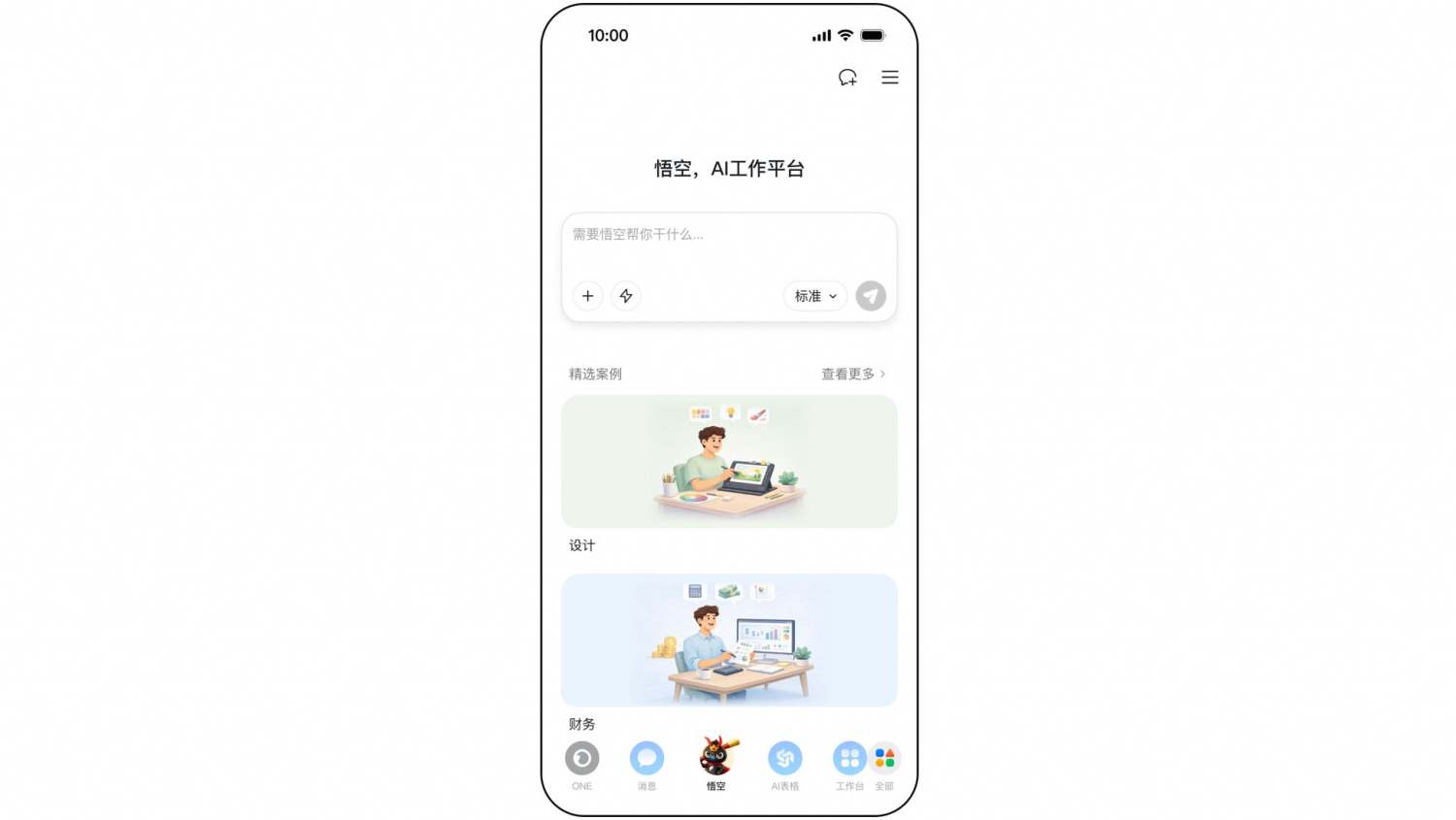
Wukong is the clearest example of how Alibaba wants the pieces to meet. Launched in invitation-only beta, the product is meant to coordinate agents across documents, spreadsheets, approvals, browsers and cloud systems. It can run as a desktop application or inside DingTalk, which Alibaba says serves more than 20 million corporate users.
The distribution advantage is obvious. Alibaba does not need to persuade every company to adopt a new collaboration environment before trying an agent. It can place the agent inside an existing work surface, then connect functions from Alibaba Cloud and, eventually, other parts of the Alibaba ecosystem as modular skills.
The harder part is not the demo. It is deciding which layer owns the customer. Does the model team decide the capability roadmap? Does DingTalk control the experience? Does Cloud price the infrastructure? Does Wukong become a product with its own commercial logic, or a channel through which the other businesses sell more?
Those questions are exactly why ATH exists. They are also why the group could become unwieldy. An organization created to remove boundaries can end up containing every boundary.
The consumer half is a different machine
Alibaba says the Qwen consumer app passed 300 million monthly active users across platforms in February. Again, that is a company figure and should not be mistaken for a measure of depth or retention. But it gives ATH a consumer laboratory at a scale few model makers possess.
The app can connect model behavior to services Alibaba already operates. A useful answer can become a shopping action, a booking or another transaction. That creates a feedback loop very different from Wukong’s enterprise sales and governance cycle.
Putting both under ATH allows Alibaba to share model and serving work while keeping two routes to use: one through daily consumer activity, another through business workflows. The model is common. The products are not.
This is where centralization needs restraint. A consumer assistant can change weekly and tolerate experimentation. An enterprise agent touching approvals and internal systems needs permissions, auditability and predictable behavior. Forcing both into one release rhythm would destroy the advantage of combining them.
Good centralization standardizes what should be shared—models, evaluation, infrastructure and perhaps agent tools—while leaving product teams room to serve different users. Bad centralization asks every team to wait for one master plan.
The open-model tension
Qwen’s reach has also been helped by open releases. Developers can adopt, modify and deploy models without entering Alibaba’s product ecosystem in the way a conventional SaaS customer would.
That openness can strengthen the commercial business: broader use creates familiarity, tooling and demand for hosted services. It can also conflict with short-term monetization. The model that wins developer mindshare is not always the model that maximizes paid token volume.
Before ATH, that tension could remain visible between a lab and a commercial unit. Inside one CEO-led group, it becomes an internal allocation decision. I would watch release terms, timing and the gap between public models and paid services. Centralization does not automatically weaken openness, but it makes the person responsible for ecosystem generosity the same person responsible for converting AI investment into revenue.
What would count as success
Alibaba can point to fast cloud growth, a large consumer app and a ready-made enterprise channel. None of those facts proves the reorganization works. The useful evidence will be in the connections.
Does a Qwen improvement reach Wukong and the consumer app without months of translation? Do developers move from open models into paid Model Studio usage because the service is genuinely easier, not because access is bundled? Do enterprise customers use agents repeatedly across real workflows? And can the research team keep making decisions whose payoff is not visible in the current quarter?
ATH is a sensible attempt to treat AI as a production system rather than a collection of projects. It may reduce the familiar distance between the lab, the cloud invoice and the application. It may also concentrate too many decisions in a group with one very busy leader.
The name is still clumsy. The bet is not.