
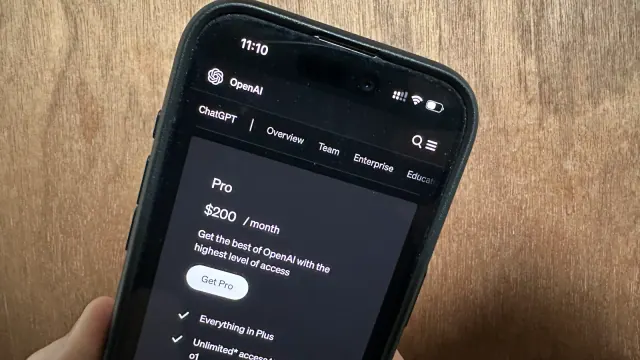
The $200 ChatGPT plan has started appearing again for some users. That sounds like a reopening. It is not.
OpenAI's current policy is much narrower. New subscriptions and upgrades to ChatGPT Pro 20X remain paused. The people who can see a working purchase option are recent members of the tier who qualify for a one-time return: they held Pro 20X when the pause began on September 10, 2026, or their access ended within the previous 30 days. They must use the same account, return within 30 days after access ends and must not have used the exception before.
I think the distinction matters more than the button. OpenAI has created a repair path for people who lost an existing place, while continuing to reject net-new buyers. Pro 20X is still printed on the menu, but access now depends on account history. The plan has become admission to a capacity pool.
That is a defensible response to a launch surge. It is also a warning about the kind of product a high-usage AI subscription has become. The monthly price is fixed; the work users ask the model to perform is not. When a new model can spend longer reasoning, retain more context and operate tools across extended tasks, the vendor cannot promise capacity in quite the same way that a conventional software company promises a feature.
One Week From Launch to Pause
GPT-6 Astra launched on September 3. OpenAI said it would roll out from a limited initial group to ChatGPT Plus, Pro, Business and Enterprise, as well as the API and cloud partners. Astra usage would draw from existing subscription allowances, and users could buy credits for additional usage. Pro, Business and Enterprise accounts would also receive access to GPT-6 Astra Pro.
On September 10, OpenAI stopped accepting new subscriptions and upgrades to the $200 Pro 20X tier. TechCrunch's Sarah Perez reported that OpenAI product leader Thibault Sottiaux attributed the decision to Astra demand and strain on the company's systems. According to the report, Sottiaux said the $200 tier placed the greatest load on those systems, so pausing it was the smallest intervention that could preserve broad access. OpenAI did not publish subscriber counts, serving-capacity figures or a date for reopening.
The pause did not abolish the tier. OpenAI's help page says existing Pro 20X subscriptions continue to renew normally. The $100 Pro 5X plan also remained available. What disappeared was the ability for a new customer—or an existing customer on a lower tier—to buy the larger allowance.
That created a sharp edge around billing. A failed renewal, cancellation or downgrade could end access to a plan that the customer could no longer repurchase. Users began reporting that the option had returned on some accounts around September 21, while others still saw it disabled or absent. Those posts were anecdotal, but OpenAI's updated help page now explains the pattern.
Eligible customers receive one chance to return during the pause. The exception covers someone who held Pro 20X on September 10 or whose access ended in the 30 days before that date. The option lasts for 30 days after access ends and can follow a cancellation, failed payment, refund or downgrade. Anyone without the required history remains locked out until the general pause ends.
This is why “Pro 20X is back” is the wrong headline. OpenAI has reopened a recovery route, not the sales channel.

The Price Card and the Purchase Gate Tell Different Stories
OpenAI's pricing page still presents Pro as a two-tier product. Pro 5X starts at $100 a month; Pro 20X costs $200. Both include the same broad set of Pro capabilities. The published difference is mainly the included usage: five times or 20 times the Plus allowance.
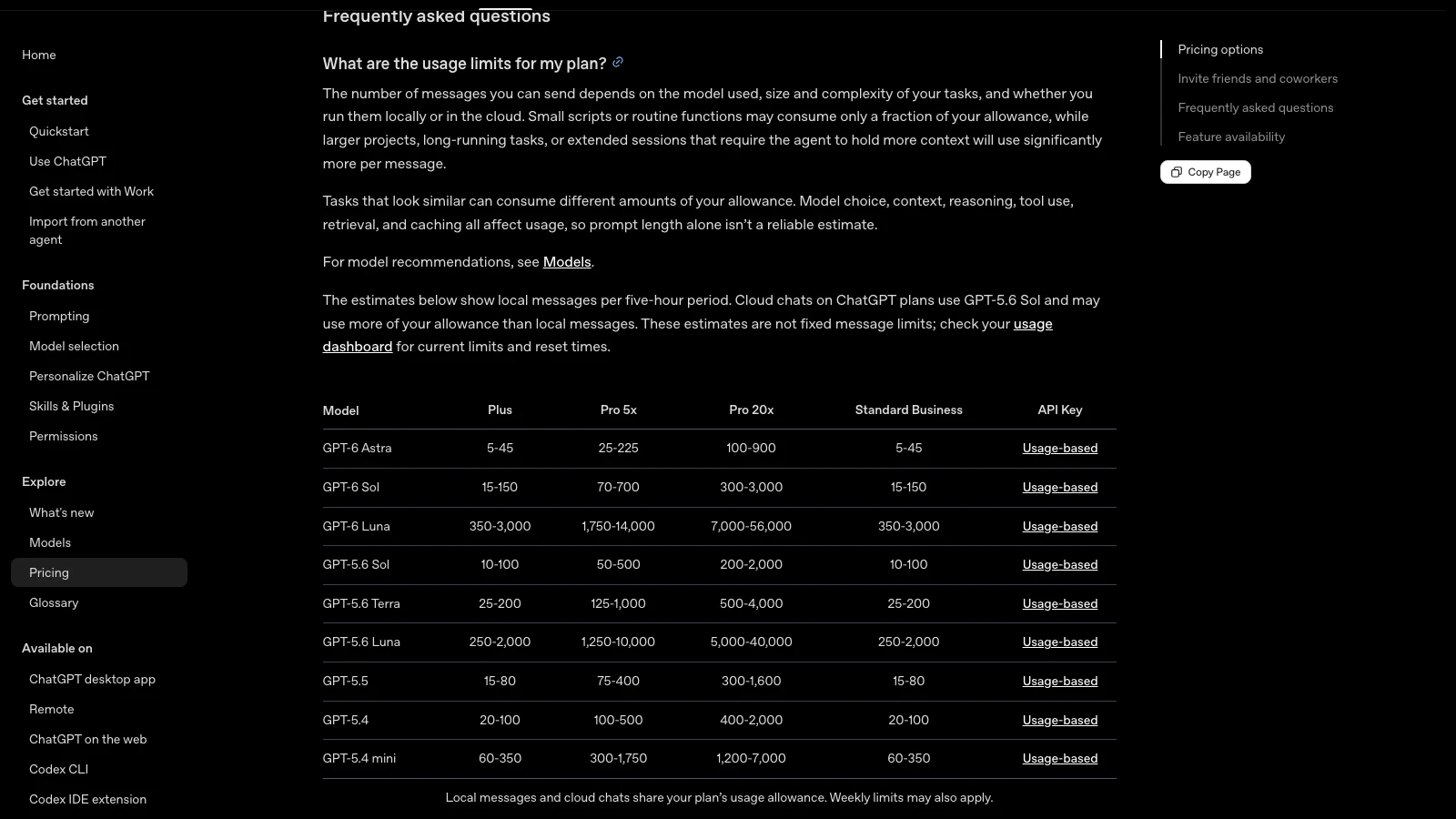
The current estimates make the split concrete:
| Plan | Monthly price | Published multiplier | Estimated GPT-6 Astra local messages per five hours | Purchase status on September 23 |
|---|---|---|---|---|
| Plus | $20 | 1X baseline | 5–45 | Generally available |
| Pro 5X | $100 | 5X | 25–225 | Generally available |
| Pro 20X | $200 | 20X | 100–900 | Paused, except eligible one-time returns |
OpenAI warns that these are estimates, not fixed message entitlements. Model choice, context, reasoning effort, tools, retrieval and caching all change consumption. Local and cloud work share the plan allowance, and weekly limits may also apply. A single complex task can therefore consume far more of the allowance than a short exchange.
The table still exposes the commercial tension. Moving from Pro 5X to Pro 20X doubles the monthly price while quadrupling the advertised multiplier. The higher tier is the better unit deal for someone who can use it heavily. It is also the tier most likely to add sustained load after a flagship-model launch.
The pricing page and the help page now describe two different layers of the product. The pricing page says what Pro 20X includes. The help page determines who is allowed to buy it. That second layer has become as consequential as price.
The Subsidy Question Arrived Before Astra
Amanda Caswell's June feature for Tom's Guide asked why a $200 AI subscription could appear to deliver usage worth many times its price. Her article drew on a SemiAnalysis experiment that exhausted paid OpenAI and Anthropic plans with long coding and agent tasks, then valued the observed usage at public API rates. In the most extreme ChatGPT Pro case, the API-list-price equivalent reached roughly $14,000 for a month.
That number is easy to misuse. It is not OpenAI's cost to serve the account. API prices include margin and do not reveal electricity, accelerator time, depreciation or internal transfer prices. The experiment measured an extreme user, not the average subscriber. It also preceded Astra, so it cannot establish the economics of the current model.
Caswell's larger question remains useful: how stable is a flat monthly fee when a minority of users can consume vastly more than the average?
A conventional subscription works because the provider can predict the cost of serving another active customer. Frontier AI makes that harder. A message is not a standard unit of work. One request may produce a short answer. Another may load a large codebase, search files, call tools, revisit failures and keep an agent occupied for a long time. OpenAI's own pricing guidance says context, reasoning and tools all affect allowance consumption.
I would not read the September pause as proof that Pro 20X loses money, or that OpenAI ran out of a particular chip. The company has disclosed neither. The safe conclusion is smaller and still important: OpenAI saw enough pressure from Astra demand to stop adding customers to the tier with the largest consumer allowance. Capacity, whatever its precise technical bottleneck, overruled the willingness of new customers to pay $200.
A Repair Path Is Also a Product Choice
The one-time return rule is a reasonable correction. A subscriber should not lose access permanently because a card expired or a downgrade took effect during an unusual sales pause. Restoring recent members protects continuity without immediately reopening the tier to everyone.
But the design also creates a class of account-level scarcity. Two users can view the same public pricing page, have the same willingness to pay and receive different purchase options because one held the plan at the cutoff date. The visible subscription is no longer the whole offer; prior entitlement has value.
That changes how power users should judge the plan. The relevant questions are no longer only “Is 20X worth twice the price of 5X?” and “How many messages do I get?” They now include:
- Can the workflow tolerate losing the tier after a billing or account problem?
- Is the included allowance merely convenient, or has the team made it operationally necessary?
- Can heavy work move to purchased credits or metered API usage if the subscription is unavailable?
- Does the usage dashboard show enough headroom for the work being planned?
None of this means a developer should abandon consumer subscriptions. Pro 20X can still be excellent value for an eligible user. It means the subscription should be treated as a variable-access workbench, not as guaranteed infrastructure for a production dependency.
Competitors are moving in the same broad direction, although their rules differ. Anthropic offers 5X and 20X Max tiers with plan-specific capacity. Google now sells $100 and $200 AI Ultra tiers, describes limits in terms of compute used, and offers paid top-ups for additional work. The emerging pattern is not unlimited frontier intelligence for one flat price. It is a base allowance, a set of limits that reflect workload, and another meter when the allowance runs out.
What a Real Reopening Would Look Like
OpenAI still calls the Pro 20X pause temporary. A genuine reopening would be easy to recognize: a customer without prior $200-plan history could select Pro 20X from the public pricing page and complete the purchase. The one-time return rule would no longer be the exception that controls access.
Until then, three signals matter. First, the help page should remove the eligibility restriction or state a broader purchase rule. Second, ordinary renewals and payment recovery should behave consistently with the published policy. Third, the pricing page and the checkout flow should tell the same story about who can buy the plan.
The September sequence has already answered the larger question. GPT-6 Astra did not simply add a better model to ChatGPT. It exposed the fragility of selling intensive agent work through a fixed-price consumer tier. OpenAI responded first by closing the heaviest door, then by opening a narrow side entrance for people who had recently been inside.
That side entrance is fairer than leaving displaced subscribers outside. It is not a return to normal sales. Pro 20X is currently a rationed entitlement, and the honest way to evaluate it is as a place in a capacity pool whose rules can change when the next model arrives.