
A server can require a password and still process an outsider’s data before anyone logs in. It has to receive a connection, understand something about the request and decide how authentication should proceed. The security question is how much work it performs along the way, and whether every reachable feature belongs there.
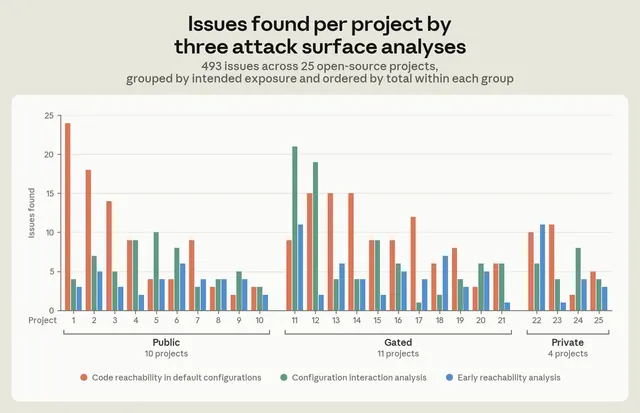
That is the practical issue behind Anthropic’s October 20 research on using Claude to reduce software’s attack surface: the parts of a program an attacker can reach. The company reports 493 findings across 25 open-source projects. Its clearest public outcome is a change in OpenSSH, software used for secure remote access, where maintainers moved checks on permitted key algorithms earlier in processing.
For a development team, this is a reason to try a narrowly defined hardening task: reducing avoidable exposure. It is also a reason to demand more from the result than a persuasive report. The worthwhile output is a change that demonstrably removes an unnecessary route into the program, survives compatibility checks and reaches the people responsible for maintaining it.
A Smaller Door Into the Same Program
Think of an imaginary service that accepts several document formats but permits customers to use only one. If it fully decodes every uploaded file before checking the permitted format, a rejected request can still exercise complicated decoding code. An earlier check could spare that work. This is an illustration of the design choice, rather than a claim about a particular product.
The location of the check matters because rejection at the end cannot undo processing that already occurred. A developer looking only at the final response might see the expected error and conclude that the restriction works. Someone inspecting the execution path could discover that the restriction takes effect later than intended.
There is an important condition: the program must safely learn enough about the input to enforce the restriction. Moving a check earlier is not simply a matter of moving a line of code. The team has to establish which information it can trust at that point and which work the protocol actually requires.
Security researcher Halvar Flake gave the general approach a strong endorsement on October 21, writing that attack surface reduction “is the one thing that reliably works.” His short public comment supplies a useful question for this case: which exposure has actually disappeared? It does not establish the effectiveness of every change proposed by an AI model.
For managers, that question changes the assignment. Asking for a list of everything that looks dangerous invites a large review queue. Asking the tool to investigate one specific boundary creates a smaller, falsifiable claim: this input should stop here, but currently reaches this additional code.
The OpenSSH Change Has a Maintainer’s Receipt
OpenSSH’s release notes show the work landing before Anthropic published its research account. Version 10.5, released August 11, says it moved the check of a public key’s type against allowed algorithms ahead of parsing the key supplied by the peer. The project credits Christopher Paul Rohlf of Anthropic with the suggestion.
Parsing means turning incoming data into the structures the program uses. In this setting, an allowlist specifies which algorithms are permitted. Checking that list earlier can keep a disallowed choice from reaching processing code. The release note establishes the direction of the change; it does not put a percentage on the reduction in security risk.
The October 6 release of OpenSSH 10.6 describes a further change: checking key types and certificate-authority signature types against allowlists as early as possible during parsing. It credits Rohlf in collaboration with Claude and Anthropic Research. The distinction between the two releases matters. An initial improvement was followed by a more comprehensive check, rather than one effortless patch solving the whole problem.
That sequence is useful for teams evaluating coding agents. A plausible first fix may enforce the right rule at one entrance while leaving another route open. Review has to follow the relevant inputs through the program. The presence of a new conditional statement, or a test that covers the most obvious request, is only a starting point.
The chronology also keeps the news in proportion. October 20 was the publication of the research account; it was not the day OpenSSH users first received the described hardening. There is no new universal deadline or newly demonstrated active exploit implied by the date of that blog post.
The accepted algorithms and supported features can change between releases. Operators need the security guidance and package information for the version they actually run. An earlier build’s disabled feature should not become a configuration assumption about a later one.

What the Headline Numbers Leave Open
Anthropic estimates that the completed change removed roughly a fifth of previously reachable pre-login code in a default OpenSSH build. Its measurement concerns reachability, rather than code deleted or a matching reduction in the likelihood of compromise.
A line count treats each line as an equal unit. Security does not. A short path that crosses a critical boundary can deserve more attention than a long routine that performs well-understood work. Conversely, a substantial body of unnecessary processing may be worth excluding even when nobody has demonstrated a way to exploit it.
The right inference is conditional: if a request no longer reaches code it does not need, defects confined to that route become less accessible through that request. Other routes and other defects remain separate questions. The value comes from the enforced boundary, rather than from converting a code statistic into a promised safety score.
The 493 reported issues also differ from a count of exploitable vulnerabilities. Anthropic says its gated-project findings were not immediately exploitable on their own. An audit must distinguish unnecessary exposure, inconsistent settings and demonstrated vulnerabilities: each requires a different assessment.
OpenSSH’s own introduction to the 10.6 release adds an important counterweight. The maintainers say many AI-assisted reports lack security impact under a realistic threat model. They welcome reports accompanied by human analysis, test cases and proposed fixes. That is a practical standard for anyone buying or commissioning an AI audit: the people who must act on it need something they can verify.
Public discussion also reveals friction between finding a problem and checking it. In the original Hacker News thread, commenters including messe and xnorswap describe defensive verification work being interrupted by model restrictions. These are individual reports, rather than evidence about all users. For a team choosing a tool, they suggest testing the complete authorized workflow, including validation, before promising a delivery date.
Put the Review Effort Into the Change
Anthropic describes execution traces—records of what a program actually runs—and regression checks, which test for unintended changes. It reserves changes to non-default behavior for human decisions. That connects a suspected exposure to a running program, rather than relying on a confident explanation of source code alone. Existing tests still need to cover the behavior the deployment requires.
This is a research method rather than a newly launched turnkey audit product. Anthropic says integration of its reusable skill into OSS-Scanner is in progress. The account does not establish a particular Claude model version, a full-run price or a controlled comparison of the total work required. Teams should budget for their own trial.
For an initial trial, choose a service whose intended behavior the team already understands. State the relevant deployment and configuration, the input under examination and the boundary it should encounter. Keep the experiment small enough that a maintainer can inspect the entire claim. A broad request to harden an unfamiliar repository makes it harder to separate discovery from guesswork.
The following criteria are an editorial proposal for evaluating that trial, not measurements of Claude or a guarantee of security.
| Evidence to request | Decision it supports |
|---|---|
| A reproducible trace showing the unnecessary path before the change | Is the reported exposure real in the stated configuration? |
| The corresponding trace after the change | Does the intended restriction now take effect at the required point? |
| Tests for legitimate requests and relevant configurations | Has the fix preserved the behavior users depend on? |
| A reviewed patch and a clear account of remaining limits | Can the maintainer accept and support the change? |
Include the review burden in the evaluation. A tool that finds one actionable issue with a compact reproduction may be more useful to a small team than one that produces dozens of ambiguous warnings. Count the time spent validating claims, correcting patches and investigating regressions, alongside the time the model spends generating them. The published study does not establish a universal saving on that total.
When Keeping the Exposure Is the Right Decision
The strongest objection to indiscriminate reduction is that some processing must remain available to an unauthenticated client. A remote-access service cannot require an established login before it performs every step needed to establish that login. A legitimate compatibility requirement may also explain a path that initially looks unnecessary.
In those cases, a team may reasonably keep the code reachable and improve another defense, or decide that the proposed change needs more work. A smaller reachable program is a useful engineering objective when it preserves the service’s purpose. It is a poor target if an agent can meet it by silently removing a supported feature.
Passing existing tests helps, but those tests express the cases somebody thought to write. They do not by themselves settle whether an unfamiliar configuration is supported or whether an untested client still works. This is where the maintainer’s understanding of the product remains part of the security result.
The OpenSSH example offers a concrete standard for a first AI hardening project: follow one unnecessary path from a reproducible observation through a reviewed change into a maintained release. If a team can complete that chain without losing required behavior, it has something more useful than a larger issue count. It has a specific boundary that the software now enforces earlier.