
When hardware engineers talk about artificial intelligence, conversation naturally drifts toward the silicon: floating-point operations, high-bandwidth memory stacks, and optical transceivers. The electrical infrastructure that feeds these chips is routinely described as plumbing, a necessary but unglamorous web of cables, transformers, and switchgear whose sole job is to sit quietly and deliver current.
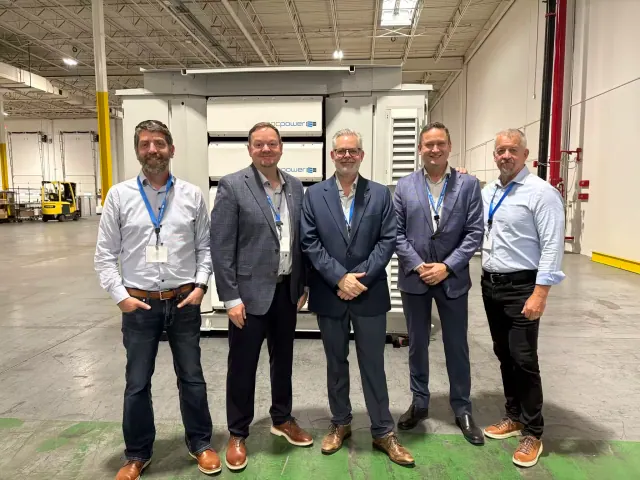
On September 3, 2026, Flex challenged that assumption by agreeing to acquire power-conversion specialist EPC Power for $4.4 billion in cash.
To understand why a global manufacturing and design services giant would commit that scale of capital to power conversion, one has to look at what happens inside an AI data center when tens of thousands of accelerators ramp simultaneously. As rack power densities climb, power conversion ceases to be passive equipment. It becomes a dynamic control problem.
Flex is betting that EPC Power’s bi-directional conversion hardware and software will allow it to govern the volatile boundary where utility feeds meet compute infrastructure. Yet the deal also surfaces a critical tension running through modern infrastructure planning: making power delivery more efficient and better controlled does not create a single kilowatt-hour of new generation capacity.
The Plumbing Turns Into a Control Layer
Inside a standard enterprise facility, power distribution is relatively straightforward. Medium-voltage alternating current (AC) enters the site, steps down through facility transformers, routes through uninterruptible power supplies, and reaches server racks as low-voltage AC before internal power supply units convert it to direct current (DC) for the motherboards.
AI clusters break this historical model through sheer density. When individual server racks demand 40 kW, 100 kW, or even higher thresholds, moving low-voltage current across a facility runs directly into basic physics. Electrical losses in conductors rise with the square of the current ($I^2R$). To deliver megawatt-scale power at conventional voltages without losing untenable amounts of energy as heat, an operator must install thick, heavy copper busbars that consume precious physical space, add mechanical weight, and escalate capital costs.
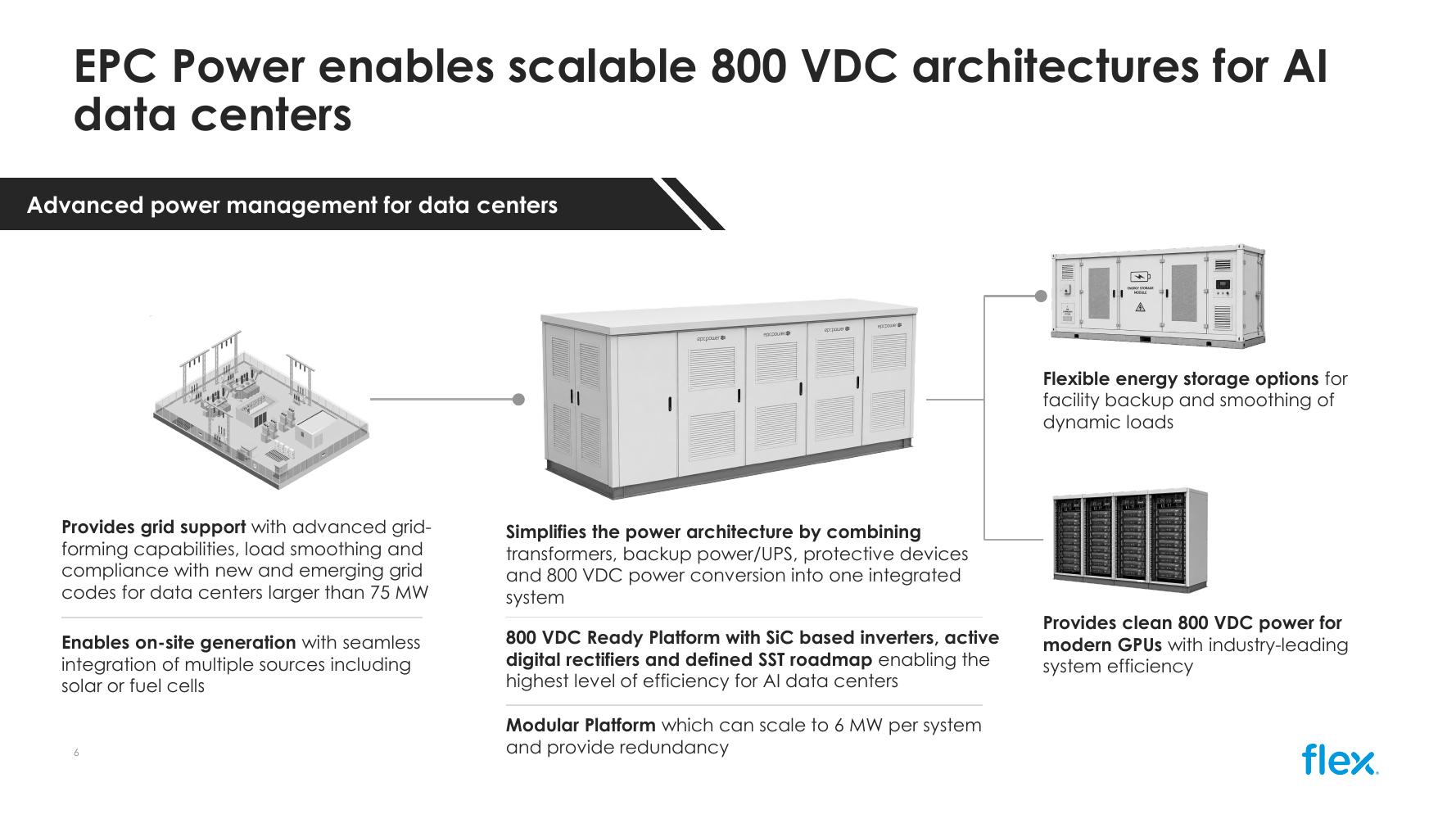
The industry’s proposed answer is moving to an 800V DC distribution architecture. By stepping up the distribution voltage, the electrical system can transport an identical amount of power at substantially lower current. That reduction in current slashes resistive losses and shrinks the physical conductor footprint required to feed dense rows of compute.
| Parameter | Lower-Voltage Conventional DC/AC Distribution | 800V DC Architecture | Operating Trade-off |
|---|---|---|---|
| Relative Current ($I$) | Higher current required for equivalent power | Lower current required for equivalent power | Lower current cuts conductor gauge and physical weight |
| Conductor Distribution Losses ($I^2R$) | Higher resistive heat generation across busbars | Lower resistive heat losses across equivalent runs | Dependent on workload profile and system setup |
| Conversion Stages | Multi-stage conversion (medium-voltage AC to low-voltage AC to DC) | Streamlined step-down and direct DC-DC conversion paths | Eliminates redundant conversion stages if architecture is unified |
| Interconnect Behavior | Slower physical response to dynamic compute step-loads | Millisecond-level digital rectification and grid-forming controls | Demands software-driven power controls rather than passive routing |
EPC Power operates squarely within this transformation. Its product portfolio spans active digital rectifiers, DC-DC converters, energy-storage integration hardware, and grid-forming control software. These are not static junction boxes; they are active, software-driven conversion devices designed to govern power transitions in fractions of a second.
Crucially, EPC’s roadmap includes solid-state transformers (SSTs)—semiconductor-based systems intended to replace massive, oil-filled or dry-type magnetic transformers with compact, high-frequency conversion stages. However, solid-state transformers remain an uncompleted engineering roadmap item without a guaranteed delivery or shipping schedule. What EPC provides today is the hardware and software layer that mediates between the incoming alternating current and the direct current feeding the compute cluster.
The Physics of Modern AI Workloads
The electrical problem inside modern AI facilities is not merely the total volume of energy consumed; it is the violent rate at which that consumption changes.
Deep learning training runs and bursty inference workloads introduce step-loads—massive, near-instantaneous spikes in power demand that occur when computational jobs synchronize across thousands of GPUs. Conversely, when a job finishes, faults, or halts for a checkpoint, power demand can plummet within milliseconds.
To a regional utility grid, these dynamic step-loads look like severe electrical disturbances. Grid infrastructure relies on rotational inertia from conventional generators to maintain steady frequency and voltage. Sudden swings in megawatt demand can cause voltage sags, trigger harmonic distortions, or trip protection relays on local distribution lines.
This operational friction explains why power conversion has evolved from a commodity hardware layer into a strategic software-defined gatekeeper. EPC Power claims its grid-forming controls can respond to power fluctuations in milliseconds, actively buffering step-loads by coordinating local energy storage or on-site generation sources. Instead of passing volatile swings directly back through the substation, these systems are designed to smooth the facility's demand profile so it behaves predictably at the point of common coupling.
Think of it like an air-lock buffer on a pressurized submarine. The compute floor is subject to turbulent, rapid pressure swings as workloads start and stop, but the control layer ensures that the outside environment—the utility grid—sees only a measured, steady draw.
Yet as industry analysts point out, this architectural capability must not be confused with generating capacity. Neil Osnato, an infrastructure analyst who evaluated the transaction for Data Center Knowledge, underscored that load smoothing is not load elimination. A digital rectifier backed by an on-site battery can absorb a transient peak or bridge a brief drop in utility supply, but it cannot alter the total quantity of megawatt-hours a data center requires over the course of a day.
Electric utilities will not greenlight a multi-megawatt interconnect because a vendor slide says the controls are intelligent. Operators still need verified documentation on ramp rates, storage discharge duration, harmonic distortion, and fault behavior when the grid is degraded. Software can reshape a load profile; it cannot skip the interconnection queue or substitute for physical generation.
Anatomy of the $4.4 Billion Bet
The mechanics of Flex's agreement to acquire EPC Power illustrate how aggressively manufacturing platforms are moving to secure proprietary positions across the AI data center stack.
Under the terms of the agreement announced on September 3, 2026, Flex agreed to acquire EPC Power for $4.4 billion in cash, subject to customary adjustments and regulatory approvals. The transaction is signed, not completed; closing remains subject to the expiration of the waiting period under U.S. antitrust laws and other standard conditions, with completion targeted for the fourth calendar quarter of 2026. To finance the purchase, Flex secured a commitment for a 364-day bridge facility of up to $4.4 billion, which it plans to refinance through a combination of debt and equity instruments.
Flex has outlined a distinct operational and corporate path for the business:
- If the transaction closes, EPC Power will be integrated into Flex's Cloud and Power Infrastructure group.
- Flex intends to separate that combined Cloud and Power Infrastructure group into an independent, publicly traded company in the first calendar quarter of 2027.
- Flex stated that EPC Power is expected to generate approximately $800 million in revenue in calendar 2026.
- Flex further projected that EPC Power would deliver roughly 40% organic revenue growth in 2027 while maintaining an EBITDA margin of around 30%.
Technology planners must treat these forward-looking targets as company projections rather than established financial results. EPC Power is expanding its industrial footprint, having opened a 167,000-square-foot manufacturing plant in Fountain Inn, South Carolina. EPC reported an initial annual production capacity of 27 GW at the site, which it claims can scale to 40 GW, alongside expectations that its total U.S. production capacity will exceed 30 GW during 2027. These capacity metrics represent theoretical manufacturing throughput under optimal operational conditions rather than audited output.
If the transaction closes as structured, it will give Flex a continuous footprint spanning compute board assembly, liquid-cooling integration, and primary power conversion. Historically, these subsystems were procured from fragmented suppliers: switchgear from electrical conglomerates, power modules from specialized component makers, and server sleds from contract manufacturers.
By holding EPC’s conversion hardware, Flex hopes to sell integrated infrastructure packages where the power-delivery train is co-designed with rack-level compute and liquid-cooling manifolds. However, the operational efficiencies of this unified portfolio remain prospective until integrated hardware is deployed and verified in customer environments.
The Limits of Electrical Control
Flex’s acquisition makes strategic sense precisely because 800V DC distribution is not an effortless plug-and-play solution. Transitioning from legacy distribution to high-voltage direct current requires substantial capital investment, unproven component reliability over multi-year cycles, and an intense engineering effort to convert theoretical electrical advantages into equipment that utilities and site operators can safely run.
The persistent danger for infrastructure executives is assuming that sophisticated electrical engineering can bypass regional energy shortages. An 800V DC system, equipped with millisecond-speed digital rectifiers and grid-forming controls, accomplishes two specific tasks: it decreases the internal conductor losses associated with delivering massive amounts of current to dense compute clusters, and it buffers the grid against the violent step-loads caused by synchronized AI workloads.
What it does not do is create energy. A data center requiring 100 megawatts of steady-state power still requires 100 megawatts of generation upstream. If a local utility lacks transmission capacity or power plants to serve that baseline demand, active power conversion will not bring the cluster online.
Flex is paying $4.4 billion because it recognizes that the physical bottlenecks inside AI facilities have shifted from the server board to the power distribution path. If EPC Power's manufacturing base scales and its controls perform as promised, Flex may capture the critical juncture where incoming power is conditioned for dense AI silicon. But that success will be measured by verified uptime, utility-certified grid compliance, and actual manufacturing execution, not by the promise of the architecture alone.