
Imagine a small team adapting an AI model to answer questions about its product. The team already has working training code. Trying a different chip becomes attractive if it can keep that code, produce equally useful answers and finish the work for less money. Rebuilding the application before learning whether the new machine helps would make the experiment much harder to justify.
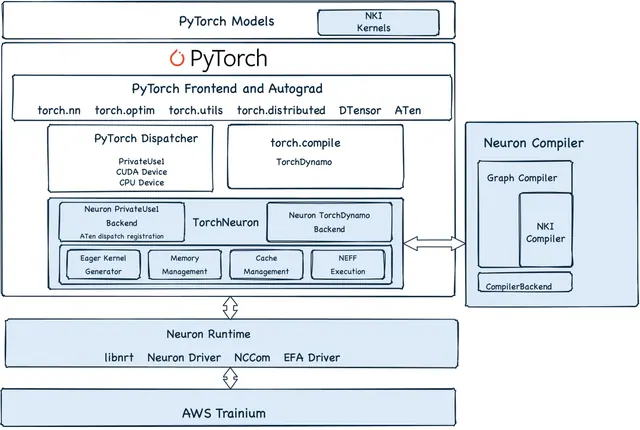
AWS’s October 20 public beta of TorchNeuron aims to lower that initial hurdle. It connects PyTorch, the software framework used to define and train models, to Amazon’s Trainium2 and Trainium3 accelerators. Developers select the neuron device for their models and inputs instead of rewriting the whole model around another framework.
The practical opportunity is to make a hardware comparison affordable enough to attempt. Whether a team should move its production work depends on what happens after the first successful run: the same model must still produce acceptable results, handle real inputs and complete the job at a useful total cost.
What the One-Line Change Buys
PyTorch provides the operations from which developers build a model. A backend connects those operations to a particular kind of processor. TorchNeuron makes Trainium a native PyTorch device, using the framework’s established extension mechanism. Training means adjusting the model from examples; inference means using the resulting model to generate an answer or another output. Trainium supports both.
Stephen Nellis’s October 19 Reuters report put the launch in the competition for developers’ existing software investment. In his interview, AWS Annapurna Labs software executive Colin Brace described reducing the steps needed to try Amazon’s hardware. That is a useful way to judge this release: how much work must a team commit before it can obtain a credible comparison?
Hugging Face’s integration announcement provides a concrete answer for some users. It recommends using its familiar libraries directly on the native backend, instead of going through Optimum Neuron’s separate adaptation layer. Its authors report support for 89% of the top 100 most-used text-generation architectures, compared with 46% under Optimum Neuron v0.4.5.
That is meaningful progress for a developer whose model belongs to a supported architecture. It is an architecture-coverage result, however, rather than a promise that 89% of complete applications will run correctly or economically. The model’s particular settings, dependencies and training method still matter.
The software is open source under Apache 2.0. Running it still requires suitable AWS compute. The beta announcement supplies no universal saving or instance price that would settle a team’s migration decision.
A Working Library Can Still Need a Particular Version
The strongest case for trying TorchNeuron is an ordinary workload built from supported PyTorch and Hugging Face components. Such a team may preserve most of its model code and spend its effort measuring the result. A custom extension written for NVIDIA’s CUDA software changes the calculation: the extension is additional software whose Trainium support must be established separately.
Hugging Face’s public TRL tracker illustrates how specific this distinction becomes. TRL is a library for adapting models with methods such as supervised fine-tuning and learning from rewards. Its maintainer’s tests cover several trainers, options and model families, with different outcomes for different library versions.
The tracker records a fused-kernel dependency that broke several trainers in TRL 1.15. The related issue was closed on October 14, and the tracker shows those trainers working on the development branch. It would be misleading to present that early failure as proof that current TRL cannot work on Trainium. It would be equally misleading to assume a fix on the development branch exists in every installed release.
These tests are useful evidence because they include configurations and failures, rather than only a launch demonstration. Their scope remains small: the tracker describes three-step tests on tiny models, with additional tests on Qwen3-0.6B. Passing those runs establishes a starting point for testing, rather than a completed production qualification.
AWS’s own upstream testing also needs its denominator. The accompanying announcement reports roughly 154,000 test outcomes in an August run, with about 69,000 skipped; around 39,000 of those skips were specific to Neuron. High pass rates among enabled tests therefore coexist with deliberate feature gaps. A team needs the capabilities its model uses, not an average across unrelated tests.
Why a Fast Training Step Can Follow a Long Wait
TorchNeuron offers eager execution, which runs operations as Python calls them, and compiled execution, which prepares larger parts of a model for optimized execution. Eager mode helps a researcher inspect and debug code. Compilation can improve repeated work, while introducing a preparation cost.
The compiler specializes work for particular input shapes: the sizes of the arrays entering the model. A different shape can require another compilation. For text models, inputs of different lengths can therefore produce repeated waits. Padding short inputs to a small set of permitted lengths, often called bucketing, trades some extra calculation for more reuse of already compiled work.
Hugging Face maintainer qgallouedec’s open issue #7733 shows why that trade matters. In an October 14 report, a Qwen3-0.6B reward-training example on one NeuronCore, a unit of Trainium compute, started with an empty compilation cache. Its six steps took 741, 733, 24, 752, 25 and 29 seconds. Previously prepared prompt-length buckets ran quickly; new buckets incurred substantial compilation.
Those are reported results from one setup, not measurements of every Trainium workload. They nonetheless expose a decision that a demonstration of a single warm step can hide. A short experiment may spend most of its life preparing work. A long, repeated job may spread the same preparation over enough useful steps that the cost becomes modest.
The current TRL guide on the development branch, whose documentation requires installation from source, gives a positive example too. For its specified one-core, 20-step supervised fine-tuning example, default padding takes 130 seconds versus 260 seconds without padding. This compares two configurations on Trainium, not Trainium against a GPU. It shows how input handling can determine the benefit within the same hardware choice.
The Work That Remains Around the Model
A supported interface does not remove numerical or execution differences. The backend README warns that float64 values run as float32, which can alter results requiring higher precision. It also says non-contiguous inputs need copying for compiled execution. A program completing without an exception does not, by itself, establish equivalent answers or efficient data movement.
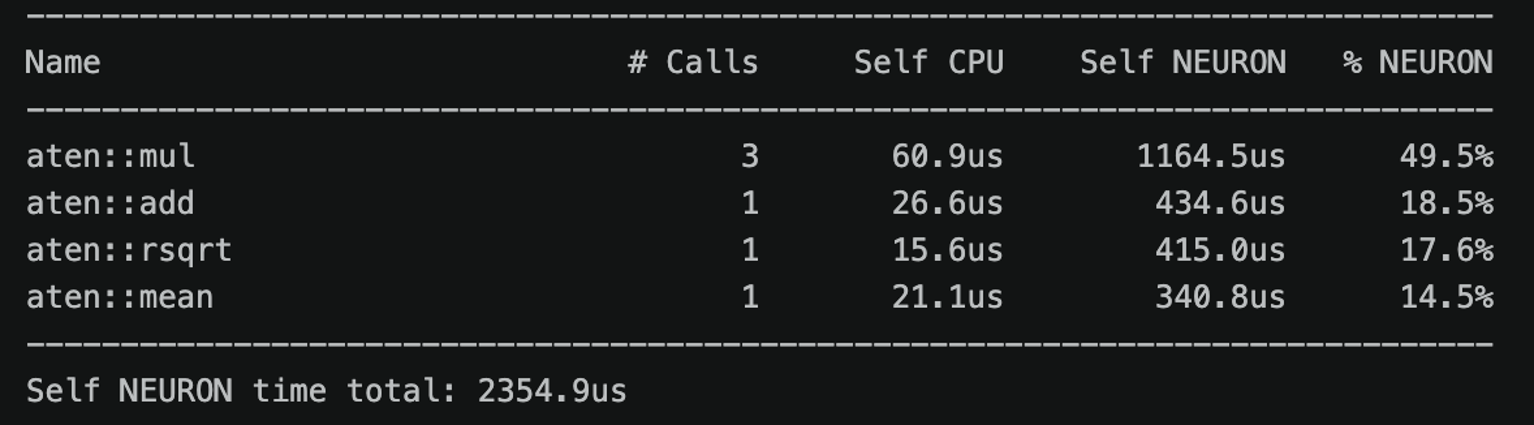
The API compatibility guide separates operations implemented on the device, operations using CPU fallback and unsupported operations. Eager CPU fallback can help code continue, but a workload relying on it needs profiling to establish where its time goes.
Compiled-graph fallback is a different mechanism. AWS’s compiler documentation says falling back to the original uncompiled graph after certain compilation or execution failures is disabled by default. Eager-mode CPU fallback therefore does not promise recovery from a compilation failure. The two paths answer different questions about where and how work runs.
Specialized optimization remains available through the Neuron Kernel Interface, or NKI. A kernel is a small routine implementing an operation efficiently for the chip. AWS’s NKI guide recommends profiling first, trying the existing library and writing a custom kernel when the bottleneck warrants it. Training through a custom operation also requires an appropriate backward calculation, which tells the model how to adjust its parameters.
That is valuable flexibility for a team with a clear performance problem. It also changes the investment: maintaining a Trainium-specific optimization requires more work than selecting another device for otherwise portable model code.
A Useful Trial Follows the Whole Job
A migration trial should answer the question the team actually faces. For the hypothetical product assistant, that means adapting the model to the same examples and assessing it against the same answer-quality requirements. The relevant output is an acceptable trained model, including the time required to obtain and validate it.
| Workload characteristic | What the trial needs to establish |
|---|---|
| Standard model using supported libraries | The exact versions and settings work, and the trained model meets the existing quality requirement. |
| Repeated batches with a few input sizes | Compilation is reused enough to improve total completion time. |
| Short runs or frequently changing shapes | Preparation and recompilation do not consume the expected saving. |
| Custom kernels or precision-sensitive calculations | Required operations, numerical behavior and maintenance work remain acceptable. |
Keep the current working system as the comparison. Record environment preparation, the first run, later runs and the evaluation separately. If compilation artifacts can be reused in the intended deployment, that is a real benefit. If each experiment changes the model or compiler enough to require fresh preparation, treating an already warm cache as the normal starting point would conceal part of the cost.
The financial comparison follows the same boundary. Instance charges for the complete task, supporting resources and the engineering time needed to establish compatibility belong alongside throughput. An open source backend can reduce adoption friction without eliminating those costs. No single token price or fast step settles the full calculation.
AWS’s Matt Wood argues that past hardware choices should place fewer constraints on what teams build next. TorchNeuron’s native integration gives that argument substance: a supported workload can reach a meaningful trial through tools its developers already know. The public integration records make the next decision more concrete. Move the workload when its complete, repeatable run meets the required quality at a better total cost; use a promising first run to begin that comparison.