
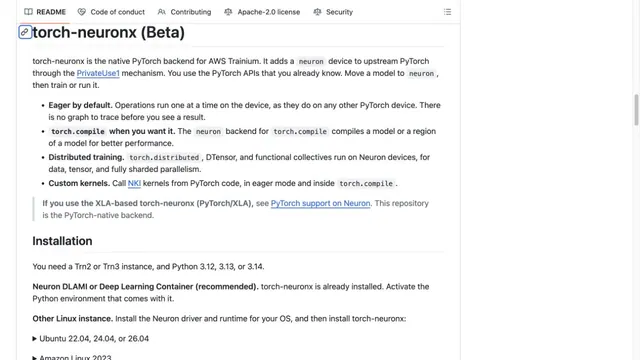
AWS announced TorchNeuron’s public beta on October 20, giving researchers a native PyTorch backend for its Trainium AI chips. Developers move models and inputs to the neuron device and can use eager execution, torch.compile, distributed training and custom kernels through the Neuron Kernel Interface, or NKI.
The announcement follows the underlying Neuron 2.33.0 component release, which the repository dates October 15. It is a software update for existing Trainium2 and Trainium3 instances, rather than the introduction of another chip.
A Different Backend With a Familiar Package Name
The public repository uses the torch-neuronx package name, but distinguishes this native backend from the older PyTorch/XLA-based product. Existing XLA code needs migration; installing an earlier package is not the same as adopting the new backend.
The current README pairs PyTorch 2.14.0 with the torch-neuronx==2.14.* package family and Python 3.12, 3.13 or 3.14. AWS recommends a preconfigured Neuron machine image or container, which already includes the package. The release notes list Ubuntu 24.04 and 26.04 on Linux x86_64 as supported, with Ubuntu 22.04 at end of support. The backend is Apache-2.0 licensed; the announcement does not specify a separate beta fee or change EC2 instance pricing.
Native APIs Still Have Limits
In eager mode, operations execute as Python calls them. The repository’s compatibility guide classifies APIs as supported, supported with CPU fallback, or unsupported. Eager-mode fallback can keep some code running on the CPU, which does not mean every operation runs on the accelerator.
Compiled execution requires static input shapes with dynamic=False. A new shape triggers another compilation. The README also warns that compilation adds time on the first call, non-contiguous inputs require copying, and float64 executes as float32, potentially changing results that depend on 64-bit precision. TorchAO integration is unavailable in this release.
Those conditions make workload compatibility a material part of moving an existing model. Familiar PyTorch calls reduce one source of porting work; they do not establish equivalent numerical behavior, throughput or end-to-end cost for every model.