Google announced Gemini 4 Carbon on October 28, starting with a subset of cybersecurity defenders and planning to expand access gradually through its Fairwind Program. Developers, businesses and consumers are due to receive it later through Google's products; the announcement gives no date for that broader release.
Carbon follows Gemini 4 Argon and targets sustained software engineering and security work. Google says its internal teams have used it on tasks lasting days, including finding and patching difficult bugs across large codebases. Those are company observations, rather than a guarantee that an unattended agent will finish a particular project.
Access and Announced Prices
Google says it is participating in the US government's voluntary process for testing models before release and is gathering feedback on safeguards during the initial rollout. The announcement does not establish general API availability or access for every paid Gemini subscriber.
Tokens are the units used to meter model input and output. The announced introductory price is $2 per million input tokens and $10 per million output tokens. Cached input receives a 95% discount, equivalent to $0.10 per million tokens. After the introductory period, the stated input and output rates rise to $4 and $20 respectively. Google does not give Carbon's introductory period an end date in the announcement.
Reported Gains Have Boundaries
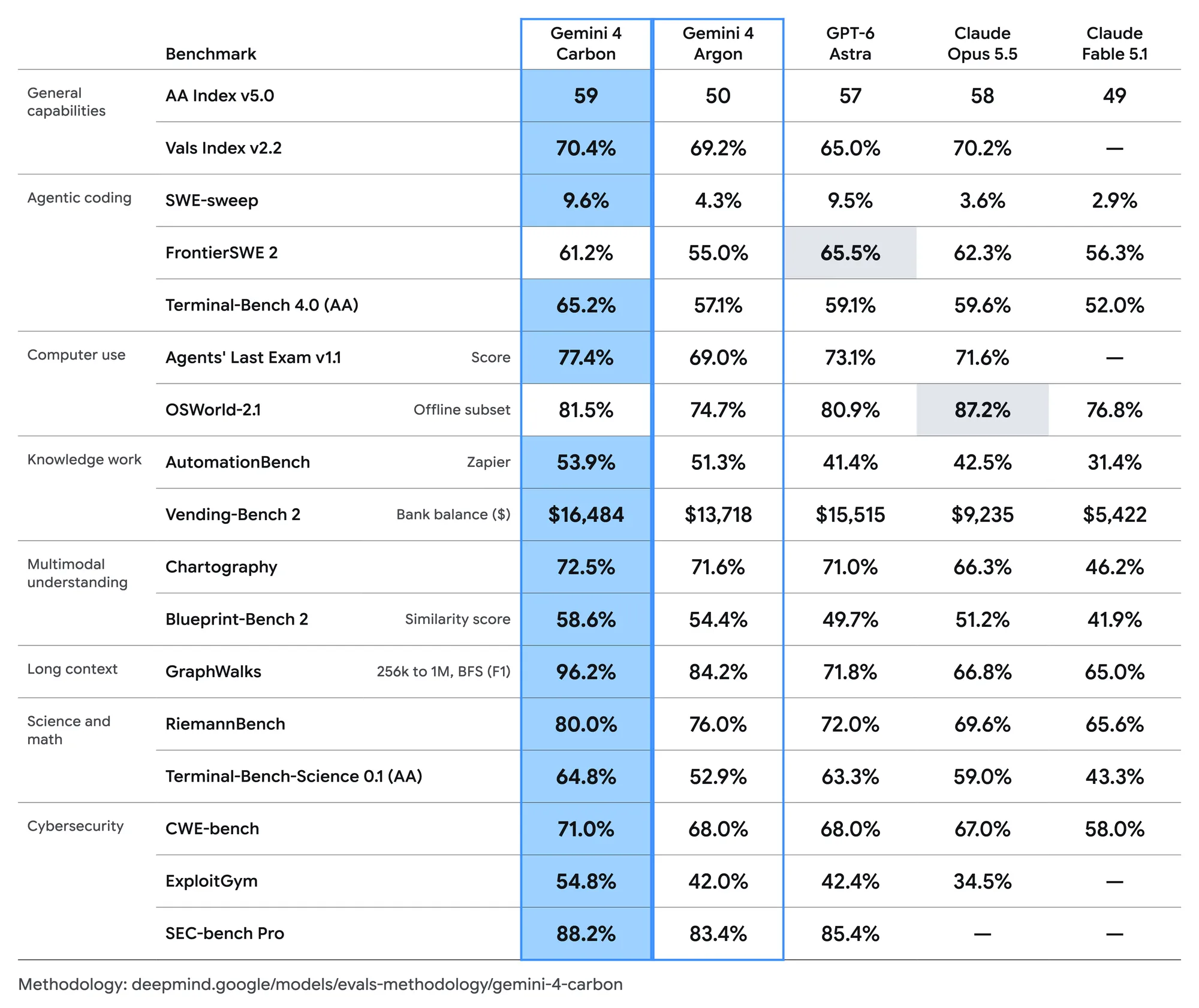
Google reports scores of 88.2% on SEC-bench Pro for vulnerability discovery, 54.8% on ExploitGym for exploitation and 71.0% on CWE-bench for patching. It explicitly says these external benchmark evaluations ran without the model’s guardrails, or safety controls, so those results do not directly describe the model's guarded production behavior.
Its comparison table also shows that gains vary by task. Carbon scores 61.2% on FrontierSWE 2, behind the listed GPT-6 Astra result of 65.5% and Claude Opus 5.5 result of 62.3%. The announcement supports a stronger successor to Argon across many evaluations, rather than a lead on every software engineering test.
Google also reports fewer unsupported claims and fewer severe misalignment alerts in internal use. Its reported zero successful attacks on a prompt-injection evaluation, which tests malicious instructions embedded in material an agent reads, means no attacks succeeded in that tested set; it does not establish immunity to future attacks.