
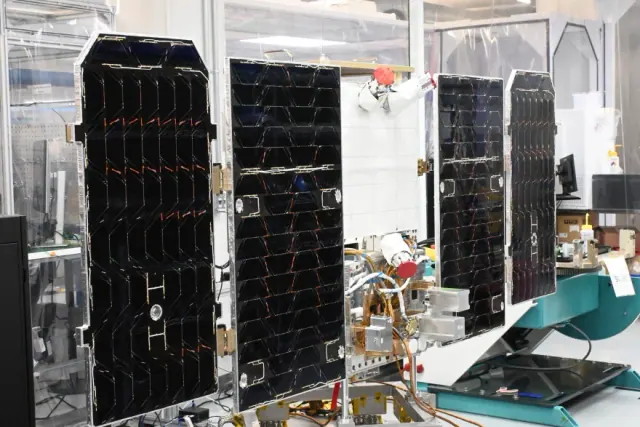
The experimental spacecraft, developed under Google's Project Suncatcher, launched aboard a SpaceX Transporter-18 mission from Vandenberg Space Force Base on October 1, 2026. Planet Labs confirmed that the prototype is one of 20 satellites launched on the flight, alongside Tanager-2 and 18 SuperDoves. Mission operators have established initial contact with Suncatcher, Tanager-2, and two SuperDoves, initiating early on-orbit commissioning. Planet said the remaining 16 SuperDoves would deploy via a D-Orbit transfer vehicle, with contact expected later.
Planet described Suncatcher as the first test of Google’s Tensor Processing Units (TPUs) in space. Its launch announcement establishes initial contact and commissioning, not successful AI computations or a commercial computing service.
Thermal Limits and Intermittent Workloads
NPR reported that the refrigerator-sized prototype carries four TPUs and will run Google’s open-weight Gemma model on simple queries for about 15 minutes at a time because of heat constraints.
Google’s September 24 engineering account explains that vacuum removes the airflow used to cool terrestrial hardware. The spacecraft uses heat pipes to carry heat to radiators. Google tested its cooling approach in a thermal-vacuum chamber before flight.
Near-constant sunlight is part of Google’s rationale for exploring orbital computing, but the prototype’s short planned runs show how limited this first experiment is.
Radiation and Ground Testing
Google said its ground tests included vibration and proton-beam exposure while the hardware processed AI workloads. The company reported that a Trillium TPU survived an ionizing radiation dose greater than expected over a five-year mission. That ground result does not establish five years of reliable operation in orbit; flight testing will examine hardware performance under space conditions.
Research Horizon
Google plans a two-satellite experiment in 2027 to test high-bandwidth laser links over short distances. Such links would let multiple spacecraft exchange data for larger computations. This is a later research stage, separate from the prototype now being commissioned.
The immediate milestone is therefore a spacecraft in orbit with initial contact established. Results from its planned AI workload tests will be needed to show what the hardware can actually sustain there.