
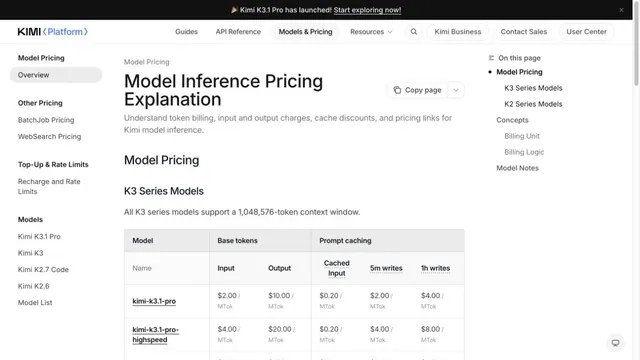
Moonshot AI has launched Kimi K3.1 Pro across its chat, work and coding products and API. The standard API model costs $2 per million input tokens and $10 per million output tokens, one third below K3’s current $3 and $15 rates. A separately priced Highspeed variant costs twice as much for uncached input and output.
The company describes K3.1 Pro as a more extensively post-trained version of K3, aimed at coding, 3D creation and financial research. Both new variants are hosted now; the announcement promises full model weights by November 4, 2026. That makes downloadable deployment a future option, rather than something available with the hosted launch.
API Access and Billing
The API supports a 1,048,576-token context window. K3.1 Pro always uses thinking, with low, high and max reasoning settings; max is the default. A successful top-up of at least $1 unlocks the flagship model, and cumulative payments determine the account’s rate-limit tier.
| Model | Input per million tokens | Output per million tokens | Cached input per million tokens |
|---|---|---|---|
| Kimi K3.1 Pro | $2 | $10 | $0.20 |
| Kimi K3.1 Pro Highspeed | $4 | $20 | $0.20 |
| Kimi K3 | $3 | $15 | $0.30 |
These are API prices before tax. Cache writes are billed separately: five-minute writes cost $2 per million tokens for Pro and $4 for Highspeed; one-hour writes cost $4 and $8. Repeated prefixes use automatic caching with a five-minute default lifetime. API billing is pay as you go and separate from Kimi membership and Kimi Code subscriptions.
Moonshot says Highspeed delivers two to three times Pro’s speed. That is a provider claim, not a guarantee for every request or account.
Products and Availability
The launch covers Kimi’s website and mobile apps, Kimi Work, Kimi Code and the API. Work requires desktop version 3.1.0 or later on Windows or an Apple silicon Mac. Code users can choose the model with /model; enterprise administrators must enable it because access is off by default at launch.
Moonshot reports stronger coding and factual accuracy than K3. Its published evaluations use particular tools, reasoning settings and internal tests, so those results do not guarantee equivalent improvements on a user’s own workload.