
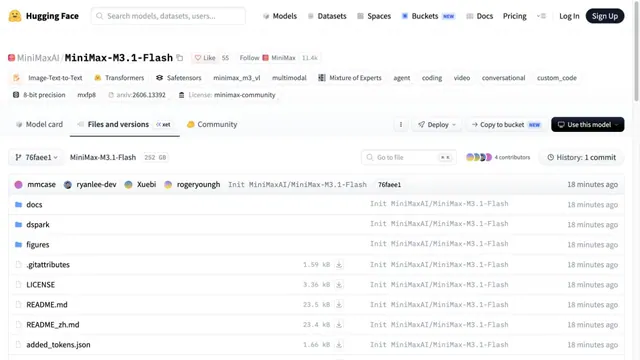
MiniMax published the M3.1 Flash model files on Hugging Face on October 23, fulfilling the weight-release date announced with its October 19 hosted launch. The repository includes 48 main weight shards, configuration files and a DSpark draft head for compatible inference systems.
The release gives developers a route to operate or adapt the model themselves. It does not turn the hosted API’s token prices into a price for running it on their own hardware.
A Large Multimodal Model
MiniMax describes M3.1 Flash as a mixture-of-experts model with about 428 billion parameters in total and 23 billion activated for each token. It accepts text, images and video and produces text, with a context window of up to one million tokens.
MiniMax recommends deployment guides for SGLang, vLLM and TokenSpeed. Its model card still lists integrations with Transformers, KTransformers, Unsloth and ATOM as work in progress. Usable context length and throughput depend on GPU memory and serving configuration.
The active parameter count does not mean the entire model fits into the memory needed for 23 billion parameters. MiniMax has not supplied one universal hardware configuration for every context length and workload.
Commercial Use Has Conditions
The weights use the MiniMax Community License. Commercial deployments must prominently display “Built with MiniMax M3.1-Flash” on a related website, interface or product documentation. Products or services generating more than $20 million in annual revenue require prior written authorization; other commercial users must send a one-time notice to MiniMax. The license also requires retaining its notices and prohibits specified uses, including military purposes.
Those conditions differ from a permissive MIT or Apache license. They also apply to commercial uses of modified models, so downloading the files is only one part of choosing a deployment path.
The hosted service remains a separate option. MiniMax’s launch prices were $0.15 per million input tokens, $0.60 per million output tokens and $0.015 per million cached input tokens. Self-hosting replaces that metered service with infrastructure and operating costs; the release does not establish a comparable cost or performance advantage.