
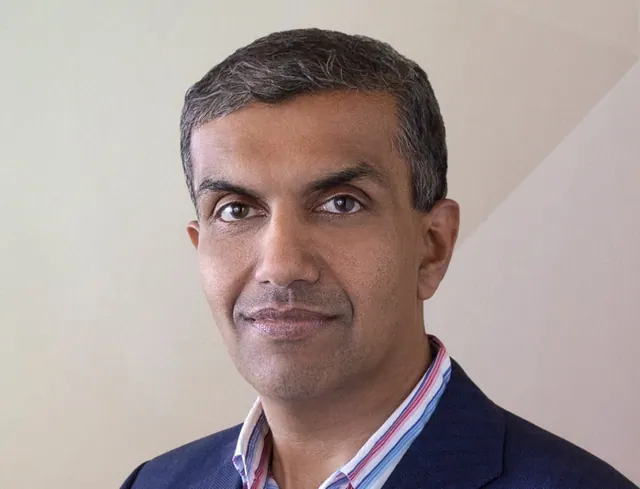
Adobe’s next chief executive does not come from the part of the company most people think of when they hear the name Adobe.
Anil Chakravarthy runs customer-experience orchestration and worldwide field operations. Before Adobe, he led Informatica, the kind of enterprise data company whose products become valuable precisely because they are difficult to remove. On December 1, he will succeed Shantanu Narayen, who moves to executive chair.
The other obvious internal contender was David Wadhwani, the executive associated with Adobe’s creative business. He has since left the company. Adobe has not published the board’s deliberations, and I have no special knowledge of them. But the choice is still readable. Boards reveal priorities by deciding which experience should sit at the top of the company.
Gregg Johnson, writing in CMSWire, offered the sharpest version of that reading: Adobe chose its moat over its market share. The creative franchise is larger and more culturally important, but enterprise orchestration is harder to replace. That argument is persuasive. It is also a little too comforting if taken as the whole story.
Two executives, two kinds of switching cost
Wadhwani represented the Adobe that designers know: Creative Cloud, Firefly and the tools through which individual people make images, layouts, video and interfaces. Those products benefit from decades of learned habits, file compatibility and professional expectations. Photoshop is not easy to dislodge simply because another service can generate an image.
But the point of entry is changing. A new user can now begin with a prompt, a browser canvas or a lightweight collaborative tool before deciding whether to open an Adobe application at all. Generative systems lower the cost of the first draft. Canva and Figma have made parts of the workflow easier to enter and share. AI-native tools are turning tasks that once required a specialized interface into something that starts in a conversation.
That does not mean Creative Cloud is in collapse. It means more creative tasks can be peeled away one by one. A team may keep Photoshop while prototyping elsewhere. An agency may preserve Premiere but generate storyboards in another tool. Substitution happens at the task level before it happens at the suite level.
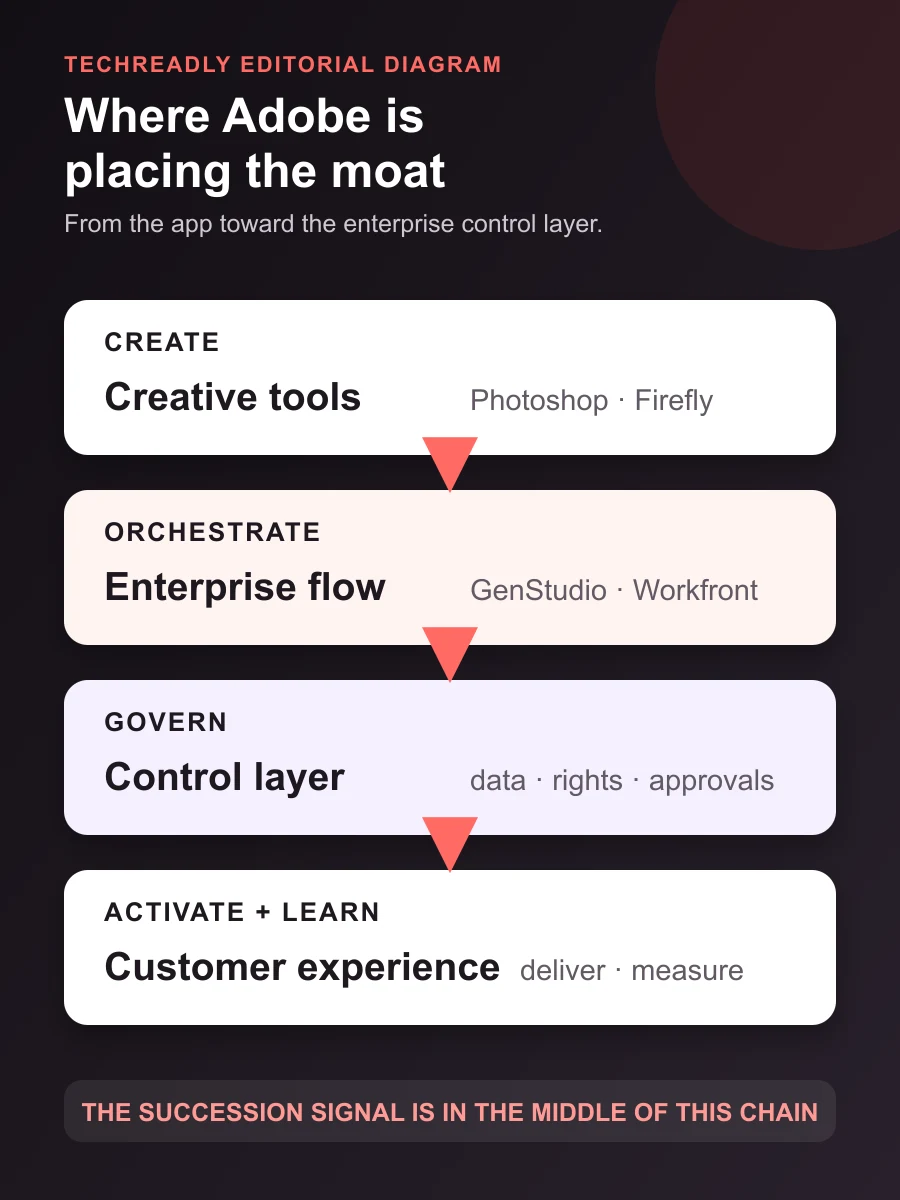
Chakravarthy’s side of Adobe works differently. Customer data, campaign operations, permissions, asset approval and measurement are tied into CRM systems, commerce platforms and internal governance. Replacing that layer is not a matter of opening a rival app. It requires data mapping, security review, procurement, migration and a great many meetings nobody enjoys.
The moat is not that Adobe can generate a better banner. It is that Adobe can know which banner may be used, for which audience, in which market, under which brand rule, and then move it through an approved workflow.
That is the kind of problem an Informatica veteran understands.
The product name gave the strategy away
Earlier this year, Adobe changed the Experience Cloud name to Adobe CX Enterprise. The obvious word is not “CX.” It is “Enterprise.”
Most software companies prefer names broad enough to flatter every possible customer. Adobe put the buyer directly on the label. Johnson noted how unusually explicit that is, and I agree. The rebrand said months before the CEO announcement that Adobe wanted to be judged as an enterprise operating layer, not merely as a collection of marketing tools.
Adobe’s own succession release reinforces the point. It credits Chakravarthy with scaling Adobe Experience Platform and leading products such as GenStudio, Brand Visibility and CX Enterprise. It also highlights his role in the acquisitions and integration of Workfront and Semrush. Those are not isolated creative instruments. They connect planning, production, customer data and performance.
This is Adobe’s answer to generative abundance: when content becomes cheap, coordination becomes valuable. A marketing department does not need only more images. It needs to decide which images are on-brand, licensed, personalized, approved and effective. Adobe wants to own that chain.
There is real logic here. The more models can produce, the more enterprises need a system for controlling production. A company that has spent years connecting creative tools to customer data has an advantage over a start-up arriving with a clever generator and no permissions model.
A moat can become a hiding place
The risk is that Adobe begins to confuse stickiness with affection.
Enterprise software can retain customers long after they stop loving it. Integrations make departure expensive. Procurement cycles delay change. A product may look safe in renewal data while practitioners quietly move their best work somewhere else.
Adobe’s cultural authority came from the creative end of the company. Designers learned its tools, shared techniques and treated its file formats as part of the profession. That bottom-up legitimacy helped Adobe become an enterprise standard. If the company treats creative applications mainly as content feeders for a larger marketing system, it can preserve revenue while weakening the reason people wanted Adobe in the first place.
This is where the succession choice becomes uncomfortable. The part of Adobe facing the most direct AI pressure is also the part that shaped its identity. Promoting the enterprise operator may protect the strongest current switching costs, but it does not answer how Adobe will make its creative products feel essential when the blank canvas is no longer the default starting point.
Nor is enterprise orchestration permanently safe. Agents are moving from generating assets toward coordinating work. Today, replacing a customer-data and campaign stack is an exhausting project. Tomorrow, better agents may make heterogeneous systems easier to connect without a single heavy suite in the middle. The attack arrives later than it does in image generation, but it still arrives.
The market reaction was a question, not a verdict
Adobe shares fell nearly 7% the day after the announcement, according to CMSWire. It is tempting to read that move as a clean rejection of Chakravarthy. Markets are rarely that legible. A one-day price change can contain expectations about guidance, succession risk, product competition and simple positioning.
What it does show is uncertainty. Wadhwani was closely associated with the business producing most of Adobe’s revenue and with the company’s response to generative AI. Choosing someone else asks investors and employees to accept a different story about where the next layer of growth comes from.
Adobe’s board says it ran a rigorous process and chose Chakravarthy unanimously. The more useful question now is not whether it selected the “right” internal candidate. It is whether the company can make its enterprise thesis create better creative products, rather than using enterprise durability to compensate for their loss of relevance.
What I would watch next
The first clue will be capital allocation. Workfront and Semrush fit Chakravarthy’s pattern: acquire something that expands the system around content, then integrate it into a broader operating layer. More deals in data, measurement, rights or workflow would make the enterprise direction unmistakable.
The second clue will be packaging. If Photoshop, Illustrator and Firefly are increasingly presented as upstream modules inside GenStudio and CX Enterprise, creative software will remain important but play a different role. Adobe will be selling the governed supply chain, not just the tools at its beginning.
The third clue is harder to see in a quarterly filing: whether creative professionals still choose Adobe first. Retention driven by file compatibility is useful. Preference is better.
Chakravarthy inherits a company with two excellent reasons to exist. One is that creative people know how to make things with Adobe. The other is that large organizations cannot easily untangle Adobe from the systems through which those things become business.
The appointment suggests the board trusts the second reason more. His job is to keep that trust from diminishing the first.