
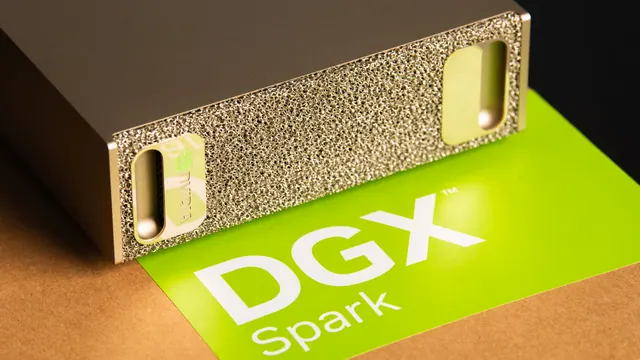
NVIDIA's new 64GB DGX Spark configuration is due on October 23 at a starting price of $4,999. The attraction is easy to understand: buy the memory a project needs, retain NVIDIA's software environment, and connect a second machine if the work grows. I find the first part of that proposition more convincing than the assumption that expansion will be the economical next step.
Two units at that starting price add up to $9,998. That is a substantial second decision, particularly when contemporaneous reports put the existing 128GB reference system around $7,000. The pair also contains two processors rather than one. Comparing only the memory total obscures both the additional resources and the work involved in using them together.
Jeffrey Kampman's October 2 analysis in Tom's Hardware makes a useful case for matching a smaller memory configuration to a workload that no longer needs the larger one. My qualification is about what happens afterward. A smaller first purchase can be sensible without making every future expansion sensible. The proposed workload, the price of the alternative and the software needed to run it must survive a second comparison.
A Smaller Configuration for a Defined Job
The October 2 announcement retains the GB10 Grace Blackwell platform while adding a partner-only 64GB option. Acer, ASUS, Dell, Gigabyte, HP and MSI are the named manufacturers. NVIDIA's current specifications list the same 20-core Arm CPU, 273 GB/s memory bandwidth and ConnectX-7 networking rated at 200 Gbps across the memory configurations. This is a change in capacity and product choice, rather than a new processor generation.
Capacity and speed answer different questions. Having enough memory allows a workload to run in a particular configuration; the amount alone does not establish how quickly it finishes. A smaller memory option can therefore be useful without representing a performance advance. Conversely, retaining the processor and bandwidth does not establish that every workload behaves identically after available memory is halved.
NVIDIA advertises support for models of up to 100 billion parameters on the smaller unit. That is a vendor capacity claim, not a promise that every model of that size fits with every context length and runtime. The useful buying question is whether the intended model, its working memory and the desired number of simultaneous requests fit together. A parameter count on a product page cannot settle that for an unspecified application.
MSI offers a more concrete account of the intended customer. It presents its 128GB EdgeXpert as a development machine for headquarters and the 64GB version as a deployment option for branches, factories and retail sites. That is MSI's proposed rollout pattern, not evidence that a particular fleet has delivered savings. It nevertheless explains why a smaller configuration might have a purpose beyond making the entry price look lower.
A repeatable task at several locations is a different purchase from an open-ended research machine. In the first case, excess capacity may have little immediate value if the application has already been validated. In the second, the ability to try larger models may be the reason for buying the computer. The same memory reduction can serve one buyer and frustrate another.
The Second Box Changes the Bill
At the announced entry price, two 64GB units cost $9,998 before any separately charged cable, tax or shipping. This is simple arithmetic, not a quote for a complete partner configuration. It also assumes that the same starting price remains available when both purchases take place. Buying one now creates no entitlement to the price of the next one.
October 2 reporting by The Register and HotHardware places the 128GB reference machine around $7,000. Their exact figures differ, and partner configurations and stock can vary. Those reports provide a useful contemporary comparison rather than a guaranteed checkout price. A buyer needs actual quotes for the machines and support being considered before turning this comparison into an order.
Even with those qualifications, the difference is large enough to challenge the casual idea of adding another box just to get more memory. If a team already knows that its application needs 128GB, the two-unit route deserves its own justification. Deferring part of the payment changes when money is spent; it does not by itself reduce the total purchase price.
There are valid reasons to accept a higher total. A smaller initial commitment may allow useful work to begin while future demand remains uncertain. The team might never need the second unit. It might later want two separate machines for different projects or locations. In those cases, preserving the choice has value even if eventual expansion costs more than buying a larger machine at the outset.
The opposite case is less persuasive: a team knows from the start that one 64GB unit cannot do the required job, yet treats the second purchase as an incidental upgrade. The first machine's lower price then describes only part of the necessary system. Evaluating the complete purchase before approving either unit is the more useful discipline.
I would not call the pair an overpriced copy of a single 128GB Spark. It contains two GB10 processors and two computers' worth of other resources. Those may be useful together or separately. But the additional hardware has to serve the work being proposed. A second processor is not automatically worth its price merely because it arrives alongside the extra memory a buyer needs.
Connecting Machines Does Not Deploy the Model
NVIDIA's product page lists a single 128GB Spark and a pair of 64GB Sparks with the same aggregate memory capacity. That makes the comparison easy to see. It does not make the systems interchangeable: in the pair, the memory resides in two devices, and a workload spanning both needs software that can use a distributed system.
The company has reduced part of the setup burden through NVIDIA Sync. Its Cluster Assistant checks devices, configures their ConnectX-7 links and sets up communication between them. The official documentation also states a clear limit: the assistant configures the network, while inference and fine-tuning workloads still need to be set up separately. That distinction is more consequential to a small team than an attractive picture of two connected boxes.
The assistant supports two to four devices within specified layouts. Two machines can connect directly with a cable; a four-device configuration requires a switch. Users still need suitable system software, access to the machines and the physical connections. A successful setup check establishes that the cluster can communicate. It does not establish that the chosen model, runtime and application are configured correctly.
This is where I would separate the hardware expansion decision from the operating plan. The organization needs someone responsible for deploying and maintaining the workload across the machines. That does not make clustering prohibitively difficult. It means the purchase includes a software responsibility that is easy to miss when the proposal is described only as doubling memory.
Cluster Assistant is already documented in earlier Sync releases. The further simplification described in the October announcement is Model Launcher, planned for the end of October. NVIDIA says it will download and launch Qwen3.8 27B on one system or a cluster and configure OpenCode to use it. That could make a supported workflow easier to start. It should be evaluated as the announced workflow when available, rather than assumed to automate every model or deployment.
What Existing Tests Can Establish
Independent experience shows that GB10 clustering can be useful, while also illustrating why configuration matters. In July, Kampman tested two Dell Pro Max GB10 systems, each with 128GB of memory. Dell supplied the machines and connecting cables. His account describes an initial firmware mismatch that limited interconnect performance and an update that resolved it, followed by model-specific tests on the working cluster.
That is evidence from a particular 256GB setup. It is not a test of the new 64GB machines or the forthcoming Model Launcher. The lesson I take from it is limited but practical: a connected cluster can become a useful local development environment, and its configuration needs validation. It would be unfair to turn an earlier setup problem into proof that today's assistant fails, just as it would be premature to assume that new automation removes every operating issue.
NVIDIA offers a narrower performance result for the new configuration. It reports up to 1.7 times the performance for Qwen3.8 27B on two 64GB systems compared with one. The comparison is a company test of two smaller machines against one smaller machine. It does not establish which is faster between that pair and a single 128GB system on a buyer's task.
Nor does a faster model run automatically establish a better purchase. A team might value shorter response times, more simultaneous work or the ability to run a larger model at all. These benefits require different comparisons. The relevant test is the one that addresses the reason for spending the money, rather than whichever headline number happens to be available.
Buy the First Machine on Its Own Merits
The strongest case for the 64GB configuration begins with work it can perform independently. A team that has validated such a workload can compare the announced entry price with its other options and decide whether the NVIDIA environment is worth the cost. Future clustering then remains an option, rather than a condition that must be fulfilled before the first purchase becomes useful.
For a team that already requires more memory, the comparison should begin with complete alternatives: a single larger-memory machine, a distributed pair and whatever other system can actually support the application. Include the intended runtime and support arrangement in that decision. There is no need to declare one design universally superior to recognize that two machines and one machine impose different responsibilities.
Actual availability and quotes on October 23 may alter the arithmetic. Model Launcher, if delivered as described, may also reduce the work needed for its supported setup. Neither development would eliminate the need to identify what the second computer is for. My judgment is that the 64GB Spark is most credible as a properly sized first machine. Expansion earns its place when the extra resources solve a demonstrated problem, not merely when two memory figures add up to a reassuring total.