API Availability and Promotional Pricing
Mistral opened the public preview on October 6 through its Studio API, using the model identifier mistral-large-4. Developers can try the hosted model now; the weights needed for self-hosting are planned for the end of October.
Mistral has posted temporary promotional rates for API access on its pricing page as of October 7:
- Input tokens: $0.68 per million tokens (discounted from a standard rate of $1.36)
- Cached input tokens: $0.07 per million tokens (discounted from $0.14)
- Output tokens: $2.09 per million tokens (discounted from $4.18)
Mistral has not announced an expiration date for these sale prices.
Multimodal Architecture and Infrastructure
The model functions as a natively multimodal mixture-of-experts architecture with an approximate footprint of 1 trillion total parameters. It supports a context window of up to 1 million tokens, structured JSON outputs, function calling, and agentic workflows.
According to company technical disclosures, the model was trained from scratch on 3,800 NVIDIA Grace Blackwell GPUs operating in European data centers. Mistral serves the current preview through this same European infrastructure, though it states that multi-region deployments are planned for future updates. The training dataset reportedly includes more than 160 languages, covering all official European Union languages, according to the company.
Coding Evaluation and Security Oversight
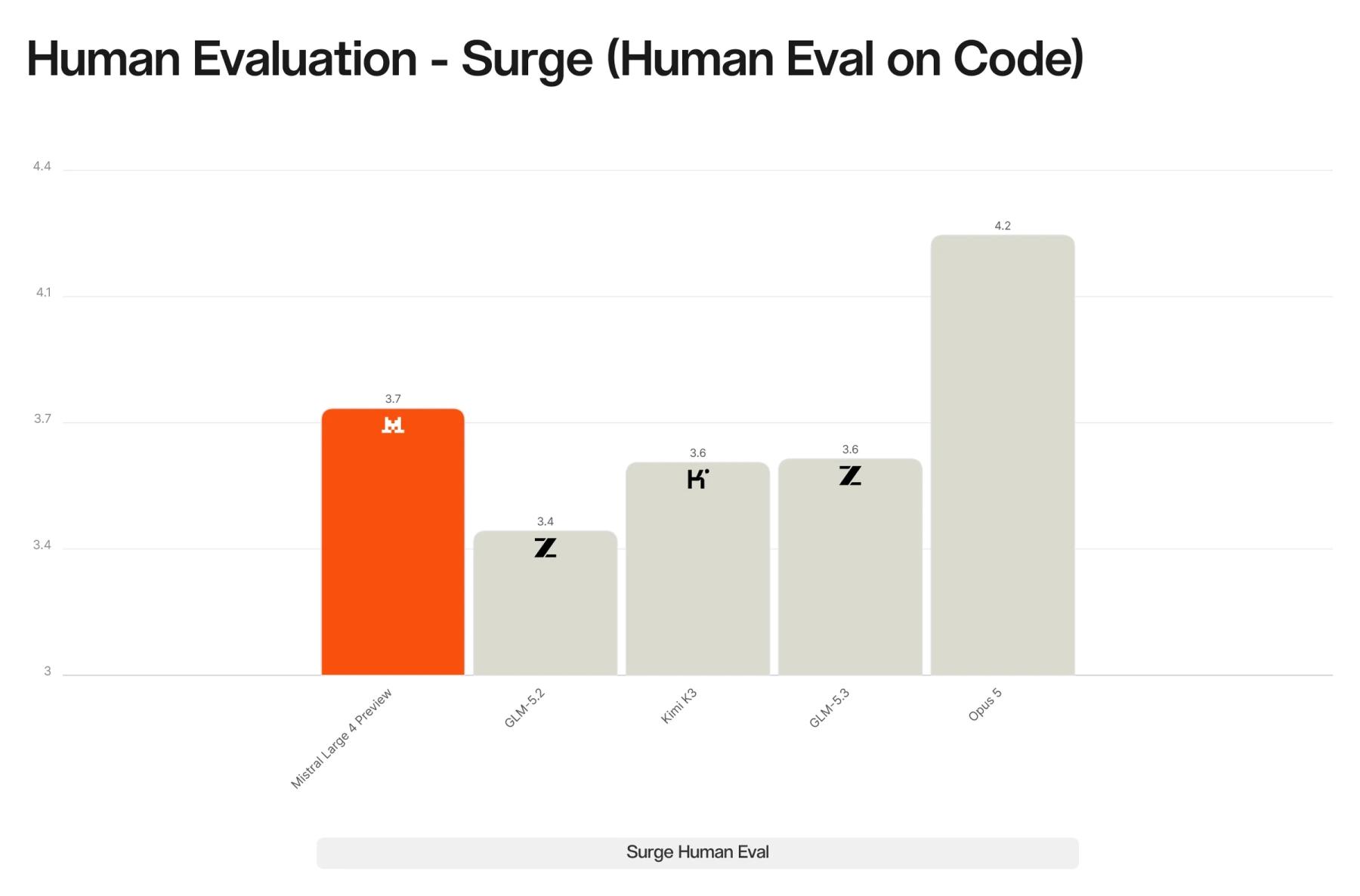
Mistral reported a blind coding evaluation conducted with Surge AI. Professional annotators rated outputs on a 1-to-5 scale with model identities hidden:
- Claude Opus 5: 4.22
- Mistral Large 4: 3.74
- GLM 5.3: 3.60
- Kimi K3: 3.59
- GLM 5.2: 3.40
Mistral placed second among the five evaluated models in that study. Mistral is targeting coding, visual understanding and enterprise tasks such as financial analysis and cybersecurity. The five-model coding study describes one evaluation, rather than a general ranking across those workloads.
Mistral says it is still red-teaming the model with cybersecurity leaders, vetted partners and state authorities before the planned weights release. It also plans specialized models based on Large 4 and says reinforcement learning on the preview is continuing.