
“Financial AI” is a phrase that makes me more skeptical, not less.
In most office work, a polished mistake is embarrassing. In a valuation model, credit memo or earnings report, it can travel through a decision before anyone notices. The danger is rarely a wild answer that announces itself as fiction. It is the figure that looks right, appears in the right row and comes wrapped in plausible commentary.
That is why I find Ling-3.0-flash-Fin interesting for reasons that are almost the opposite of a normal model launch. InclusionAI, Ant Group’s AI organization, describes a system that can search sources, review evidence, calculate, build valuations, work in spreadsheets and prepare reports. The model is open-weight, MIT-licensed and small in active computation relative to its total size. Yet the independent results also contain the warning label: better business-knowledge accuracy can coexist with more hallucination, and competent-looking work can still fail difficult automation tasks.
The useful question is not whether Ling knows finance. It is whether the product around it can make a financial professional comfortable enough to inspect—and reject—what it does.
The job is a chain, not a prompt
Brooker Belcourt’s feature about building an AI financial analyst begins from the drudgery of earnings season: collect the filings, update the model, write the preview, repeat. His point is not that a sufficiently clever chatbot makes the process disappear. The workflow gets more useful as instructions, source material, tools and review become more structured.
That is the right frame for Ling. A real financial research task might require the system to find an audited figure, reconcile a different reporting period, update a formula, check that a balance still balances and explain the change. Each step has a different standard of proof. Retrieval needs provenance. Arithmetic needs deterministic execution. Spreadsheet editing needs formulas and cell-level history. Commentary needs a clear division between fact, assumption and judgment.
A single fluent answer hides those boundaries. It can cite the right filing and still use the wrong period. It can calculate the right multiple from a copied number that should have been adjusted. It can create a beautiful workbook by pasting static values where formulas ought to be.
This is where I depart from the usual “AI analyst” fantasy. I do not want the model to hand me a finished report that feels as if it appeared by magic. I want it to leave working papers.
What InclusionAI actually released
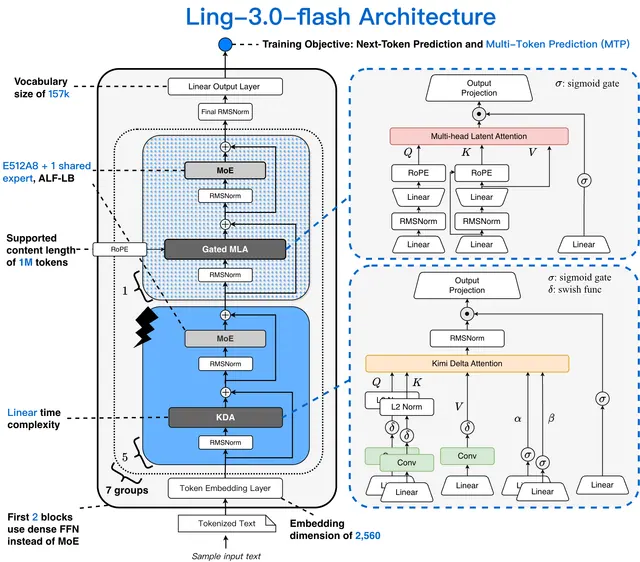
Ling-3.0-flash-Fin extends the general Ling-3.0-flash model with further training on financial data, developed with financial institutions and domain specialists. The model card lists 124 billion total parameters, with 5.1 billion activated for each token, and a 256,000-token context window. It accepts and produces text. Thinking mode is enabled by default.
The weights are published under the MIT license, and the BF16 checkpoint can be served through SGLang or vLLM using the same architecture as the base model. That gives teams more control over where the system runs and how it is integrated than a closed API would. It does not make deployment trivial: 124 billion total parameters remain a substantial object to store and serve, even when only a fraction are active for any token.
InclusionAI also released FinFIRST, a benchmark for source-grounded financial search, and reports results across other tests for financial reasoning, spreadsheets and agents. More important than the score list is the model card’s own limitation. It says complex, long-horizon workflows still need validation and that valuation assumptions, results and investment conclusions require professional review.
That is not boilerplate to skip. It is the beginning of the product specification.
More knowledge did not mean fewer inventions
Artificial Analysis’s first independent test gave Ling-3.0-flash-Fin a score of 23 on its Intelligence Index and 24 on its Finance & Accounting Index. Those numbers only make sense inside that version of the evaluator’s methodology, so I would not use them as permanent labels.
The comparison underneath them is more revealing. Against the multimodal Ling-3.0-flash-VL, the finance model posted higher business-knowledge accuracy: 17 percent versus 11 percent. It also had a higher business-knowledge hallucination rate: 33 percent versus 19 percent.
That pairing is the heart of the article. Specialization did not simply move a “finance ability” slider upward. In this test, the model attempted more of the domain and got more right, while also producing more unsupported answers. A system can become more useful and more dangerous at the same time.
The workflow results add another boundary. Flash-Fin scored 7 percent on AutomationBench-AA, which tests multi-step work across business applications under rules and constraints. It scored zero on the version of Terminal-Bench used in the comparison, as did the VL model. On two professional-work evaluations cited by Artificial Analysis, the finance model trailed its multimodal sibling.
None of this proves that Ling will fail a specific internal finance process. It does puncture the idea that domain training turns a language model into an autonomous analyst. Knowing the vocabulary of a job is not the same as reliably executing the job.
Sparse computation does not guarantee a small bill
The architecture sounds efficient: 124 billion parameters in total, 5.1 billion active for a token. That is one reason mixture-of-experts models are attractive. They can store broad capacity while using only selected parts of the network for each step.
But an agent’s cost also depends on how many steps it takes. Artificial Analysis reported that Flash-Fin produced about 67,000 output tokens per Intelligence Index task in its harness. That was roughly 34 percent more than Ling-3.0-flash-VL and more than three times the output of MiniMax-M2.7 in the same comparison.
The result does not tell us the cost of a company’s own workload; there was no universal deployment price attached to it. It tells us not to infer cheap serving from active-parameter count alone. A model that activates fewer parameters per token can still occupy hardware for a long time if it generates many reasoning and answer tokens.
For finance teams, excessive generation has a second cost: review. Every additional page of reasoning, caveat and commentary must either be checked or ignored. Verbosity can look like diligence while quietly moving the verification burden back onto the human.
Open weights help only if the trail stays open
Ling’s MIT license matters because financial data is often sensitive and because firms may want to run the model inside infrastructure they control. Local or private-cloud deployment can keep filings, transaction materials and internal assumptions away from a third-party model API—provided the surrounding application does not send them elsewhere.
Open weights also let engineering teams pin a revision, inspect the runtime and tune the system around a narrow job. They do not make the output auditable by themselves. A number can be invented just as confidently on a private GPU.
The harness therefore has to preserve a trail the model cannot smooth over. A retrieved figure should carry the document, page and table location from which it came. A derived number should be calculated by a deterministic tool. A spreadsheet change should retain the previous cell, the new formula and the assumption that caused the edit. A final paragraph should link back to those objects rather than merely cite a source list at the end.
I would also separate proposal from execution. Let the model prepare a set of changes; let a rule-based layer reject broken formulas and unbalanced statements; then let a person approve the surviving diff. The goal is not to put a human rubber stamp at the end. It is to make review easy enough that a human can still find the consequential mistake.
My rule for the live workbook
I would let Ling-3.0-flash-Fin near a live financial workbook only when two conditions are enforced by the software, not requested in the prompt.
First, every derived cell must contain an inspectable formula or an explicit, sourced assumption. No unexplained hardcoded forecast number should survive validation. Second, every historical input must link to the exact source passage or table from which it was extracted. If either link breaks, the edit fails.
That standard does not sound futuristic. It sounds like basic accounting discipline applied to a new kind of junior collaborator. That is precisely why it is useful.
Ling shows real progress: an open model aimed at the messy chain between research, calculation and presentation rather than another finance-themed chat demo. Its independent results also show why the last mile cannot be delegated to confidence. In this domain, the best model is not the one that delivers the most convincing answer. It is the one whose work is easiest to check.