
The model is called MiniCPM5-2B. The main BF16 weight file is about five gigabytes.
That is not a scandal or a naming trick. “2B” describes a parameter class, not the number of bytes that lands on a device. Independent analysis puts the actual count at roughly 2.6 billion parameters, and each parameter in BF16 needs two bytes before runtime memory enters the picture. The arithmetic is ordinary. The reminder is valuable.
On-device AI is physical in a way cloud AI tries hard to hide. A local model occupies storage, competes for memory, warms a processor and drains a battery. A 131,072-token context window on a model card is not the same thing as a pleasant 131,072-token experience on a phone. The runtime, numerical format and device matter as much as the model name.
OpenBMB’s September release is impressive precisely because it makes those trade-offs worth considering. MiniCPM5-2B is an Apache 2.0-licensed text model intended for local and resource-constrained use. In Artificial Analysis’s release-time comparison, it led the measured open-weight models under four billion parameters and showed unusual strength on some agentic work. It also failed plenty of hard tasks and declined many questions.
I do not see the refusals as an embarrassment to explain away. For a small local model, knowing when to hand a job elsewhere may be the feature that makes the whole system safe to use.
The model is only the first memory bill
OpenBMB distributes MiniCPM5-2B in formats for several parts of the local ecosystem: BF16, GGUF, MLX, GPTQ and LiteRT among them. It can run through familiar frameworks including Transformers, vLLM, SGLang and llama.cpp. There is also a DSpark draft model intended to accelerate generation through speculative decoding.
Those choices are not packaging trivia. BF16 preserves more numerical precision but carries the roughly five-gigabyte weight file. Quantized variants can reduce the footprint, often enough to make a model practical on hardware that could not hold the original. MLX targets Apple silicon; LiteRT opens a path toward mobile integration; GGUF makes the model accessible to popular local runtimes.
None of those labels tells you final memory use or speed on a particular machine. The active prompt and generated sequence require additional runtime memory. Frameworks schedule work differently. A four-bit quantization may fit easily while behaving differently from the reference checkpoint on the tasks a product cares about.
OpenBMB’s own documentation supplies a wonderfully specific example. It warns that llama.cpp’s default min_p setting can lead to repetitive output and recommends setting it to zero. The weights did not change. The serving configuration did, and so did the usefulness of the result.
This is why I resist sentences such as “the model runs on your phone” unless the phone, format, context length and measured speed appear in the same paragraph. “Can load” and “works well” are different claims.
Small does not mean simple
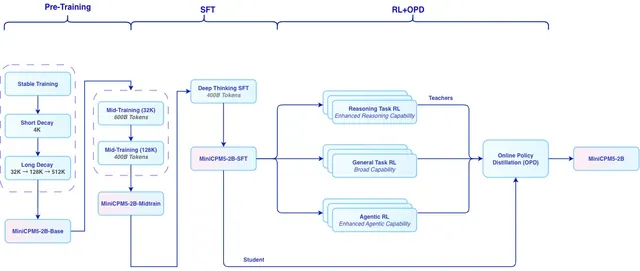
MiniCPM5-2B is a dense model rather than a sparse mixture of experts. OpenBMB released more than the final chat checkpoint: its model family includes earlier training stages and several UltraData datasets for web pre-training, code, supervised agent examples and reinforcement learning.
That wider release makes the project interesting beyond a leaderboard position. Developers can inspect more of the path that produced the model, compare checkpoints and adapt the artifact without asking an API vendor for permission. The Apache license gives broad room for commercial work.
But the small-model pitch often slides from “available” to “private” too quickly. An application is private only if inference and data processing stay on the device or within the controlled environment. A local model wrapped in remote telemetry, cloud retrieval or fallback calls may still send sensitive material away. The weights make private design possible; the product architecture decides whether it is real.
The same caution applies to the 131K context limit. It is an architectural ceiling, not a promise that every detail in a book-length prompt will be remembered correctly. Artificial Analysis found weaknesses in its long-context evaluation compared with larger peers. Teams should test the length and document shape they actually plan to use rather than fill the advertised window because it exists.
The benchmark result I keep returning to
Artificial Analysis reported strong results for the model’s size on professional agentic evaluations. In its release article, MiniCPM5-2B reached an Elo of 831 on GDPval-AA v2, ahead of the other small models in the cited comparison, and it was competitive on the evaluator’s banking and briefcase tasks. It used about 19,000 output tokens per Intelligence Index task, relatively restrained for the reasoning models in that set.
The weaknesses were equally clear. It scored 9 percent on the terminal benchmark used at the time, 9 percent on Humanity’s Last Exam and zero on CritPt. These are not product verdicts, but they are useful boundaries. The model can be surprisingly capable inside a constrained workflow without becoming a general substitute for a much larger service.
The most revealing result came from the knowledge evaluation. MiniCPM5-2B attempted only 29 percent of the questions. Its accuracy was 8 percent, yet its non-hallucination rate was 78 percent because it often abstained instead of guessing.
A press release would probably hide the 8 percent. I would put it in the product meeting.
If a local assistant is asked for a fact it does not contain, the correct behavior is not to improvise convincingly. It should say it cannot answer from local knowledge, ask permission to search, or route the request to a stronger service. The low attempt rate becomes useful only when the application recognizes abstention and has a good next step. Without that routing, the user simply experiences a model that says no.
The case for a local first pass
The strongest use for MiniCPM5-2B is not “everything the cloud model does, but free.” Local inference still consumes hardware, electricity and engineering time. The better case is that some jobs do not need to cross a network at all.
A small model can classify a local note, extract fields from a short document, rewrite text under explicit rules, choose among a limited set of tools or prepare a request for a stronger model. These tasks are bounded, their relevant information can fit in the prompt, and failure can be detected by surrounding software.
Keeping them local can reduce latency, avoid per-call API charges and preserve a tighter data boundary. It can also make a product usable when the network is poor or unavailable. Those benefits survive even if the local model is far less knowledgeable than a frontier service.
The routing problem is harder than the demo. A product needs to distinguish a request for formatting from a request for legal interpretation; a file operation from an open-ended shell task; a question answered by supplied text from one that requires current facts. The model can participate in that decision, but it should not be the only judge of its own competence.
I would combine explicit task classes, confidence signals, validation rules and user choice. Sensitive data should not be sent to a cloud fallback silently. A refusal should say what is missing and what an escalation would share. “Local first” is meaningful only when the user can see when local ends.
My local-versus-cloud rule
I would keep a task on MiniCPM5-2B when the instructions and evidence are present, the output can be checked, the privacy benefit is real, and the device meets a measured latency and memory budget. I would escalate when the job depends on broad factual knowledge, long and messy document sets, difficult terminal work or consequences that exceed the strength of the validation layer.
That rule is less glamorous than carrying a universal assistant in your pocket. It is also closer to a product that can ship.
MiniCPM5-2B matters because it expands the set of chores a device can plausibly handle on its own. Its limitations tell us where to draw the line. The best version of pocket intelligence is not a tiny model pretending to know everything. It is a system confident enough to stay local when it can help—and honest enough to ask for a hand when it cannot.