
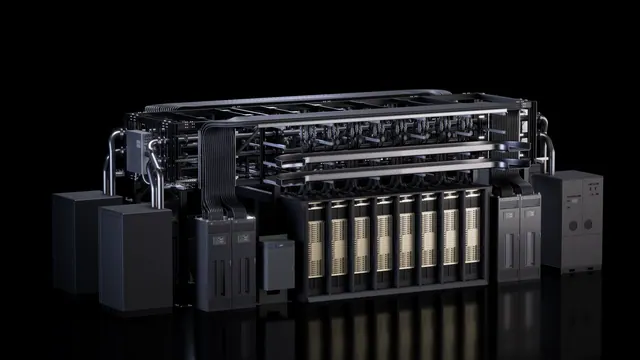
NVIDIA's October 12 announcement that it has contributed key Vera Rubin rack and compute-tray designs to the Open Compute Project deserves more than a verdict on whether the company is “open.” My judgment is that the contribution can widen supplier choice without making the whole compute platform interchangeable. Those outcomes can coexist, and an infrastructure buyer needs to know which one a particular specification delivers.
Ben Wodecki's reporting for SDxCentral captures the commercial logic. At a press briefing, NVIDIA described common specifications as a way for equipment makers to start building without waiting for one customer's proprietary requirements. Wodecki also observed that manufacturers can build around the platform while NVIDIA's compute hardware remains central. That gives us a better question than whether openness weakens NVIDIA: what can a buyer change while retaining a working, supported configuration?
The answer varies across the rack, network, management software and building. The week's OCP disclosures offer concrete examples of choice, alongside explicit limits. Treating every shared design as an interchangeable product would overstate the contribution. Treating every NVIDIA-centered design as meaningless openness would miss useful engineering work.
Mechanical Interfaces Give Suppliers a Common Target
NVIDIA says MGX 1.2 adds rack-scale blind-mate liquid cooling, a liquid-cooled 5,000-amp busbar, native 19-inch equipment support and configurable input-output bays. It includes fanless liquid-cooled compute trays and standardized power and cooling interfaces, supporting rack deployments up to 250 kilowatts. That last number is a design capability, rather than measured electricity consumption in a customer's facility.
A blind-mate connection joins as equipment slides into position. For suppliers, a shared interface offers a target against which to design and manufacture. For buyers, the opportunity is to compare compatible implementations rather than commission a different physical design for every purchase. Whether that produces a lower price or faster installation depends on the suppliers, qualification work and contracts. The announcement does not establish those savings.
The broader MGX product catalog also matters. NVIDIA explicitly lists configurations using Grace, Vera, x86 and other Arm processors, spanning individual servers and racks. It would therefore be wrong to describe MGX as requiring one CPU configuration everywhere. Equally, catalog flexibility does not establish that an operator can replace a processor inside a particular Vera Rubin NVL72 with any alternative.
This distinction changes a procurement conversation. “Built to MGX” identifies an architecture; it does not answer every question about the delivered assembly. A tender still needs to identify the components supplied, their interface versions and the party responsible for validating the combination. Otherwise, two offers carrying the same broad architecture label may leave the buyer comparing different obligations.
There is a practical benefit even if the accelerator remains the same. A buyer may value another equipment manufacturer, a different service arrangement or an integration that fits its existing operations. Those are meaningful choices in their own right. They should be specified as such, rather than inflated into a promise that every component can be exchanged without further work.
Meta Shows What a Shared Software Boundary Can Do
Meta's October 12 engineering account supplies a more specific example of choice. Its IcePack liquid-cooled network rack houses IceCube switch blades in two variants: one based on Broadcom's Tomahawk6C chip, the other on NVIDIA's Spectrum-6. Both run Meta's FBOSS network operating system using OCP's Switch Abstraction Interface, which provides a common way for software to control switch hardware.
Here, the shared boundary is visible: different switch-silicon implementations sit beneath a common operating software layer. That does not mean the chips can be swapped on one circuit board, or that every configuration performs identically. It does show why dismissing all standards work around NVIDIA as empty branding would be too broad.
For a buyer, this is a more useful description than a general declaration of vendor independence. It identifies what stays common and where implementations differ. Reproducing the arrangement elsewhere would still require the appropriate engineering and validation; Meta's account is an example, rather than a universal compatibility certificate.
Other network announcements describe a future boundary. NVIDIA says Google's Falcon transport will be supported on future ConnectX-10 network adapters and BlueField data processing units, with applications retaining standard remote direct memory access interfaces. Remote direct memory access lets systems move data between memories without the same CPU involvement as ordinary software copying.
Google's original 2023 Falcon account explains the separate transport problem: reliable, low-latency communication over Ethernet using hardware assistance, traffic shaping, retransmission and multiple paths. A common rack format alone cannot supply those behaviors. They depend on the network implementation, making transport compatibility a separate question from whether equipment fits inside the enclosure.
NVIDIA and Cisco's new USFP optical-module announcement similarly describes plans. The proposed form factor targets 400 gigabits per second per lane, with initial planned modules using 16 full-duplex lanes. The companies are working with Amphenol and TE Connectivity toward a community-led supply ecosystem. Planned participation creates a path toward multiple sources; it does not establish that a buyer can order qualified alternatives today.
I would distinguish a standard that lets suppliers begin development from products that have completed the work needed for a particular deployment. Both stages matter. Confusing them encourages a purchasing decision to depend on a future option that may not yet have a delivery date, validated configuration or support agreement.
Open Management Code Has Its Own Boundaries
NVIDIA's public Config Manager repository provides an unusually clear maturity statement: it is a Developer Preview and is not recommended for production use. The Apache 2.0 project combines network configuration, provisioning and workflows. Nautobot is its bundled reference provider and default deployment, rather than a dependency built into the core services.
That provider boundary may be useful to a team integrating an existing inventory system. The preview status still belongs beside the capability description. An operator evaluating integration possibilities is making a different decision from one choosing software to run a production fleet.
The separate Rack Management Service repository describes rack-level power control, inventory, firmware updates and switch configuration through a common application programming interface. Beneath that interface, it communicates with management controllers and power shelves over Redfish/HTTPS, and with NVIDIA switch trays through other management interfaces. The project is also licensed under Apache 2.0. A common entry point therefore sits above hardware-specific implementation paths.
Its hardware compatibility document makes a further distinction. Listed systems have been tested or exercised internally in limited scenarios; inclusion does not imply qualification, certification, support or a continuing compatibility commitment. The document carries an August 5 update date. Its tables and Rubin-related descriptor entries should not be read as a new October certification announcement.
That is a support boundary, not a reason to ignore the code. An engineering team can inspect the implementation and evaluate how it would connect to its tools. A purchase agreement must separately establish who owns failures, firmware changes and support for the selected hardware. The license and the hardware list do not answer that commercial question by themselves.
The initial choice of management software can also affect later replacement decisions. If changing a power shelf requires changes to a hardware-specific management path, a buyer needs to account for that work even when the physical connector is compatible. Openness can make such work possible to inspect and modify. It does not make the work disappear.
A Shared Rack Design Still Meets a Particular Building
The facility documents highlighted at OCP extend the question beyond equipment sourcing. The Open Data Center Specification revision 0.7.0 is dated August 27 and targets 2027–2028 infrastructure. It sets guidelines for structural, power and cooling design, with contributions from AMD, Google, Meta and NVIDIA.
One example is an 8,000-pound rack-weight design target over a stated 28-by-48-inch footprint, with handling equipment also accounted for in moving loads. Another is a recommended 12-foot transport aisle. These are future facility-design parameters, not evidence that every current Vera Rubin installation has those dimensions or that any existing building can accept the rack.
For a colocation provider, shared requirements can make a customer's needs more legible before construction. They cannot supply the building or remove its physical constraints. The document's future planning horizon is part of its usefulness: it gives designers common assumptions to consider before the equipment arrives.
The utility-interface specification is narrower than a generic promise of “two-second recovery.” Version 1.0.0, effective September 17, addresses the computational load component of a facility. Within defined disturbance conditions, it calls for recovery to 90% of pre-fault load within two seconds after voltage at the point of interconnection returns to 0.90–1.10 times nominal voltage. It permits backup transfer without those return expectations when disturbances exceed the defined magnitude or duration envelope.
The table also allows reduced consumption during specified voltage sags. It therefore cannot be read as a guarantee of unchanged load through every fault, or full-facility recovery from any outage. These are interface-performance requirements, rather than a demonstrated service-availability result. Shared expectations help equipment designers and operators coordinate; a specification does not itself secure electricity supply or prove a particular site's behavior.
The dates matter here. The October event brought attention to a package containing documents with earlier dates and different scopes. Reading them as one newly delivered, fully validated system would erase the distinction between designing an interface, implementing it and demonstrating that it works at a site.
Ask What Survives a Replacement
My test for openness is concrete: which supplier or component can change, and what can the buyer retain afterward? The OCP material supports different answers at different boundaries.
| Boundary | Choice the evidence describes | What still needs to be established |
|---|---|---|
| Rack equipment | Shared physical interfaces give manufacturers a common design target. | Compatibility and responsibility for the delivered assembly. |
| Switch software | Meta describes two chip variants running FBOSS through OCP SAI. | Validation of the chosen implementation and operating configuration. |
| Management tools | Public code exposes integration paths and hardware-specific operations. | Production suitability and a support commitment for the selected system. |
| Future optics and transport | Announcements outline additional implementation and supply options. | Available products and qualification for the intended deployment. |
This is why the contribution can serve NVIDIA and still be useful to buyers. A wider manufacturing ecosystem can make its platform easier to build, while giving customers more choice among the companies implementing parts of it. Those interests need not be opposed. The benefit becomes clearer when a buyer can name an alternative and compare its actual obligations with those of the incumbent supplier.
The next persuasive evidence would be specific: an alternative implementation qualified for a defined system, with documented interfaces and an identified support provider. That would turn an architectural possibility into a purchasable option. Independent reports of faster assembly or lower costs would add a different kind of evidence, measuring the benefit rather than assuming it from publication of a design.
I would welcome the shared specifications and keep the replacement question attached to the purchase order. A buyer gains useful freedom when a change preserves the functions and support it needs. Counting that freedom interface by interface gives NVIDIA's contribution credit where it is earned, without asking the word “open” to settle the whole decision.